
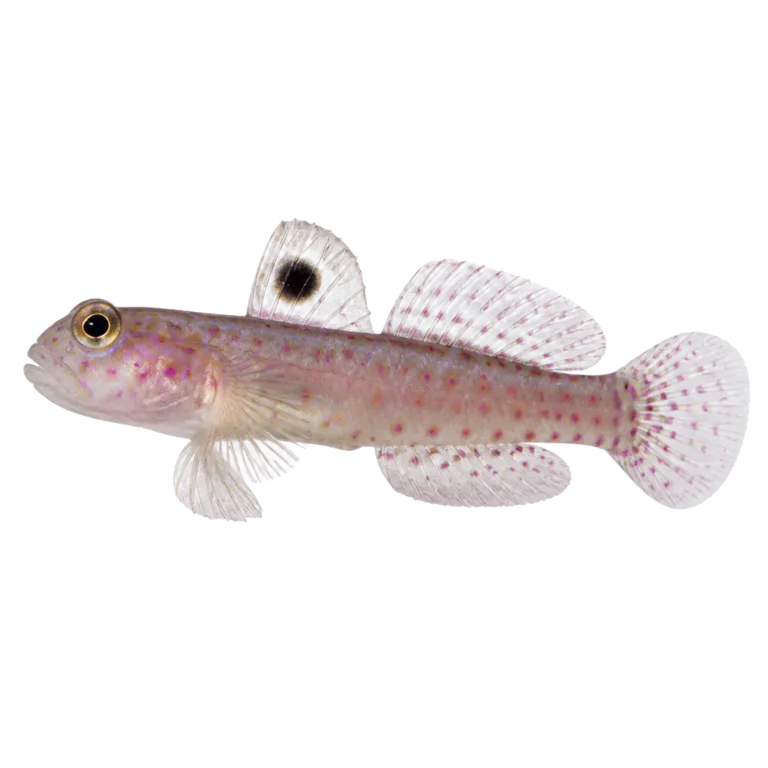
Pink Spotted Watchman Goby
Summary
Cryptocentrus leptocephalus is a bottom-perching shrimp goby rather than an open-water swimmer. Expect it to spend long periods watching from a burrow entrance, making short hops across nearby sand, and retreating abruptly when startled. This is normal behaviour, not necessarily a sign that it is unwell.
Its preference for sheltered sand and rubble explains its digging behaviour in an aquarium. It may form a partnership with an Alpheus pistol shrimp, sharing and guarding a burrow; the goby can also settle without a shrimp if it has a secure retreat.
Care
Build the rockwork securely on the tank base before adding sand, then leave a sheltered area of sand and small rubble at the front or side for a burrow. Cryptocentrus leptocephalus can excavate beneath rocks, so a rock balanced on sand can shift as the fish remodels its home.
Give it an open patch near cover rather than filling the bottom with tightly packed coral colonies. It usually remains close to its chosen entrance and needs a clear route to dart back inside; a fish forced to cross exposed, high-flow areas may remain hidden and miss food.
Choose a calmer substrate zone away from a direct, forceful pump outlet. Persistent sand movement can collapse the burrow or leave the fish repeatedly searching for a new shelter.
Feeding
Feed small meaty foods daily, using mysis, enriched brine shrimp, finely chopped marine seafood, and quality frozen carnivore preparations. Deliver at least part of the food to the sand immediately beside its burrow, since this goby often waits there rather than competing in the water column.
Split the ration into smaller offerings when active fish take food quickly. A goby that appears healthy but stays at its entrance while tankmates intercept every morsel can slowly lose condition; target feeding near the burrow is more reliable than expecting it to chase food in open water.
Do not treat sand stirring as feeding. It may pick at material around the burrow, but it still needs regular protein-rich meals and may prey on very small mobile invertebrates.
Compatibility
Keep one individual unless you obtain a known compatible pair. A resident Cryptocentrus leptocephalus may defend its burrow fiercely from another of its species or from similarly shaped shrimp gobies, and adding a second goby later is more likely to produce persistent chasing than a pair.
Favour peaceful fish that use the middle and upper water levels. Avoid combining it with territorial bottom dwellers that claim caves or sand patches, and avoid fish large enough to treat a small bottom goby as prey; either situation can keep it confined to its burrow.
Add this goby before territorial sand- or cave-dwelling fish when possible, or provide clearly separated bottom territories. It is reef compatible with sessile invertebrates, but its excavation can bury low-mounted frags, displace loose coral pieces, and undermine unsecured rockwork.
Good to know
A newly introduced fish may disappear into the sandwork for a while, especially after lights-on activity or a disturbance. Watch for brief appearances at the burrow entrance and place food there; continued refusal to emerge for feeding is a reason to check for harassment or a collapsed shelter.
Once settled, it may repeatedly move sand and rubble as it alters its burrow. Treat fresh piles of substrate or a newly opened tunnel as normal maintenance behaviour, but correct any rock or coral that has become unstable before the excavation enlarges.
If kept with a pistol shrimp, expect the pair to reorganize the substrate together and occasionally relocate the entrance. Secure aquascaping matters even more in this arrangement, because the shrimp usually performs much of the digging.