
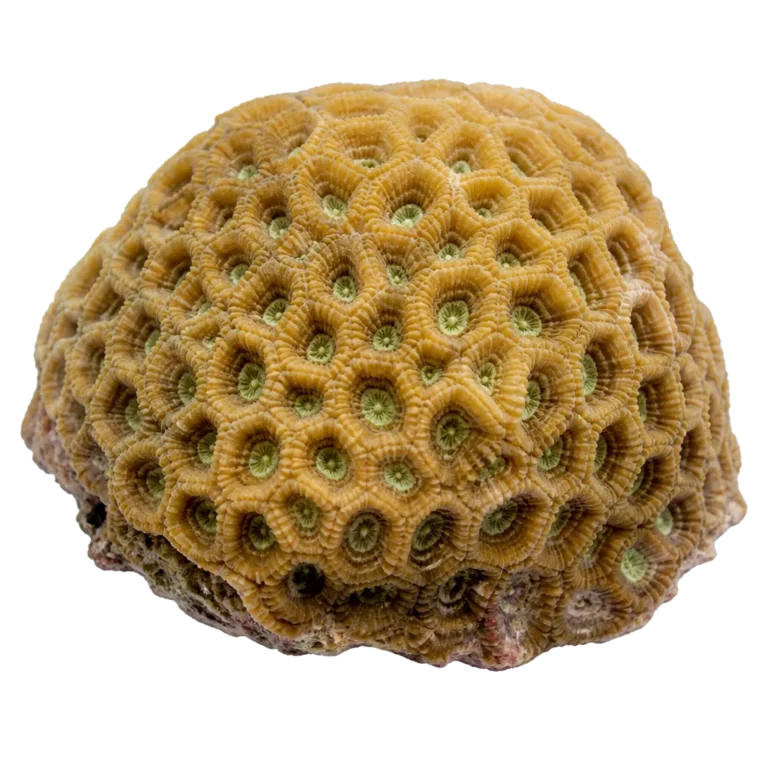
Pineapple Coral
Summary
Pineapple Coral is best treated as Dipsastraea favus, a colonial LPS coral sometimes still sold under older hobby use of “Favia.” Its separate, round corallites share a hard, usually encrusting-to-mounding skeleton, so a small frag gradually claims space beyond its original plug rather than remaining a compact, isolated polyp.
This species occurs on Indo-Pacific reef habitats, including reef margins, where changing water movement helps keep sediment off the colony. In an aquarium, that translates to a lower-to-middle placement with indirect, moving water rather than a sheltered dead spot or a powerhead blast.
General care
Mount Dipsastraea favus securely on rockwork or a stable substrate in the lower-to-middle tank, with open space around every side. Do not wedge living tissue against sharp rock or bury the colony where sand can repeatedly scour the corallites; irritation often begins as persistently retracted tissue or bare skeletal spots along the contact area.
Handle it only by the plug or exposed skeleton, keeping fingers and tools off the fleshy corallite rims. Before purchase, pass on specimens with fresh white skeleton, tissue pulling away from corallite walls, or a damaged edge that continues to recede, especially if the colony has been recently cut.
Lighting needs
Begin a new specimen in a slightly shaded lower position and increase exposure gradually after it has resumed normal inflation and nighttime feeding-tentacle extension. This is safer than placing a freshly shipped coral immediately under its final intensity, because abrupt exposure can bleach tissue before the coral has acclimated.
At suitable light, color remains even and tissue stays settled over the corallites. Fading, whitening, or prolonged contraction after a move suggests excessive exposure; shift it lower or provide temporary shade. Darkening combined with weak tissue presentation and little response to feeding can indicate insufficient exposure, provided flow and water quality have first been ruled out.
Flow needs
Aim for indirect, variable medium flow that clears detritus from between corallites without pinning the flesh to the skeleton. The desired response is clean tissue with relaxed daytime coverage and feeding tentacles emerging after dark; flow should carry food past the colony rather than leave it sitting on the mouths.
If flow is too weak, fine debris accumulates in the valleys and the colony may remain dirty or show reduced nighttime extension. If it is too strong or directly aimed, tissue stays tightly retracted, bends hard in one direction, or begins to wear back along exposed skeletal ridges. Redirect the source rather than simply increasing or decreasing all tank circulation.
Feeding and growth
Photosynthesis supplies much of this coral’s energy, so feeding is most useful for small frags, recently stressed colonies, nutrient-lean systems, or hobbyists seeking steadier tissue recovery and growth. Offer a modest amount of fine zooplankton-sized food, such as copepods, finely minced mysis, or a suitable small-particle coral food, after lights dim when feeding tentacles are visible. Large chunks are more likely to sit on the tissue or foul the colony than improve feeding.
Dipsastraea favus generally grows as a slow, broadening encrusting or low-mounding colony. Plan its location for lateral expansion: a frag that appears small now can eventually occupy nearby rock and reduce the available buffer for other corals.
Compatibility
Dipsastraea favus is semi-aggressive because it can deploy stinging sweeper tentacles after dark. Leave at least 15 cm5.9 in of clear space from neighbouring corals, and check the colony after lights-out before assuming a daytime gap is safe. Increase that buffer if sweepers reach farther or if current carries them toward a neighbour.
Do not place it beside corals that cannot tolerate occasional contact, even when the rockwork looks adequately spaced during the day. Butterflyfish and angelfish that pick at coral tissue can keep polyps withdrawn, while unstable rockwork or burrowing animals can cause abrasion by tipping the colony or throwing sand onto it.
Water parameters
This is moderately demanding rather than unusually delicate, and it usually does well in an established reef when conditions change slowly. It is more vulnerable to repeated swings in alkalinity and salinity than to being held at one stable, suitable value; after a sudden correction, watch for tissue recession around corallite edges rather than waiting for the whole colony to look pale.
Keep calcium, alkalinity, and magnesium in balance with the colony’s skeletal growth, especially as it begins to broaden. Avoid driving nutrients abruptly toward an overly sterile system: fading tissue, reduced feeding response, and stalled growth are reasons to review recent nutrient or dosing changes before moving the coral again.