
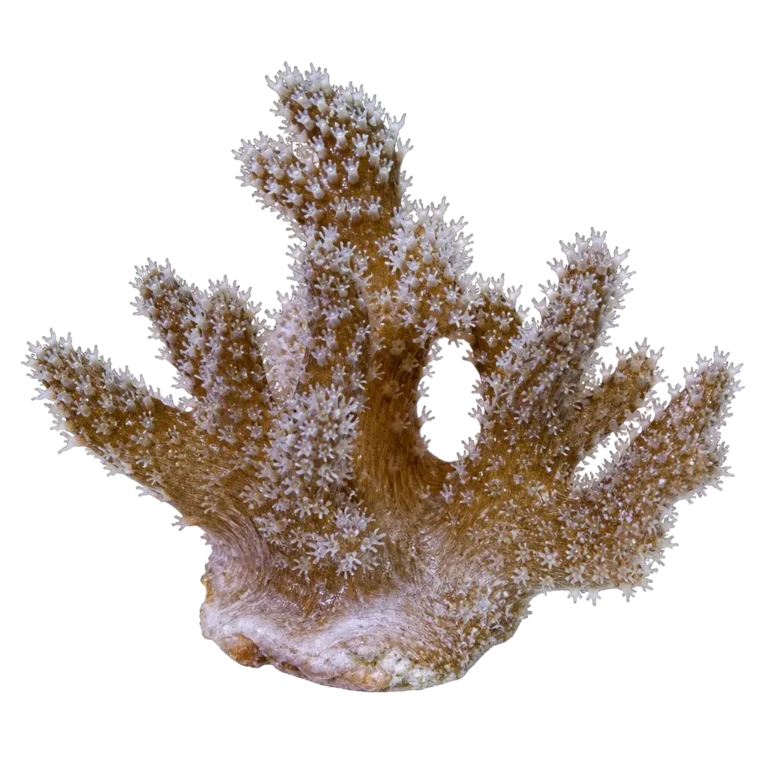
Paralemnalia Coral
Summary
Paralemnalia sp. is a nephtheid soft coral, but a genus-level name covers variation among trade specimens. Expect a flexible, upright colony with lobed or branching growth and polyps that expand and contract with conditions. Its soft body benefits from a secure attachment point and room to sway rather than a tightly packed rock crevice.
General care
Mount the base securely on a stable middle-level rock where it cannot be shaded as it enlarges. Handle the hard attachment point or the base whenever possible; pinching or pulling the expanded upper tissue can tear it. A newly moved colony may stay contracted while it settles, but damaged tissue, persistent collapse, or a loosening base calls for checking flow, light, and mounting rather than repeatedly handling it.
Lighting needs
Start a new Paralemnalia sp. lower in the intended light zone or use reduced output, then increase exposure gradually after it is regularly extending its polyps. Healthy acclimation looks like steady polyp extension and normal tissue firmness. Prolonged contraction, paling, or tissue that remains shrunken after a lighting increase suggests excessive exposure; weak extension and a stretched, sparsely inflated colony can indicate that the light is insufficient.
Flow needs
Provide broad, alternating flow strong enough to keep the branches and polyps in constant gentle motion and to prevent detritus from lodging between lobes. If flow is too weak, the colony often stays slack, collects debris, and extends poorly. If a pump is aimed directly at it, tissue may remain tightly contracted, bend sharply in one direction, or show abrasion at exposed tips; redirect the flow rather than simply increasing it.
Feeding and growth
Most established colonies rely mainly on their symbiotic algae, so feeding is most useful when nutrients are very lean, when a colony is recovering, or when you want to support growth. Offer fine suspended planktonic foods rather than large meaty pieces, and allow the current to carry food through the open polyps. Growth is usually upright and increasingly branched or lobed, so leave open water above and around the mounting point instead of treating it as a small static frag.
Compatibility
Paralemnalia sp. is physically peaceful and is not known for powerful sweeper tentacles, but it can compete chemically with other corals. Leave at least 15 cm5.9 in of physical clearance as it grows, run activated carbon in mixed reefs, and watch nearby sensitive stony corals for reduced extension or unexplained decline after adding or pruning the colony. Fish that nip soft-coral tissue and invertebrates that repeatedly crawl over the branches can keep it closed or create tears; persistent irritation is a reason to relocate the animal or the coral.
Water parameters
This is generally less demanding than many stony corals, provided conditions do not swing abruptly. It is more likely to tolerate ordinary reef conditions than to thrive through repeated salinity or temperature changes, which commonly show up as extended contraction and poor polyp extension. Keep nutrient availability from becoming stripped out completely: a colony that remains closed or fades despite appropriate placement may respond better to restoring a balanced, consistently fed reef system than to chasing frequent parameter corrections.