
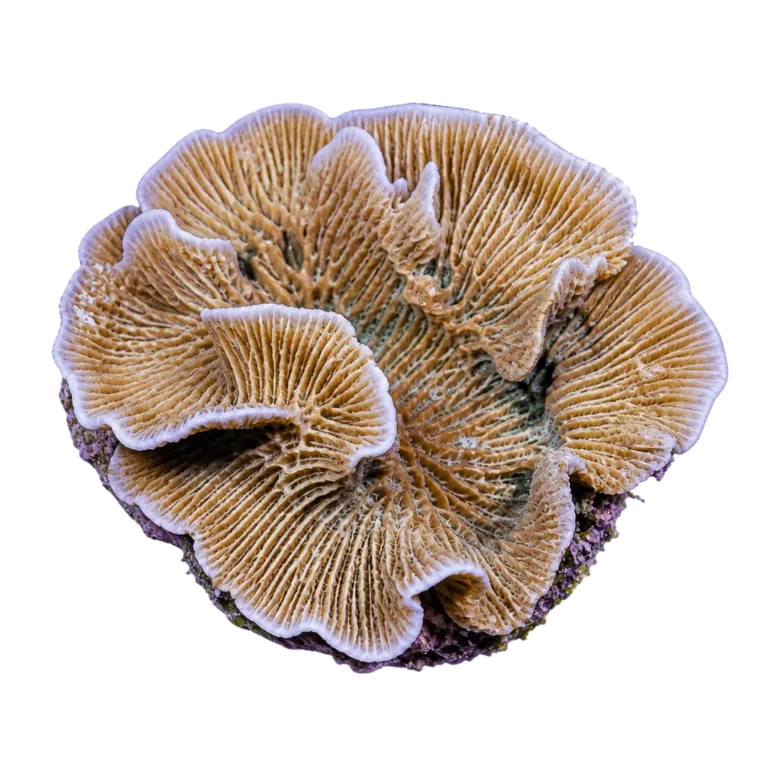
Papyrus Coral
Summary
Leptoseris papyracea is a thin, unifacial stony coral that develops delicate, irregular fronds rather than a thick, solid colony. Its paper-like skeleton and tissue make it a poor choice for exposed, high-energy rockwork or a tank where corals are frequently moved.
paragraphs?
General care
Mount it low on stable rock or a protected horizontal surface where detritus will not settle. Avoid placing it beneath a fast-growing overhang: its thin fronds need open exposure to light and clean water, yet can be shaded, abraded, or broken easily.
Handle the plug, base rock, or bare skeleton rather than the living surface. Do not press on the thin edges or allow the colony to flex during transport; small fractures and torn tissue at the margin can become recession points.
Lighting needs
Treat this as a lower-light Leptoseris and begin in a shaded lower area, then make only gradual increases after it has remained expanded and firmly colored for several weeks. Its natural occurrence in deeper or protected habitats explains why abrupt exposure to bright aquarium lighting is a common cause of trouble.
Too much light commonly appears as paling or bleaching, a washed-out surface, or tissue pulling back from the growing edge. Too little light is more likely to show as persistently dull coloration and little visible edge extension despite otherwise clean tissue; move it brighter in small steps rather than making a large change at once.
Flow needs
Provide gentle-to-moderate, indirect, variable flow that keeps the fronds clear without folding or whipping their edges. At the right flow, the surface stays free of sediment and feeding tentacles may extend without the colony being visibly pushed over.
Increase flow or redirect it if film, detritus, or cyanobacteria repeatedly collects between lobes. Reduce or diffuse flow if tissue stays tightly withdrawn, the thin margins flutter sharply, or the colony is bent enough to rub against rockwork.
Feeding and growth
Feeding is most useful when the coral is newly imported, recovering, or kept in a nutrient-lean system; healthy specimens still rely heavily on light. Offer fine suspended foods such as powdered coral foods, rotifers, or very finely minced marine fare when tentacles are visible, and avoid oversized pieces that sit on the tissue.
Growth begins as a thin encrusting base and can continue into overlapping, divided, plate-like fronds. Leave open substrate around the mounting point: even a modest frag can spread sideways and create shaded pockets or eventually approach neighbouring corals.
Compatibility
Give Papyrus Coral a clear zone of at least 10 cm3.9 in from other corals, and check it after dark before reducing that gap. Leptoseris can extend stinging sweeper tentacles and will also win space simply by growing into a neighbour; a coral that looks safely spaced in daylight may show localized burn marks after nighttime contact.
Avoid placing it beside corals with powerful sweepers or fleshy tissue that can rest against its edges. Most reef-safe fish ignore it, but grazing fish, large snails, and mobile invertebrates can dislodge a lightly mounted frag or scrape its delicate surface, so secure it before introducing animals that bulldoze rockwork.
Water parameters
This coral is best suited to an established reef with consistent chemistry rather than a newly cycling or frequently corrected system. Its thin growing margins can show recession after abrupt alkalinity or salinity changes even when the rest of the colony initially looks intact.
Keep nutrients available but controlled and respond early to persistent surface film or edge recession. Because this species naturally favors areas with little sediment movement, repeated sediment burial or dirty flow can be as damaging as an imperfect test result; clear accumulations gently with a turkey baster and correct the circulation pattern.