
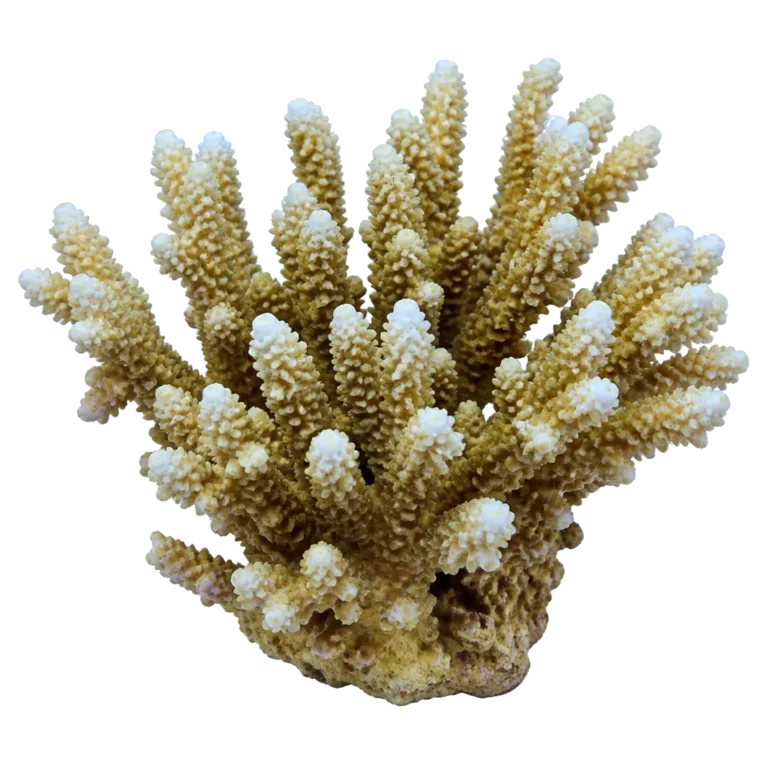
Papillare Coral
Summary
Acropora papillare is a difficult SPS coral that forms compact clumps of thick, irregularly curved branches from an encrusting base. It comes from shallow, wave-exposed Indo-Pacific reefs, which explains its need for intense light, energetic circulation, and a system that does not swing from day to day. Plan for it as a branching coral that will shade and crowd its own base as it matures, rather than as a small frag that will remain unobtrusive.
General care
Mount Acropora papillare high on stable rockwork where it can receive light and multidirectional flow from several angles. Secure the encrusting base or frag plug firmly; a loose frag that rocks in the current can repeatedly abrade tissue at the attachment point and fail before it establishes.
Handle it by the plug or bare skeleton whenever possible. The branches are comparatively stout, but can snap under leverage, and the thin living tissue can be damaged by squeezing, scraping, or allowing a branch to rub against rock during placement.
Lighting needs
Acclimate new pieces to high lighting gradually by beginning in a less exposed position or reducing the initial photoperiod, then increasing exposure only after the coral is holding color and showing normal polyp extension. A freshly shipped or recently moved frag is more likely to bleach under an immediate jump in intensity than an established colony.
Too little light commonly shows as duller or browner coloration, slower encrusting, and weak growth at branch tips. Too much light shows first on the uppermost surfaces as paling, sharply faded tips, or tissue bleaching; reduce exposure promptly rather than waiting for the color loss to spread.
Flow needs
Provide strong, turbulent flow that reaches around and through the branch cluster. At the right flow, fine detritus does not settle between branches and the small polyps move gently or extend without being pinned flat in one direction.
If flow is too weak, debris accumulates at the base and within the colony, polyps may remain poorly extended, and recession can begin in shaded, stagnant areas. If a pump creates a harsh fixed jet, tissue can stay retracted on the exposed side or develop localized damage; redirect or diffuse the flow rather than simply reducing all circulation.
Feeding and growth
Most established Acropora papillare colonies obtain much of their energy from their symbiotic algae, so feeding is most useful in nutrient-lean systems, for newly settling frags, or when growth and coloration are weak despite otherwise appropriate conditions. Offer fine suspended coral foods or appropriately small zooplankton-sized foods in circulation; large meaty pieces are poorly suited to its small polyps and can foul the branches.
Growth begins by encrusting the mounting surface and then develops into a dense cluster of curved branches. Leave open rock around the base and above the colony, because its own branches can shade lower tissue and its expanding outline will soon occupy more space than the original frag plug suggests.
Compatibility
Keep Acropora papillare clear of neighboring corals from the start. It competes through direct contact and can deploy mesenterial filaments, so do not let its branches grow into another coral even if both appear healthy initially. Allow at least 10–15 cm3.9–5.9 in of open space, then increase that gap as branches extend.
Avoid placing it where large, clumsy fish can use the branches as a perch or where coral-picking fish repeatedly nip the tissue. Inspect Acropora additions closely for Acropora-eating flatworms and other coral pests, because damage can resemble poor flow or chemistry at first and may spread through an Acropora collection.
Water parameters
This is less forgiving than a typical mixed-reef coral and is best added to a mature system with predictable daily chemistry. Acropora papillare is particularly sensitive to abrupt alkalinity changes, but sudden shifts in salinity or temperature can also trigger rapid loss of color or tissue. Make dosing adjustments gradually and verify consumption before increasing supplementation.
Avoid driving nutrients so low that the coral becomes pale and stalls, while also preventing detritus and dissolved waste from accumulating around the colony. Consistent color, active tip growth, and intact tissue from branch tip to base are better signs of success than chasing a single test result.