
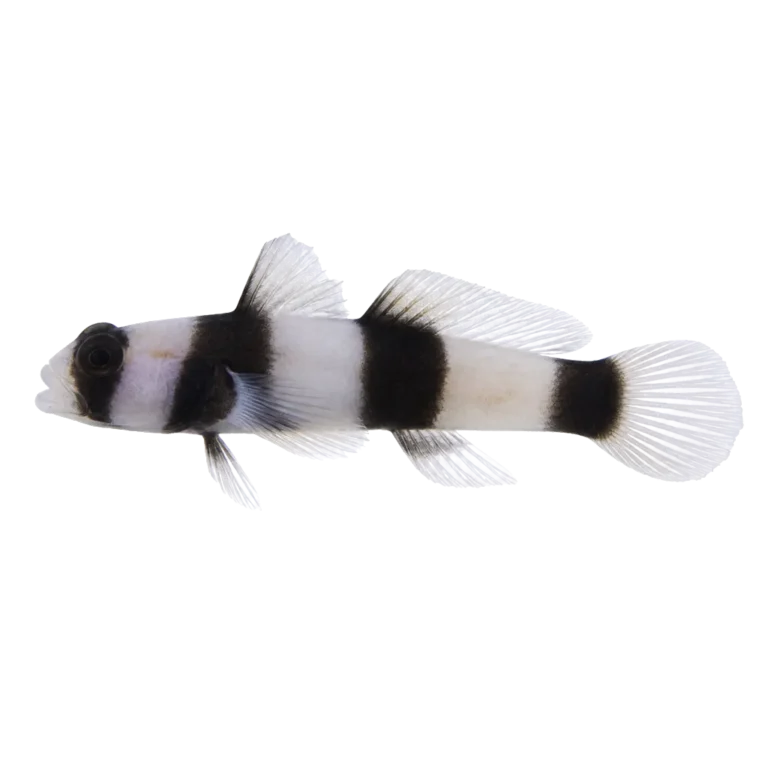
Panda Goby
Summary
Paragobiodon lacunicolus is a coral-dwelling goby rather than an open-water swimmer. It normally stays deep within the branches of a living Pocillopora colony, perching briefly at the edge to snatch passing food before retreating. In an aquarium, a fish that spends most of the day concealed in its chosen coral is usually behaving normally, not necessarily failing to settle.
Its dependence on a branching coral refuge is the main stocking consideration. This is a specialist best suited to an established reef that can support both the goby’s fine-particle feeding and a healthy host coral; a sparse fish-only layout leaves it exposed and often reluctant to feed.
Care
Add the goby only after a dense, established branching Pocillopora is securely placed and thriving. The coral provides its shelter, lookout and territory, so rock caves and open sand do not substitute for the tight branch structure it naturally occupies. Expect it to select one colony and remain there rather than explore the aquarium.
Arrange flow so fine foods pass through the outer branches without blasting the fish from its perch. A goby that repeatedly abandons the coral, wedges into an unsuitable crevice, or remains pinned low in the branches may be unable to use the coral comfortably or may be avoiding disturbance from tankmates.
Feeding
Feed small portions of enriched copepods, enriched Artemia, and finely minced marine foods repeatedly through the day rather than expecting one broad feeding to reach it. Deliver food just upstream of its coral with a pipette or turkey baster so particles travel through the branches, where the goby is willing to make short feeding dashes.
Do not rely on unenriched Artemia as the staple. This species is small, sedentary and easily beaten to suspended foods by faster fish; a goby that only watches food pass from within the coral can slowly lose condition without obvious drama. Check for a pinched belly and make sure it is actually taking several items, not merely emerging at feeding time.
Compatibility
Keep a single Panda Goby as the default plan. Paragobiodon lacunicolus may defend its host coral from other individuals, so adding another to an occupied colony can lead to persistent chasing through the branches. Attempt a pair only when both are introduced together and the aquarium offers enough separate branching coral structure for the subordinate fish to withdraw if necessary.
Choose quiet tankmates that will not repeatedly inspect or raid the host coral. Avoid fish with large mouths, active coral-probing habits, or a tendency to dominate feeding, including aggressive dottybacks and predatory or boisterous reef fish. Peaceful, non-competitive companions are a better fit if they leave fine suspended foods for the goby.
It is reef compatible, but the host coral will be used continually as living cover and as a source of mucus. Do not place one with the expectation that it will remain separate from SPS corals, and avoid making a prized delicate branching colony the only possible refuge if its constant occupancy would be unacceptable.
Good to know
The most common failure is treating a hidden fish as a self-sufficient fish. A well-settled individual may be rarely visible, but it should still appear for food and retain a rounded body. If it becomes thin, stops making feeding dashes, or abandons its coral, intervene by reducing feeding competition and directing finer foods into the branches.
The health of its chosen coral has direct consequences for the goby. When a host colony declines or loses its dense branch cover, the fish loses its primary shelter and becomes more exposed to stress and harassment. Plan the purchase around maintaining the coral long term, rather than adding the coral only after the goby is already unsettled.