
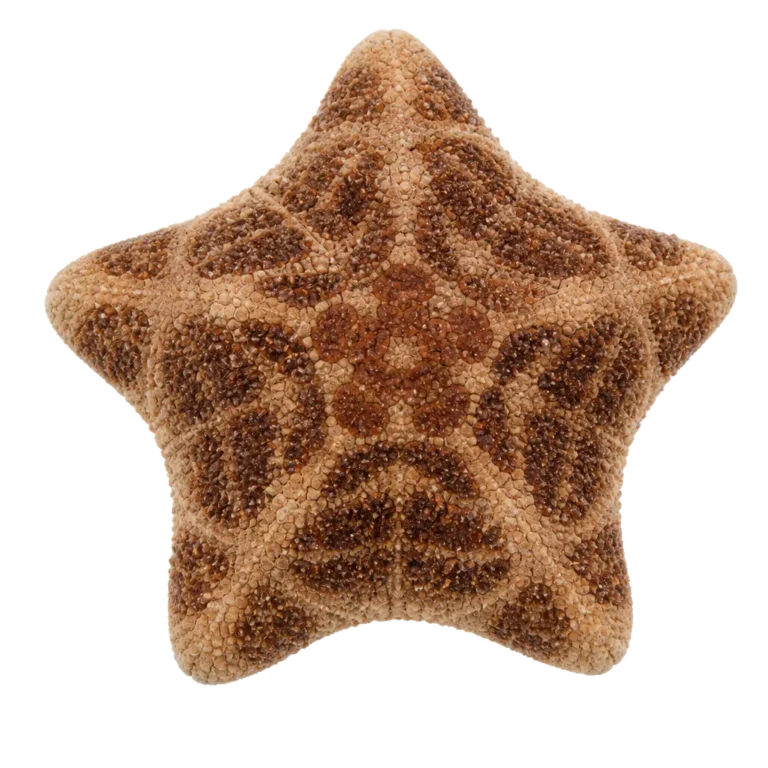
Panamic Cushion Star
Summary
The Panamic Cushion Star, Pentaceraster cumingi, is a heavy-bodied eastern Pacific sea star that forages over rocky reef, sand, and seagrass-associated bottoms. Its broad body and slow, deliberate movement make it poorly suited to crowded aquascapes: it needs open routes across the substrate and enough established natural grazing to support it between feedings.
It is not a conventional ornamental “cleanup crew” star. Pentaceraster cumingi is a difficult specialist whose survival depends more on a large, food-rich benthic system than on finding scraps in a recently set-up reef.
Care
Provide broad, unobstructed areas of sand and stable rockwork rather than a densely packed coral garden. The star should be able to travel over the bottom and around rock without regularly climbing unstable structures or knocking frags loose.
Add it only to a long-established aquarium with extensive biofilm, benthic algae, and detrital food across hard surfaces and substrate. Bright reef lighting can support this natural grazing base, but the star itself does not require special lighting; the important sign is visible, persistent benthic growth rather than a tank kept artificially sterile.
Use steady, non-blasting flow across the bottom. Strong directional currents can make a slow-moving sea star struggle to remain in feeding areas, while dead zones that accumulate foul detritus are not a substitute for healthy grazing surfaces.
Feeding and role
Let Pentaceraster cumingi graze naturally, but do not expect grazing alone to sustain it in captivity. Its diet includes benthic algae, biofilm, detritus, and small invertebrates, so supplement it directly with appropriately sized pieces of marine-origin foods such as clam, mussel, shrimp, or other unsalted seafood. Place food beside the oral surface after lights-out or when the animal is settled, and confirm that it remains over the food rather than merely passing across it.
A well-fed individual may consume some nuisance film algae and detritus, but it will not meaningfully clean an algae problem or replace normal maintenance. Its willingness to eat small echinoderms also means it is not a safe choice for a cleanup crew built around small urchins or other vulnerable echinoderms.
Compatibility
Keep it away from fish and large crustaceans that pick at exposed tube feet or overturn sea stars. Repeated nipping can prevent normal movement and feeding even when the star is not visibly injured.
Treat it as reef-compatible with caution. It is not known as a dedicated coral predator, but its size and weight can dislodge unsecured corals, and it may graze encrusting algal films around the aquascape. Secure frags and leave clear travel paths rather than placing delicate corals directly in its usual routes.
Add a single specimen unless the aquarium is exceptionally large and has a demonstrably abundant natural food base. Wild individuals can occur in aggregations, but that does not make a typical home aquarium able to support several competing stars; crowding them increases the risk of chronic underfeeding.
Good to know
Acclimate slowly and avoid abrupt salinity change. Like other echinoderms, it is highly sensitive to copper and many medications, so never place it in a system being treated with copper-based drugs.
Watch for persistent shrinking, loss of firmness, failure to grip surfaces, or an animal that remains inactive without feeding response. These signs are more useful warnings than occasional movement patterns and often indicate inadequate long-term nutrition or unsuitable water conditions. Remove a declining specimen promptly if tissue begins to break down, as a large sea star can foul the aquarium quickly.