
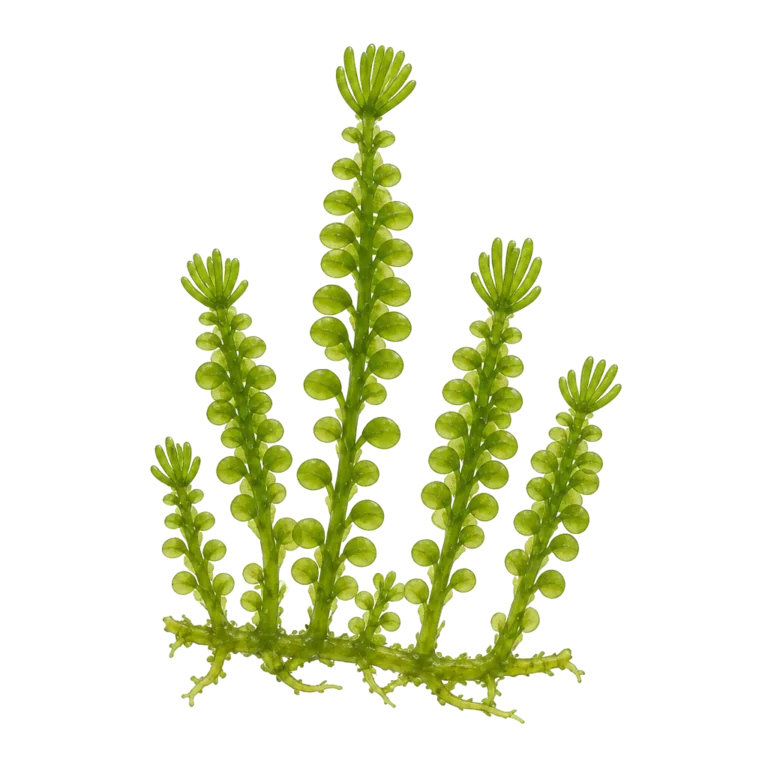
Palm Tree Caulerpa
Summary
Palm Tree Caulerpa, Caulerpa paspaloides, is a marine green macroalga rather than a true invertebrate. Its upright, palm-like fronds arise from creeping runners that attach at multiple points, so a small planted piece can become a spreading patch if it is not confined.
It occurs in shallow marine habitats on rock or sand, which explains its versatility in an aquarium: it can anchor to hardscape or root across the sand surface. That same runner-driven growth makes it better suited to a managed refugium or a clearly isolated area of the display than to open rockwork around corals.
Care
Secure Caulerpa paspaloides to a small, removable rock or keep it in a separated refugium section. It does not need a deep sand bed, but loose runners can attach to nearby rock and sand; a removable base makes routine containment much easier.
Give it consistent reef lighting strong enough to maintain active green growth, along with flow that keeps detritus from collecting through the fronds without continually flattening or tearing them. A mature, nutrient-producing aquarium is more suitable than a newly sterile system, because this macroalga needs dissolved nutrients to grow rather than simply surviving in clear water.
Inspect its perimeter routinely and remove advancing runners before they reach coral bases, porous rock, or overflow areas. Prune whole runner sections rather than repeatedly clipping only the visible fronds; otherwise, attached remnants may continue spreading from hidden holdfasts.
Feeding and role
Caulerpa paspaloides is photosynthetic and takes up dissolved nitrate, phosphate, and trace nutrients. It is not an animal that needs target feeding, but it can fade or stall in systems kept too nutrient-poor for macroalgae; persistent paling and failure to produce new fronds call for reviewing nutrient availability rather than adding food directly to the algae.
Its useful cleanup role is nutrient export: remove healthy harvested growth from the system to export the nutrients stored in that tissue. It does not consume detritus, uneaten food, nuisance algae, or fish waste directly, and one small clump will not meaningfully correct an overstocked or overfed aquarium.
Compatibility
Keep a clear buffer between this Caulerpa and corals, clams, or other sessile invertebrates. The algae can spread over nearby surfaces and shade or physically crowd slower-growing organisms, especially where runners can disappear into branching rockwork.
Herbivorous fish and invertebrates may browse the fronds, so do not rely on a display planting where persistent grazing is expected. Conversely, do not add grazers solely to control an established patch; manual runner removal is more predictable and avoids creating an unsuitable stocking choice for the rest of the aquarium.
A single small planting is enough to establish a colony. Adding several pieces usually increases the containment problem rather than producing a fuller, more stable display, because separated fragments and runners can each continue growing.
Good to know
Watch for fronds or runners that turn pale, translucent, or begin breaking down unusually quickly. Caulerpa can undergo a reproductive breakdown often called going sexual, releasing stored nutrients and reproductive material into the water. Remove affected tissue promptly, harvest excess healthy growth, and use appropriate water changes and filtration if the water becomes cloudy.
Avoid major swings in lighting routine or long periods of neglect followed by severe pruning. Keeping the colony regularly thinned and removing decaying sections early is safer than allowing a dense mass to overgrow its space.
Never dispose of live fragments into drains, waterways, or outdoor areas. Bag unwanted material for disposal, because even small attached pieces can remain viable and Caulerpa species can become invasive outside the aquarium.