
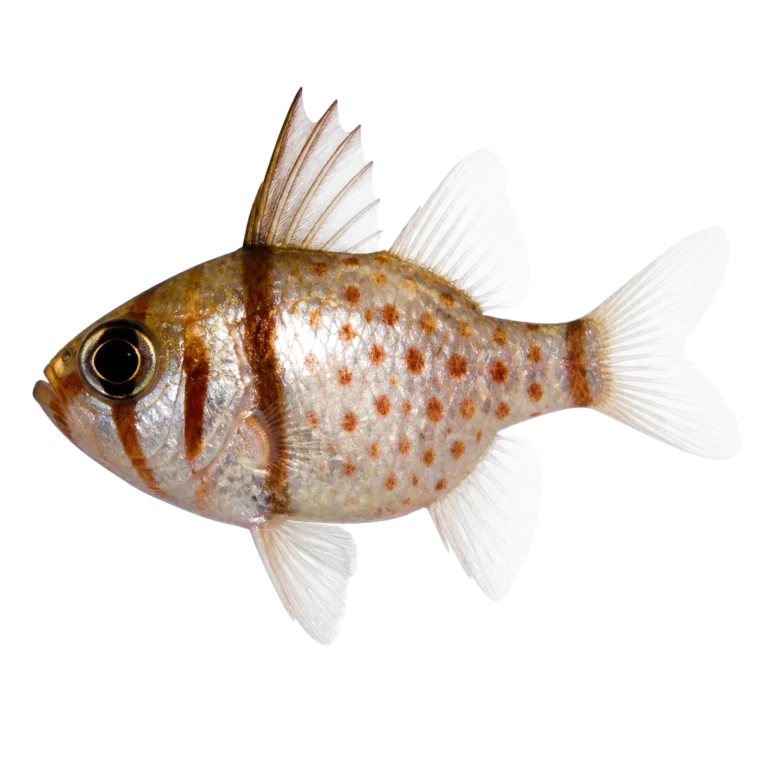
Orbic Cardinalfish
Summary
Sphaeramia orbicularis is a slow, hovering cardinalfish that spends much of the day close to cover rather than cruising the open water. A fish that remains under ledges, among branching structure, or beside a protected vertical surface is usually using the aquarium as intended; persistent pinning in a single inaccessible corner more often points to intimidation.
Its strongest feeding activity is often around dusk and in low light, reflecting its natural habit of taking small planktonic crustaceans after dark. Expect a calm fish that may look inactive in daytime, then become more purposeful when fine meaty food enters the water.
Care
Build the aquascape with shaded overhangs, branching coral structure, rock recesses, or other protected stations near the mid-to-lower water column. Sphaeramia orbicularis should be able to hover beside cover while still making short, unobstructed sorties for food; a bare, brightly exposed layout can leave it withdrawn.
Use gentle-to-moderate, indirect circulation rather than a continuous narrow blast through its preferred resting area. This species is a deliberate hoverer, so an individual that must constantly paddle against flow may abandon otherwise suitable shelter.
Give each fish more than one protected station when keeping a group. Multiple visual breaks allow subordinate fish to disengage instead of being held away from cover by a more settled individual.
Feeding
Offer small marine meaty foods that remain suspended briefly, such as enriched frozen zooplankton, finely chopped crustacean foods, and other appropriately sized carnivore preparations. Feed in modest portions on a regular schedule, and include a dusk or lights-down feeding when daytime competition is preventing it from getting a share.
Target-feed or release food upstream of the fish’s shelter when it is housed with fast planktivores. The usual warning sign of being outcompeted is not refusal to strike, but repeated hesitant sorties followed by retreat while quicker fish clear the food first.
Avoid relying on a single rich food such as brine shrimp as the entire diet. A varied small-prey menu better matches its natural planktonic feeding and reduces the risk of a fish that eats eagerly but gradually loses condition.
Compatibility
Sphaeramia orbicularis suits peaceful community reefs with fish that do not repeatedly rush its resting space or monopolize suspended food. Calm gobies, assessors, blennies, smaller peaceful wrasses, and other non-bullying community fish are generally more suitable categories than forceful damselfish, large territorial wrasses, or predatory fish.
Keep a single fish, or introduce a compatible group together into an aquascape with several sheltered stations. Adding one newcomer to an established group can leave it excluded from cover and feeding lanes, so observe closely and be prepared to separate a fish that stays isolated.
It is reef-compatible with corals, but it is not a safe choice for a system intended to raise tiny ornamental shrimp or fish fry. Very small shrimp and newly released fry can be treated as prey.
Good to know
A male carrying a brood holds the eggs in his mouth and may eat little or stop feeding for a period. Do not mistake this alone for immediate disease if he otherwise breathes normally, holds good body condition, and remains near a familiar shelter; remove feeding competition only if he begins to lose condition.
Because activity rises in dim light, a fish that seems shy during the day may be functioning normally. Investigate instead when it also misses dusk feedings, breathes rapidly, develops a sunken belly, or is prevented from reaching its chosen cover.
Cover openings in the aquarium. Startled cardinalfish can make abrupt upward escapes, particularly during introductions, nighttime disturbance, or conflict around a shelter.