
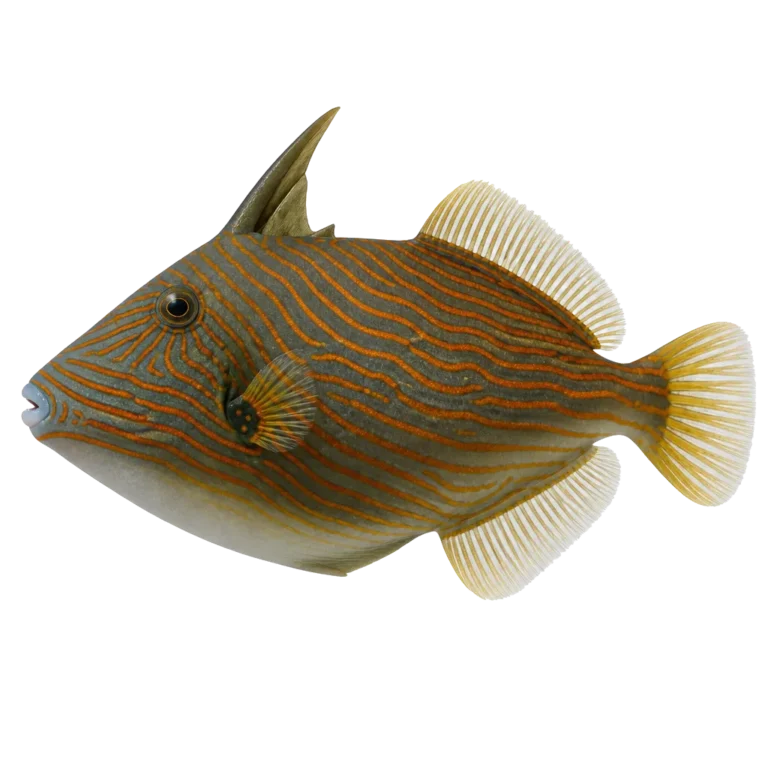
Orange-lined Triggerfish
Summary
Balistapus undulatus is a highly territorial, active triggerfish that patrols the rockwork and open water rather than remaining in one refuge. Its natural use of coral-rich reef structure helps explain its aquarium behavior: it treats caves, ledges, and surrounding swimming space as defended territory, then retreats tightly into crevices when alarmed or resting.
Choose this species only for a system planned around one assertive fish with a clear contingency for removing tankmates. Persistent pursuit, cornering, damaged fins, or a fish refusing to leave shelter are incompatibility signals, not normal social settling.
Care
Build a rigid rock structure with several deep crevices and overhangs, while preserving a broad, unobstructed patrol route. Secure every rock directly and protect or place vulnerable equipment out of reach, because a powerful trigger investigating the aquascape can shift loose pieces or damage exposed hardware.
Use strong mechanical filtration and export waste consistently. This fish produces substantial waste and scatters meaty foods, so declining water clarity, accumulating detritus around the rockwork, or rising nutrients usually call for more effective feeding control and maintenance rather than simply feeding less variety.
Give it a permanent shelter that it can enter fully at night or when startled. A trigger that repeatedly wedges itself into the same crevice is usually using a chosen refuge; a fish that remains exposed, breathes heavily, or cannot settle may be stressed or being excluded.
Feeding
Offer a varied rotation of marine-based meaty foods, including shrimp, squid, mussel, clam, marine fish flesh, and hard-shelled crustaceans. Include hard items routinely because they help wear down the teeth; a diet made up only of soft foods can leave the fish less able to process food normally.
Feed measured portions in more than one location when other large fish are present. Balistapus undulatus is fast and forceful at feeding, so timid tankmates can lose access even when food appears plentiful. Watch each fish rather than judging by the triggerfish’s appetite alone.
Remove uneaten pieces promptly and avoid using large amounts of one food as a staple. Its broad natural diet is reflected in a willingness to eat many items, but that is not a reason to rely on fatty seafood or a single convenient frozen food.
Compatibility
Keep Balistapus undulatus singly. Do not plan on adding another triggerfish or attempting a pair: this species is strongly territorial, and an established individual can inflict serious injury on a newcomer.
If companions are attempted, choose similarly robust, alert fish that can occupy different parts of the aquarium and still be prepared to separate them. Avoid slow-moving, timid, narrow-bodied, or substantially smaller fish, as well as fish that spend most of their time close to the same rockwork the trigger will claim.
Add the orange-lined triggerfish after the rest of a carefully chosen robust community, not as an early resident. This may reduce its initial ownership of the entire aquarium, but it does not make risky tankmates safe; aggression can still develop once it settles in.
Do not use this species in a conventional reef or ornamental-invertebrate display. It may prey on crustaceans and mollusks and can bite corals, so even large decorative shrimp, snails, clams, and established coral colonies are not dependable exceptions.
Good to know
Expect territorial behavior to become clearer after the fish has selected sleeping and retreat sites. Repeated charging, biting, or preventing another fish from feeding should be acted on early with separation or removal; waiting for a hierarchy to stabilize can result in severe injuries.
It uses rock crevices as nighttime and threat shelter. Plan access to the fish before it is introduced, because a settled individual can be difficult to net from a dense reef structure and may need a removable trap or other deliberate extraction method if compatibility fails.
A sudden refusal of hard foods, dropping items repeatedly, or visible difficulty closing the mouth deserves prompt attention, as tooth overgrowth or oral injury can interfere with feeding. Continue offering suitable hard-shelled foods rather than switching permanently to soft foods just because they are easier to eat.