
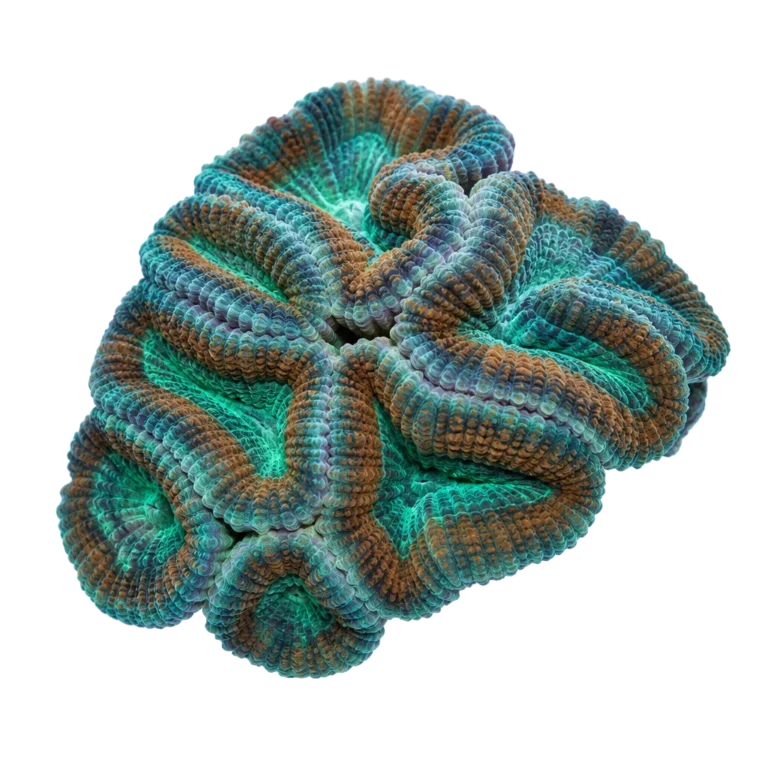
Octospawn Coral
Summary
Fimbriaphyllia yaeyamaensis is a branching LPS coral recognized by thick tentacles with multiple small, rounded side tips, giving the colony its octospawn appearance. Its fleshy daytime expansion is normal, but that same exposed tissue makes it unsuitable for cramped rockwork or positions where it can touch hard surfaces or neighboring corals.
General care
Place it on stable lower to middle rockwork where each branch has room to expand without rubbing the rock or sand. Secure the skeleton rather than wedging or gluing living tissue; a damaged polyp can recede quickly if its inflated tissue is cut, pinched, or repeatedly abraded. Inspect purchases for intact flesh around every head and avoid specimens with exposed skeleton beneath otherwise inflated tissue.
Lighting needs
Start a newly acquired colony in the dimmer part of its suitable lighting range, then move it brighter only after it is opening consistently for at least a week. Healthy acclimation looks like steady daytime inflation and retained color; persistent tight retraction, paling, or bleaching on the upper-facing tissue suggests excessive light. In insufficient light, the coral may remain expanded but gradually lose color, show weak growth, and fail to maintain full, firm tissue.
Flow needs
Use indirect, changing flow that keeps the tentacles moving softly in several directions while allowing the polyps to remain fully inflated. At the right flow, food and loose debris do not settle among the heads, yet the tentacles are not pinned in one direction. Too little flow leaves detritus and mucus caught in the colony; too much causes persistent contraction, sharply whipped tentacles, or tissue that rubs against the skeleton.
Feeding and growth
Light provides most of this coral’s energy, but occasional target feeding is useful for recovering, recently divided, pale, or actively growing colonies. Offer zooplankton-sized foods or finely chopped marine foods after the tentacles are extended, and feed sparingly enough that uneaten particles do not lodge between heads. Fimbriaphyllia yaeyamaensis typically builds a branching colony with individual heads, so leave open space above and around it for new branches and for its expanded tentacles.
Compatibility
This coral defends its space with stinging tentacles and may extend longer sweepers after dark. Keep at least 15 cm5.9 in between it and other corals, then increase that gap if nighttime contact appears; do not assume nearby hammer or frogspawn-type corals are safe to touch. Clownfish may try to host in the fleshy polyps, and an overly persistent fish can keep a small colony retracted or abrade its tissue. Avoid coral-nipping fish and invertebrates that repeatedly pick at the polyps or steal food directly from them.
Water parameters
Treat this as moderately demanding rather than a coral for a newly fluctuating reef. Fimbriaphyllia yaeyamaensis often responds to abrupt salinity, alkalinity, or nutrient changes with prolonged retraction, reduced inflation, or tissue recession, even when the final values are acceptable. Make corrections gradually, and investigate quickly if a previously open head stays shrunken, produces excessive mucus, or exposes new skeleton.