
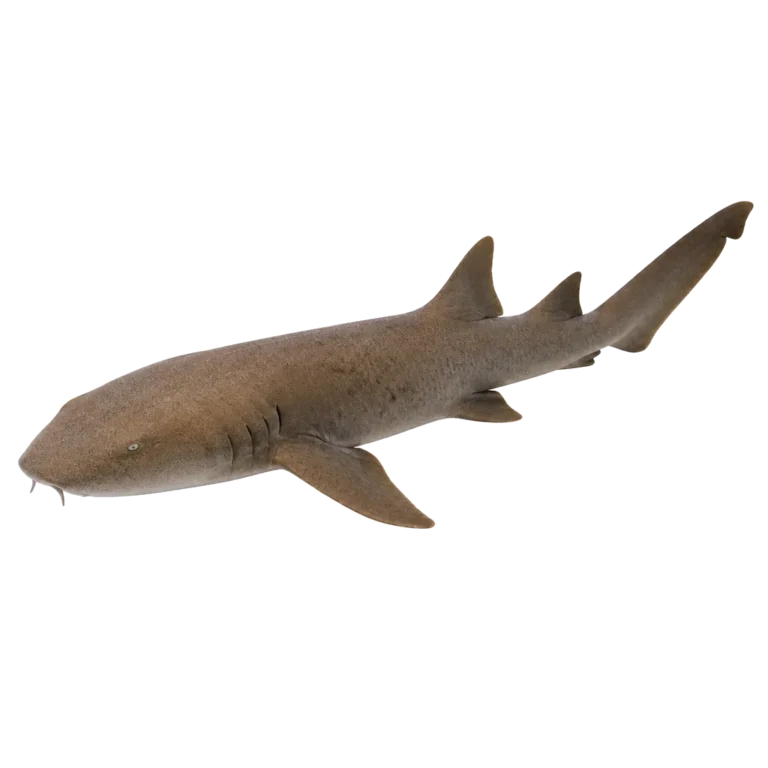
Nurse Shark
Summary
Nurse Sharks, Ginglymostoma cirratum, are bottom-oriented, mostly nocturnal sharks that spend much of the day resting and become active after dark as they search the substrate for prey. That apparently sedentary daytime behaviour should not be mistaken for suitability in a home reef aquarium: this is a very large, long-lived shark whose adult needs exceed normal private reef systems.
A shark that repeatedly returns to a preferred resting site needs broad, unobstructed floor space rather than a rock-packed display. In a confined aquarium, turning difficulty, persistent contact with rockwork, and damage to corals or tank walls are predictable welfare problems rather than normal behaviour.
Care
Keep this species only in a purpose-built, public-aquarium-scale system with a very large open footprint, rounded turns, and extensive soft substrate. Nurse Sharks move close to the bottom and can use their pectoral fins to push across it, so narrow channels, sharp rock projections, and densely stacked aquascapes create abrasion and entrapment hazards.
Build shelter as a spacious, open-ended resting area rather than a tight cave. The shark must be able to enter, turn, and leave without scraping its body or having to force rockwork aside; a shark that repeatedly wedges itself, circles without settling, or rubs its underside needs a safer layout.
Use robust life-support sized for a heavy-bodied predator that produces substantial waste, and protect intakes and overflows so the shark cannot rest against or enter them. Decorative reef structures should be treated as movable obstacles: even a calm individual can shift unsecured rock, bury corals with substrate, or break branching colonies simply by passing through.
Feeding
Offer a varied marine-based diet of appropriately sized whole or sectioned seafood, including items with bone, shell, or other natural structure where suitable, rather than relying on plain fish fillet. A monotonous, soft diet can be nutritionally incomplete and does not reflect the shark's ability to crush or suction-feed on hard-bodied prey.
Feed after the main lights dim or at another consistent low-light period, then confirm that the shark is actually obtaining its share. Nurse Sharks are deliberate feeders, and fast daytime fishes can strip food before a resting shark responds; target feeding may be necessary, but keep hands and tools clear of the mouth because suction can be forceful.
Do not use ornamental shrimp, crabs, snails, clams, or similarly sized bottom animals as long-term tankmates with the expectation that they will be ignored. They are potential prey, and unexplained disappearance of clean-up-crew animals is a stocking outcome, not evidence of a mysterious water-quality problem.
Compatibility
Do not plan a conventional mixed reef around a Nurse Shark. Sessile corals are not necessarily targeted as food, but the shark's size and bottom movement make fragile colonies, loose frags, and elaborate rockwork vulnerable to physical damage.
Avoid keeping it with ornamental crustaceans, mollusks, rays, or bottom-dwelling fishes that can be approached while resting. Slow, small, or sleeping fishes are also at risk, especially once the lights are out.
Multiple Nurse Sharks should be considered only in an exceptionally large professional system with separate resting areas and the ability to manage feeding individually. Individuals may rest near one another, but that does not make crowding safe; competition is most likely to become evident around food and preferred shelter.
If a collection includes large, robust fishes, introduce and establish them before the shark only when the enclosure still provides unobstructed bottom space. Never rely on a shark's generally calm daytime posture to offset the risks created by incompatible prey or a restrictive aquascape.
Good to know
Nocturnal activity can make a Nurse Shark look inactive or unwell during the day when it is simply resting. Assess it after dark as well: purposeful bottom exploration and a reliable feeding response are more useful indicators than daytime movement alone.
A resting shark can remain in one place for long periods, but persistent rubbing, damaged skin, inability to turn cleanly, or repeated attempts to climb through rockwork indicate that the enclosure is failing its physical needs. These problems require changing the system, not merely adding another cave.
Treat handling as a serious safety and welfare issue. Nurse Sharks are capable of defensive biting and powerful suction when disturbed, so routine capture, hand-feeding, or attempts to reposition a resting animal should not be part of normal husbandry.