
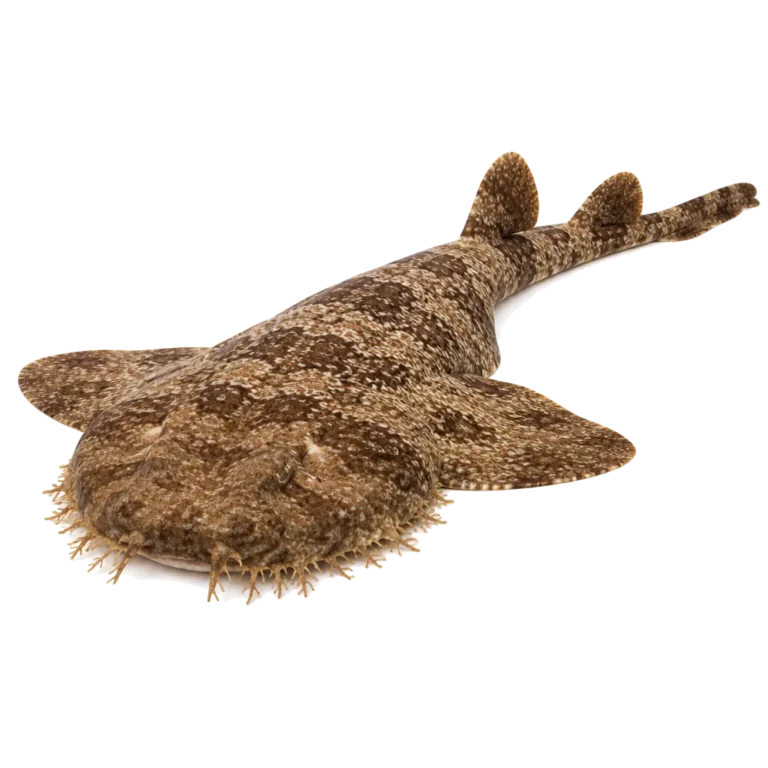
Northern Wobbegong
Summary
Northern Wobbegong, Orectolobus wardi, is a bottom-resting carpet shark that relies on camouflage and a short ambush strike rather than constant swimming. A fish that spends much of the day motionless is behaving normally; repeated open-water pacing, inability to turn cleanly, or persistent rubbing against rockwork points to an unsuitable footprint or layout.
Treat it as a specialist shark for a purpose-built, very large marine system rather than a conventional reef display. Its broad head and bottom-hunting behaviour mean that every fish or mobile invertebrate within swallowing range is potential prey, even if it has previously shared the tank without incident.
Care
Build the aquarium around uninterrupted bottom area, with wide turning routes and sand or another smooth substrate. Keep rockwork securely supported off the base and leave open lanes around it, because this shark moves by cruising and pivoting along the bottom and can scrape itself or become trapped in tightly built aquascapes.
Provide a shaded recess, low ledge, or open-bottomed cave large enough for the shark to settle beneath without being wedged in. It will often choose a resting site and remain there for long periods; rearranging that area or directing a strong pump at it can cause avoidable stress and force it into exposed, less suitable places.
Use strong overall filtration and oxygenation without creating narrow, blasting jets across the floor. Food items missed during feeding can foul the water quickly, while a shark that must constantly brace against excessive flow will rest poorly and may repeatedly relocate.
Feeding
Offer varied, marine-based meaty foods such as suitably sized whole marine fish, crustaceans, squid, clam, and mussel. Rotate prey types rather than relying on one item, because a narrow diet can leave a slow-growing ambush predator with nutritional gaps that are not obvious until body condition declines.
Feed deliberate, spaced meals and adjust portions by body condition rather than offering food every day. Remove uneaten pieces promptly; a Northern Wobbegong may ignore food while settling in, but repeatedly refusing appropriate food or losing fullness behind the head warrants investigation rather than simply adding more food.
Target-feed with long tongs or a feeding stick, ideally after other fishes have been fed. Do not hand-feed: the shark can strike suddenly at scent or movement, and fast tankmates may steal food before it reaches a resting animal. Avoid freshwater feeder fish and mammal meat, which are poor long-term staples for a marine shark.
Compatibility
Keep a Northern Wobbegong singly. There is little benefit to housing multiple individuals in a home system, while shared floor space, feeding access, and accidental contact create unnecessary conflict and make it harder to prevent injury.
Favour only calm, robust fishes that are far too large to be swallowed and that do not nip, crowd, or compete aggressively at feeding time. Avoid small fishes, ornamental shrimp, crabs, lobsters, and similar bottom-dwelling invertebrates; the shark may eventually take them as prey, including long-established tankmates.
Plan tankmates before the shark is introduced, then do not casually add smaller livestock later. A reef aquarium may retain sessile corals, but it is not reef-safe in the usual community sense: mobile invertebrates are at risk, and a resting or turning shark can dislodge poorly secured corals placed on the sand or at floor level.
Good to know
Never assume a resting Northern Wobbegong is safe to touch or move. Its camouflage makes it easy to overlook, and a disturbed shark can bite defensively with serious force; use tools and careful planning for maintenance instead of reaching around or under it.
Avoid copper-based medications and other treatments not confirmed safe for cartilaginous fishes. If illness occurs, seek a shark-experienced aquatic veterinarian or specialist before medicating, because a treatment tolerated by reef fish may be poorly tolerated by an elasmobranch.
A sudden change from settled, concealed resting to repeated circling, climbing at the glass, or struggling to turn should be treated as a husbandry warning. Check for restricted floor space, unsuitable flow, deteriorating water quality from missed food, or harassment by tankmates before assuming the behaviour is normal activity.