
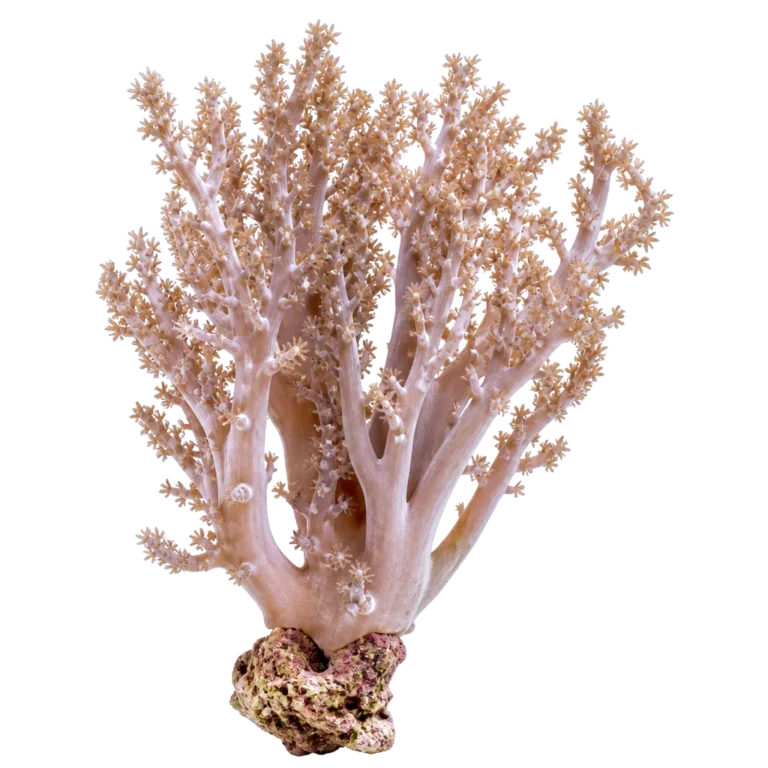
Nephthyigorgia Coral
Summary
Nephthyigorgia sp. is a non-photosynthetic soft coral, often sold as chili coral. Genus-level identification matters: colony shape and expansion can vary among imported specimens, but all should be treated as suspension feeders rather than light-driven corals. Their Indo-Pacific habitat in shaded, current-exposed reef areas explains the aquarium priority: dependable delivery of fine food in moving water, not bright illumination.
Expect a fleshy, fingered or bushy colony that may look compact when its feeding polyps are withdrawn, then expand into a much larger, fuzzy outline when conditions suit it. A newly introduced colony is a poor choice for a lightly fed display reef; its long-term success depends on whether the aquarium can support frequent plankton-sized feedings without chronic nutrient accumulation.
General care
Mount Nephthyigorgia sp. low in the aquarium, ideally in shade or beneath an overhang where it still receives a clean, indirect current and can be reached for feeding. Do not bury its base in sand or place it where detritus settles between the lobes; trapped debris can keep polyps closed and irritate the tissue.
Handle the plug, rock, or firm basal attachment rather than squeezing the branches. This is a soft coral supported by internal sclerites rather than a rigid external skeleton, so torn tissue and crushed lobes are realistic risks during shipping, mounting, and cleaning. A colony that remains limp after acclimation, develops damaged patches, or sheds mucus repeatedly needs gentler flow around the injury and close attention to water quality.
Lighting needs
Treat lighting as a placement issue rather than an energy source. Start the colony in shade or very dim indirect light, then leave it there while it settles into the feeding schedule; moving it progressively upward for more light will not improve its nutrition.
Excessive direct light can coincide with persistent daytime contraction, fading color, and nuisance algae collecting on tissue, especially when flow is also inadequate. There is no useful visual target for “too little” light in this genus: if the coral is failing in a dim location, first assess food delivery, flow, detritus, and tissue condition rather than increasing illumination.
Flow needs
Provide medium-to-strong, indirect and irregular flow that keeps the branches gently moving and carries fine suspended food across every side of the colony. Correct flow allows the small polyps to extend without being pinned flat and clears mucus and waste from the lobes.
Too little flow leaves food and detritus caught in the colony, often followed by dull, closed polyps and a coating of film or cyanobacteria. Flow is too forceful or too direct when the branches are held over in one direction, polyps cannot remain extended during feeding, or tissue repeatedly rubs against nearby rockwork; redirect the outlet rather than simply reducing all circulation.
Feeding and growth
Regular feeding is essential rather than optional because Nephthyigorgia sp. does not gain meaningful energy from aquarium lighting. Feed when the polyps are extended or when the colony predictably responds to food, using suspended zooplankton-scale items such as rotifers, copepods, Artemia nauplii, and finely minced marine foods. Deliver food into the surrounding current so it passes through the polyps; a heavy blast directly at the tissue usually causes retraction.
Frequent particulate feeding helps preserve fullness and supports growth, but it also adds waste. If the colony opens but gradually becomes thinner, smaller, or less responsive, increase the consistency and distribution of suitable fine foods while strengthening nutrient export; if uneaten food settles nearby, reduce each feeding portion rather than allowing it to decompose.
Colonies usually develop thick, branching fingers that occupy more space when fully expanded than when closed. Leave open water around the future outline and avoid wedging the base into a narrow crevice, where growth can press tissue against rock or make debris removal impossible.
Compatibility
Nephthyigorgia sp. is generally peaceful and does not depend on long sweeper tentacles to claim space, but it can still be harmed by contact, shading, and the dissolved compounds common among soft corals. Give it at least 10 cm3.9 in of clearance from neighboring corals, measured from its fully expanded branches rather than its contracted daytime shape. Use extra separation if the aquarium contains several leathers or other chemically active soft corals.
Avoid fish that routinely nip coral polyps, particularly known coral-feeding angelfish and butterflyfish, because repeated picking can prevent this coral from feeding. Crabs, large hermits, and other climbing invertebrates can also abrade or topple an unsecured colony; a coral that only opens when those animals are inactive should be protected or moved.
Water parameters
This is more demanding than a typical mixed-reef soft coral because it needs a stable environment while receiving enough food to remain nourished. Its main vulnerability is the combination of starvation and polluted water: a system can look chemically clean yet underfeed the coral, while excessive feeding can drive nutrient and bacterial problems that cause chronic closure or tissue decline.
Keep salinity and alkalinity especially steady during acclimation and after changes to feeding, filtration, or water-change routines. Sudden swings can delay polyp extension, but a slow loss of fullness despite stable test results more often points to inadequate capture of fine food or poor flow through the colony. Plan filtration and maintenance around the ongoing feeding load before adding this coral.