
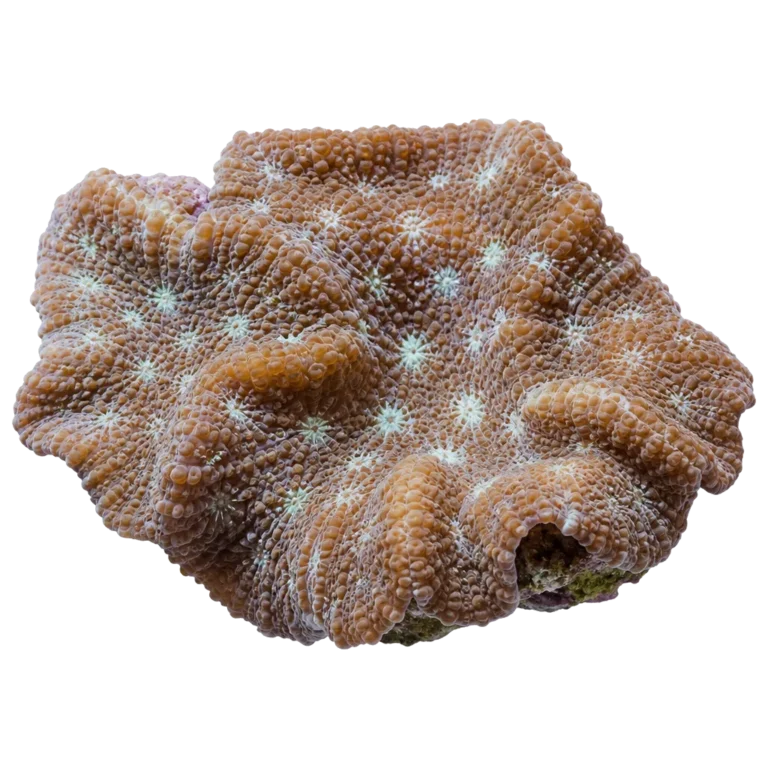
Moseleya Coral
Summary
Moseleya latistellata is a slow-growing LPS coral with a low, disc-like to submassive colony form and a conspicuous central corallite surrounded by smaller ones. Its natural occurrence in turbid, muddy shallow-water habitats helps explain why it is better suited to subdued bottom-zone conditions than to intense reef-crest lighting; that does not mean it should be allowed to collect detritus in the aquarium.
Expect a coral that may look compact by day but extends feeding and defensive tentacles after dark. Confirm the scientific name when buying, as Moseleya can be confused with similarly shaped fleshy LPS corals that may have different space and flow requirements.
General care
Place it low in the aquarium on a secure, level patch of rock or on stable substrate where shifting sand cannot bury or abrade the tissue. Keep the colony from rocking, being undermined by burrowing animals, or sitting where waste settles in its corallite valleys; persistent sediment on the tissue can lead to localized recession.
Handle Moseleya latistellata only by its skeletal base and keep fingers, tools, and adhesive away from living tissue. Buy an intact, healthy colony where possible rather than planning to divide it soon after purchase: its dense, low skeleton and tissue-covered surface make casual breakage a poor handling strategy.
Lighting needs
Begin new specimens in a shaded bottom position, then increase exposure gradually only after the tissue remains expanded and color is stable for an extended settling period. This species is adapted to relatively muted conditions, so moving it directly under a strong fixture is more likely to cause stress than to improve coloration.
Too much light is suggested by persistent daytime contraction, paling or bleaching on the upward-facing ridges, or tissue recession that begins on the most exposed areas. Too little light is more often a slow loss of color intensity and reduced overall tissue fullness; correct either problem by making small placement or shading changes rather than repeatedly moving the colony.
Flow needs
Use gentle, indirect flow that keeps fine debris from settling in the coral's valleys without lifting, folding, or sharply fluttering its tissue. At suitable flow, the tissue stays settled and inflated, the surface remains clean, and food can briefly contact the polyps rather than being immediately swept away.
If flow is too low, detritus and films accumulate between corallites and the tissue may stay dirty despite otherwise good health. If flow is too strong, the coral remains tightly withdrawn, exposed ridges become irritated, or target food cannot settle; redirect the current rather than placing the colony directly in a pump's path.
Feeding and growth
Most of its energy comes from photosynthesis, but occasional target feeding is useful in nutrient-lean systems, after shipping stress, or when feeding tentacles are visible after dark. Offer zooplankton-sized meaty foods or finely chopped marine foods that each mouth can take without leaving large pieces to decay on the tissue.
Growth is usually slow and broad rather than vertical, with new corallites enlarging the colony's footprint around its margins. Reserve open bottom space from the start, because a colony can eventually occupy substantially more horizontal area than its low profile suggests.
Compatibility
Moseleya latistellata is semi-aggressive: after dark it can extend sweeper tentacles that sting nearby corals. Leave at least 15 cm5.9 in of clear space around the colony and inspect it at night after introduction; increase that buffer if sweepers reach toward a neighbour or if another coral shows unexplained overnight tissue damage.
It is generally compatible with reef-safe fish and invertebrates, but coral-nipping fish can damage its exposed tissue and sand-sifting fish, burrowing shrimp, or large roaming invertebrates can bury or dislodge a bottom-placed colony. Do not rely on its compact daytime appearance when planning a mixed LPS garden.
Water parameters
This is moderately demanding rather than unusually delicate, but it is a poor choice for an immature aquarium with recurring salinity or alkalinity swings. Keep chemistry changes gradual, because abrupt instability commonly shows first as reduced inflation, poor nighttime feeding response, or recession along stressed tissue edges.
Avoid driving nutrients so low that the coral remains pale and fails to respond to occasional feeding, while also preventing detritus from accumulating on it. When its condition declines, first check for a recent chemistry change, sediment buildup, excessive light, or a nocturnal sting before assuming it needs more food.