
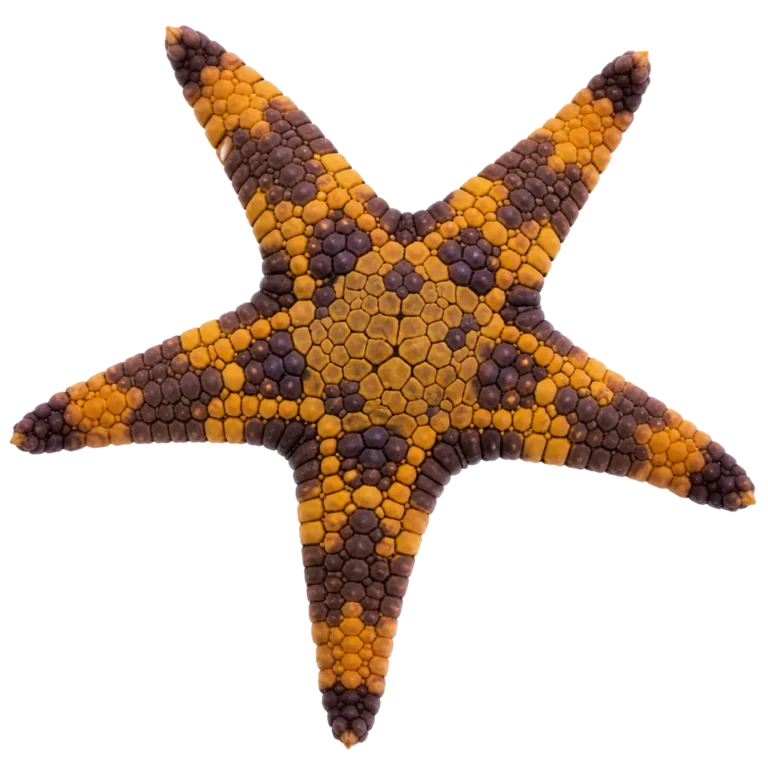
Mosaic Cushion Star
Summary
Halityle regularis is a thick-bodied cushion star with five short arms and a distinctive mosaic-like upper surface. It is a tropical Indo-Pacific sea star associated with reef and reef-rubble habitats, so it spends its time slowly travelling over firm rock, sand, and mixed bottom rather than climbing high-flow structures.
Its appearance should not be mistaken for hardiness. This is a specialized, slow-moving echinoderm whose exact nutritional needs in captivity are poorly documented; purchase it only for a large, established reef with abundant natural benthic life, not as a decorative or general-purpose cleanup animal.
Care
Provide a broad area of unobstructed sand, rubble, and low rockwork that the star can cross without being wedged between corals or unstable stones. Keep rock securely supported independently of the sand, because a heavy-bodied sea star can undermine loose structures as it moves beneath or alongside them.
Use gentle to moderate, diffuse flow over the bottom. Direct, forceful flow can leave the animal unable to settle or feed normally; a star that repeatedly folds its arms upward, is pushed across the substrate, or remains trapped against a rock needs a calmer route across the tank.
Lighting is relevant mainly to the habitat around it, not as a direct requirement. It can be kept under normal reef lighting when shaded areas and open substrate are available. Add it only to a mature aquarium with established biofilm, microfauna, and natural detrital food pathways; a newly set-up, visually clean system is a poor match.
Feeding and role
Do not rely on the Mosaic Cushion Star to live on nuisance algae or leftover fish food. Available natural-history evidence indicates benthic feeding, including small bottom-dwelling organisms, and it should be offered varied meaty marine foods placed beneath or immediately beside it, such as finely chopped clam, mussel, shrimp, or other marine invertebrate flesh. Observe feeding rather than assuming the food was found: the star should settle over the offering and remain engaged with it for an extended period.
Its cleanup role is limited to consuming some available organic material and small benthic prey. One individual will not meaningfully clean a sand bed, control algae, or replace routine maintenance. A steadily thinning body, shrinking profile, poor grip, or long periods of roaming without settling to food should be treated as possible underfeeding.
Compatibility
Keep it away from animals that bite, flip, or pick at echinoderms, especially triggerfish, large wrasses, puffers, some crabs, and predatory shrimp. Repeated nipping can injure tube feet and body tissue even when the star is not immediately eaten.
Treat small clams, sedentary snails, and other vulnerable benthic invertebrates as potential feeding risks rather than guaranteed-safe tankmates. There is no sound basis for using this species as a coral predator-control animal; it is best regarded as coral-compatible only where corals are securely placed and the star is well fed, since its bulk can dislodge frags or irritate tissue while crossing a colony.
Add individuals singly unless the system is exceptionally spacious and has a proven surplus of suitable natural food. Multiple cushion stars compete for the same poorly defined benthic resources, and grouping them does not make feeding easier.
Good to know
Acclimate slowly and keep the animal fully submerged during transfer. Sea stars are highly sensitive to rapid salinity change and to air exposure; handle it in a submerged container rather than lifting it into a net or exposing its underside to air.
Never use copper-based medication in a system containing this sea star. If treatment is necessary for fish, move the fish rather than medicating the display.
Watch for abnormal loss of firmness, a curling or lifting edge, pale or damaged patches, detaching arms, or tissue breaking down around the underside. These are urgent signs of stress or decline, not normal shedding. Remove a dying specimen promptly, as decomposing echinoderm tissue can foul the aquarium quickly.