
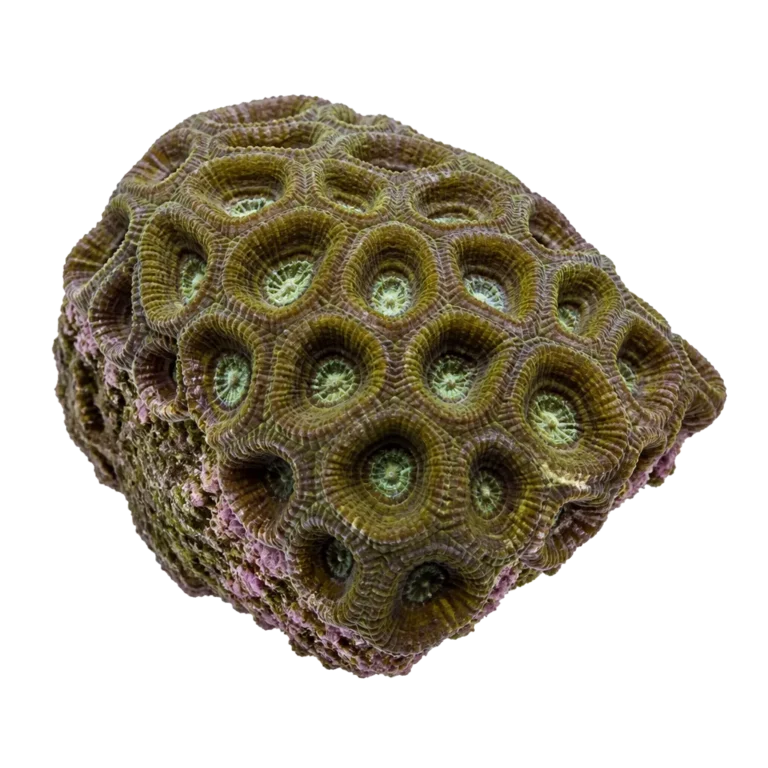
Moon Coral
Summary
Favites flexuosa is a stony LPS coral that forms a hard, often dome-shaped or encrusting colony of large, deep corallites. “Moon coral” is used loosely in the trade, so confirm the scientific name when buying; care can differ among corals sold under similar common names.
Its Indo-Pacific origin and occurrence across varied reef settings help explain its adaptability, but not its tolerance for abrupt changes. Give it room to expand as a solid colony and plan for nighttime aggression rather than treating a small frag as permanently compact.
General care
Place Favites flexuosa on stable rockwork in the lower to middle part of the aquascape, where its base cannot be undermined by burrowing animals or shifted by snails. A fall can crack the skeleton and tear the living tissue along sharp edges, creating a site for recession.
Handle it by the exposed skeleton or its plug, not by the fleshy upper surface. Before purchase, inspect the colony for intact tissue over the corallites, no freshly exposed white skeleton, and no persistent brown jelly or damaged areas around the mouths.
Lighting needs
Begin a new Favites flexuosa in a dimmer area of its intended lower-middle placement, then increase exposure gradually after it has settled. This avoids a sudden change from shipping or store lighting, which can cause paling, persistent contraction, or tissue loss on the upward-facing surface.
Healthy tissue should remain inflated enough to cover the skeletal structure and retain its normal coloration. Pale or bleached upper surfaces and withdrawn tissue suggest excessive light or overly rapid acclimation; progressively darker, browner tissue and a colony that appears to reach upward can indicate that light is insufficient.
Flow needs
Use indirect, moderate flow that keeps the tissue gently moving and clears particles from between corallites without blasting the colony from one direction. Correct flow allows the coral to stay normally expanded while preventing detritus from settling in its valleys.
Too little flow leaves food, sediment, or algae trapped on the colony and can lead to irritated, receding patches. Too much flow causes repeated tissue contraction, exposed skeletal ridges, or a side of the colony that remains tightly withdrawn; redirect the flow rather than simply increasing it.
Feeding and growth
Favites flexuosa obtains much of its energy from light, but target feeding is useful for newly established frags, recovering colonies, and systems with very little available food. Offer fine zooplankton-sized foods or small, soft meaty pieces when feeding tentacles are visible, usually after lights dim; oversized pieces are more likely to be dropped or sit on the tissue.
Expect a medium-paced, outward-growing encrusting to low-domed colony rather than isolated heads that can be easily separated. Its footprint steadily broadens, so leave open rock around the growth edge and do not fill every nearby gap with less aggressive corals.
Compatibility
Favites flexuosa is aggressive at close range and can extend sweeper tentacles, particularly after dark, to sting neighboring corals. Keep a minimum clear radius of 15 cm5.9 in around the colony, and increase that buffer if nighttime sweepers reach farther in your particular flow pattern.
Do not judge compatibility only under daytime lighting: inspect the tank after dark before placing another coral nearby. Sessile invertebrates within reach can be damaged even when the Favites appears calm by day, while coral-picking fish and invertebrates can injure its fleshy tissue and leave localized recession.
Water parameters
This is moderately forgiving compared with many delicate SPS corals, but it responds poorly to rapid chemistry changes while healing, growing, or adapting after shipment. Keep alkalinity especially consistent; sudden swings can show first as reduced inflation, stressed mouths, or recession beginning along a damaged edge.
Avoid letting accumulated detritus and localized irritation become chronic problems. If tissue is receding despite suitable light and flow, check for instability, physical damage, nighttime coral contact, and debris caught between corallites before making large corrective changes.