
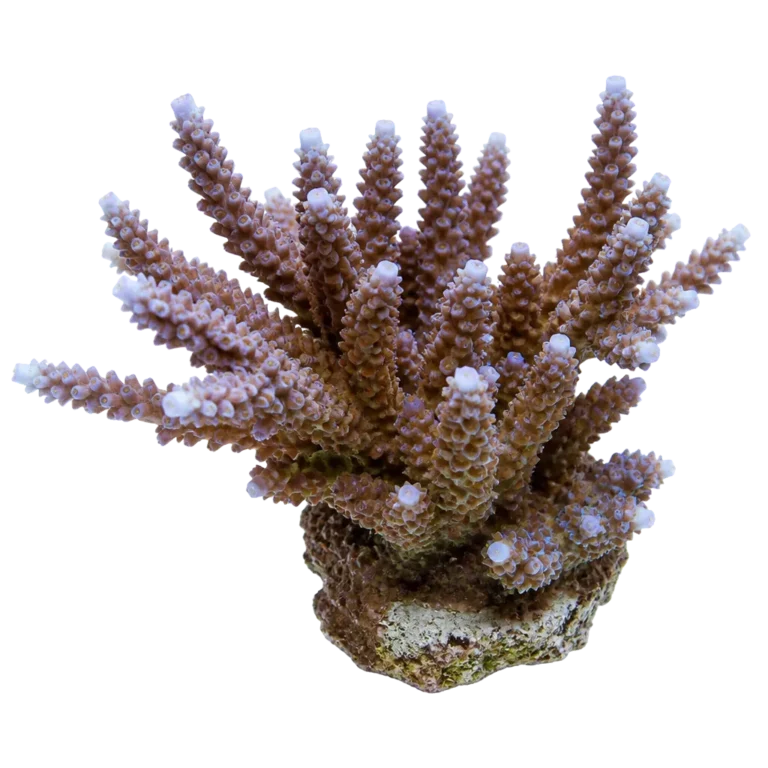
Mirabilis Acropora
Summary
Acropora mirabilis is a small-polyp stony coral that forms corymbose plates or irregular clumps of upright, tapered branches. Its shallow reef-slope origin helps explain its need for intense light and energetic, changing water movement. It is a difficult coral best added to a mature reef whose chemistry and daily maintenance are already consistent.
paragraphs?
General care
Mount Acropora mirabilis securely on upper-middle rockwork where water can circulate around the branch bases as the colony thickens. Choose a position with room above and around it before gluing; repeated relocation can damage its thin tissue and interrupts acclimation.
Handle only by the bare skeleton or mounting plug, keeping fingers and tools away from living tissue and branch tips. The branches can snap easily, but broken pieces can usually be remounted as frags if their tissue remains intact. Inspect new frags closely for Acropora pests before placing them near established colonies.
Lighting needs
Acclimate a new frag below its final light exposure or use temporary shading, then increase exposure gradually over several weeks. A coral moved directly from dim holding light into strong aquarium lighting can bleach before it has adjusted.
With suitable light, tissue remains evenly colored and branch tips show steady extension. Too little light commonly produces slower growth, duller or browner tissue, and loss of color on lower areas; too much light produces paling or bleaching first on upward-facing surfaces, sometimes followed by tissue loss at the tips.
Flow needs
Provide strong, irregular flow that reaches between branches and around the base without a pump jet striking one surface continuously. At the right intensity, polyps and fine tissue move gently in changing directions while detritus does not settle in the colony.
If flow is too weak, debris accumulates between branches or at the base, polyps appear less responsive, and shaded interior tissue may decline. If it is too forceful or too direct, polyps stay pinned to the skeleton and tissue can look abraded or recede on the pump-facing side; redirect or diffuse the flow rather than simply reducing all circulation.
Feeding and growth
Most of this coral’s energy comes from light, so feeding is most useful in a very lean system, during recovery, or when trying to support growth without allowing nutrients to bottom out. Offer fine suspended planktonic foods that small Acropora polyps can capture, and allow current to carry food through the branches rather than blasting food onto the tissue.
Expect rapid branching once the coral is settled. A small frag can develop upright branches and broaden into a clump that shades nearby rockwork, so reserve open space in every direction and plan for later trimming or fragging.
Compatibility
Acropora mirabilis is not a long-sweeper coral, but direct contact is still harmful: it competes through tissue contact, shading, and fast branch growth. Leave at least 10–15 cm3.9–5.9 in of open space from other corals, with more room on the sides and above where new branches will extend.
Keep it away from corals that can reach it with long sweeper tentacles or rapidly overgrow its base. Butterflyfish, some angelfish, and other polyp-picking fish may repeatedly nip Acropora tissue; Acropora-eating flatworms and red bugs can also spread quickly among closely packed colonies, making early inspection and isolation of a declining frag important.
Water parameters
This is less forgiving than a typical mixed-reef coral. Keep its environment consistent rather than chasing rapid corrections: abrupt shifts in alkalinity, salinity, or temperature can trigger tip burn, paling, or tissue recession even when a single test result appears acceptable.
Alkalinity stability is particularly important under strong light and rapid growth. Avoid driving nutrients to undetectable levels; pale tissue, weak polyp extension, and increasing light sensitivity can indicate that the coral lacks nutritional support, while persistent excess nutrients can reduce coloration and encourage algae around the base.