
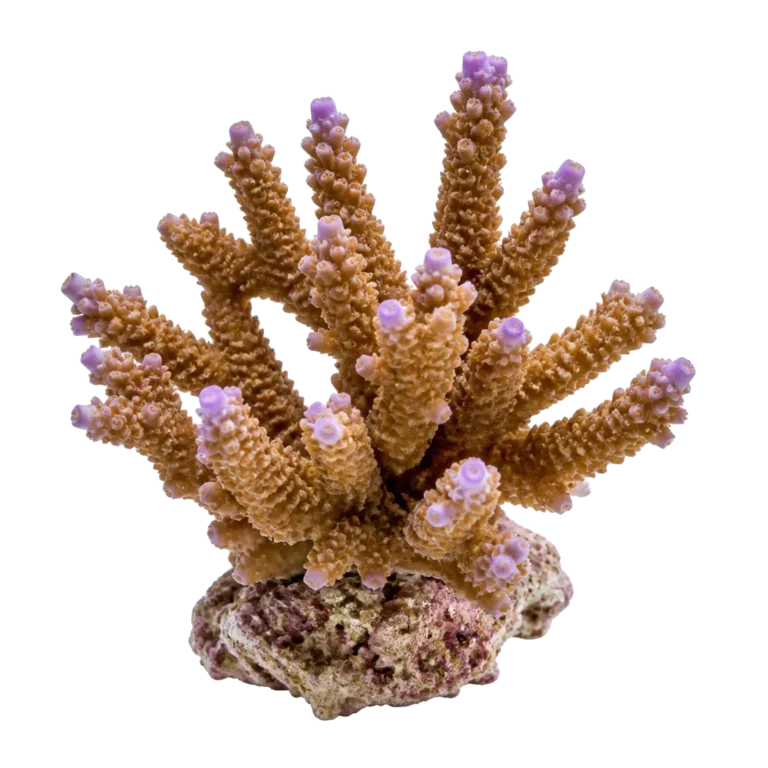
Microclados Acropora
Summary
Acropora microclados is a small-polyp stony coral that develops low, corymbose plates of short, evenly spaced branchlets. Its upper-reef-slope origin explains its need for intense light and continuously changing, oxygen-rich flow. It is best stocked into an established SPS-focused system, where small swings are already under control rather than still being corrected week to week.
The close branching that gives a mature colony its compact form can also trap sediment and shade its own lower surfaces. Plan for a mounting position with open water around the colony and room for it to broaden, rather than placing a small frag tightly between rockwork or other corals.
General care
Mount Acropora microclados securely on upper-middle rockwork before it has time to encrust. A loose frag can be repeatedly knocked over, which abrades tissue, breaks fine branchlets, and leaves vulnerable fresh skeleton exposed to algae or tissue loss.
Handle the plug or bare skeleton at the base, not the living tips or side tissue. Even brief scraping, crushing, or exposure to a direct air stream can damage the thin tissue layer; inspect new frags for chipped tips, exposed white skeleton, or recession around the cut before placing them.
Lighting needs
Begin a newly acquired frag lower or partially shaded from its intended final position, then increase exposure gradually as it settles. This is especially important when the seller used different spectrum, fixture height, or photoperiod; a sudden change can stress an otherwise healthy Acropora.
With insufficient light, growth usually slows and coloration may become darker or browner while the colony remains intact. With excessive or abruptly increased light, tissue can become unusually pale, fluoresce less predictably, or recede first from exposed tips and upper-facing surfaces. Reduce the change in exposure rather than making repeated large corrections.
Flow needs
Provide strong, irregular flow that reaches between the branchlets without aiming a narrow pump stream directly at one side of the frag. At suitable flow, polyps can extend without remaining flattened, and detritus does not settle in the branch bases or on the plate.
Too little flow allows film, detritus, and mucus to collect in the dense structure; lower branches may lose color or show recession where debris remains. Too much direct flow keeps polyps tightly withdrawn, bends tissue persistently in one direction, or produces localized recession on the pump-facing side. Reposition or diffuse the flow rather than simply reducing all circulation.
Feeding and growth
Photosynthesis supplies most of this coral’s energy, so feeding is most useful for a newly healing frag, a rapidly growing colony, or a system run so lean that growth and polyp extension have stalled. Offer fine zooplankton-sized foods or suspended coral foods in small portions, ideally when polyps are visibly receptive; heavy target feeding can foul the tight branch structure.
Growth typically begins as encrusting at the base, then develops into a broad, short-branched plate. Leave at least 10–15 cm3.9–5.9 in of open space in the directions it can spread, and expect the colony to shade corals directly beneath it as the plate widens.
Compatibility
Acropora microclados mainly competes by direct contact, overgrowth, and the localized effects of nearby corals rather than by conspicuous long sweeper tentacles. Keep at least 10 cm3.9 in of clearance from neighboring corals, especially fast-growing SPS and corals with strong nighttime sweepers, then increase that space as the colony plates outward.
Avoid fish known to nip SPS polyps, including many butterflyfish and some angelfish, because repeated picking can leave pale, damaged branch tips. Watch for Acropora-specific pests such as red bugs and Acropora-eating flatworms; reduced daytime polyp extension, patchy color loss, bite-like tissue damage, or unexplained recession on several branches warrants close inspection before the problem spreads.
Water parameters
This is more demanding than a typical mixed-reef coral because it responds poorly to rapid changes in alkalinity, salinity, temperature, and available nutrients. Add it after the aquarium has demonstrated consistent consumption and replacement of major elements; repeated manual corrections can be more harmful than holding a slightly imperfect but steady routine.
Alkalinity instability is a particular risk, often showing first as stalled tip growth, paling, or tissue recession at branch tips and bases. Avoid abrupt nutrient stripping as well: a colony that was colored and growing can pale or lose tissue after a sudden change in filtration, feeding, or dosing.