
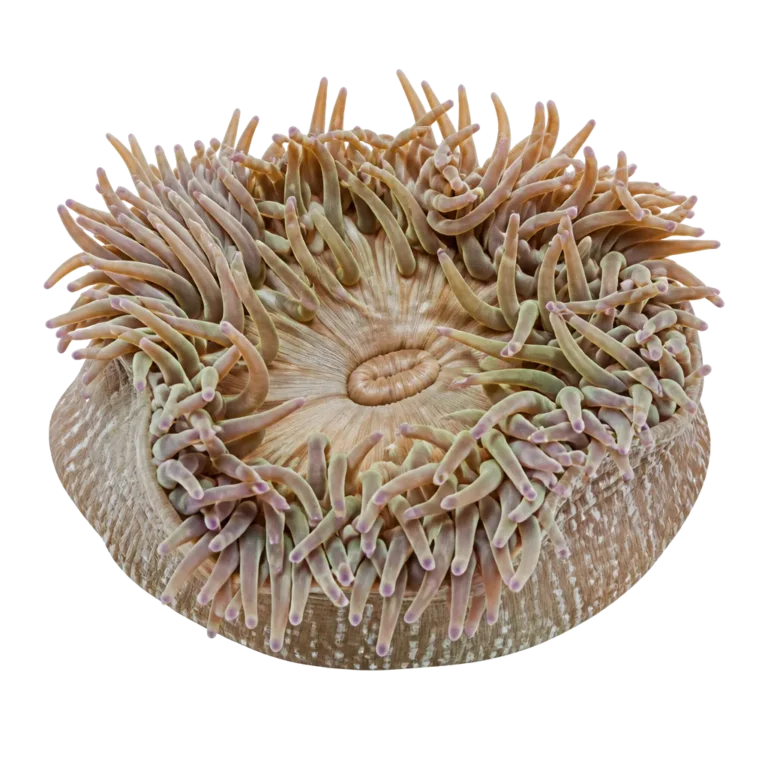
Mertens’ Carpet Anemone
Summary
Stichodactyla mertensii is a broad, adhesive carpet anemone from Indo-Pacific rocky and coral reef habitat. Its short, very sticky tentacles and disc are built to grip uneven hard surfaces rather than sit openly on sand; the same contact response makes it capable of severely stinging neighbours and capturing animals that blunder into it.
Plan for a specimen that claims a large, permanent area once settled. A firmly attached, expanded anemone with a sticky surface is behaving normally; one that repeatedly releases its footing is signalling that its placement or conditions are unsuitable.
Care
Build a secure rock structure with a deep crevice or irregular hard surface where the small pedal disc can lock in place. Stabilize all surrounding rock before introduction, because an attached Mertens' carpet can exert considerable force and must not be crushed by a shifting structure.
Provide intense reef lighting and broad, moderate-to-strong water movement that keeps the disc clear without directing a hard jet at it. Start the animal under reduced intensity and increase exposure gradually; sudden light changes can cause contraction or loss of colour. Keep pump intakes fully guarded, since a moving carpet anemone can be fatally injured if it reaches an impeller.
Add this species only to a mature, consistently managed reef system with established filtration and room to keep its chosen site clear. It is a poor fit for a newly assembled aquarium, or for a reefscape that will need frequent rearranging after the anemone has attached.
Feeding and role
Photosynthesis supplies part of the energy budget, but Stichodactyla mertensii should also receive appropriately sized portions of marine fish, shrimp, krill, or other unseasoned meaty seafood. Offer food gently to the tentacles and use modest portions; repeated regurgitation indicates the pieces or feeding load are excessive.
This is not a cleanup-crew animal. It does not control algae or process detritus in a useful, predictable way; instead, it is an ambush predator that may consume fish or mobile invertebrates that contact its tentacles.
Compatibility
Keep corals well beyond the anemone's potential expanded reach and leave an open buffer around its intended site. Any coral, clam, or sessile invertebrate it contacts can be stung, and moving it after it has attached risks foot damage.
Do not rely on size alone when choosing tankmates. Small fish, sleeping fish, ornamental shrimp, and other mobile invertebrates can be captured if they touch the disc; avoid fish that habitually perch or rest on the rockwork beside it. Butterflyfish and other animals that feed on anemones or cnidarian tissue are unsuitable.
A compatible clownfish may use this species as a host, but hosting does not make every fish safe around the tentacles. In a mixed reef, plan around a single Mertens' carpet anemone rather than adding several carpets whose expanding discs could compete for the same rockwork and sting surrounding livestock.
Good to know
Inspect a prospective specimen before purchase: a securely attached foot, inflated oral disc, responsive tentacles, and a closed mouth are better signs than colour alone. Decline animals with a torn foot, persistently gaping mouth, limp tissue, or repeated collapse, as transport-stressed carpet anemones can deteriorate quickly after introduction.
Acclimate carefully while limiting abrupt light exposure, then avoid handling the foot unless removal is essential. If the anemone begins roaming, protect all pumps immediately and identify the cause rather than repeatedly relocating it; changes in light, flow, or available attachment points commonly prompt movement.
Do not expose Stichodactyla mertensii to copper-based medications. If treatment is required, move fish to a separate treatment system rather than medicating the anemone's display aquarium.