
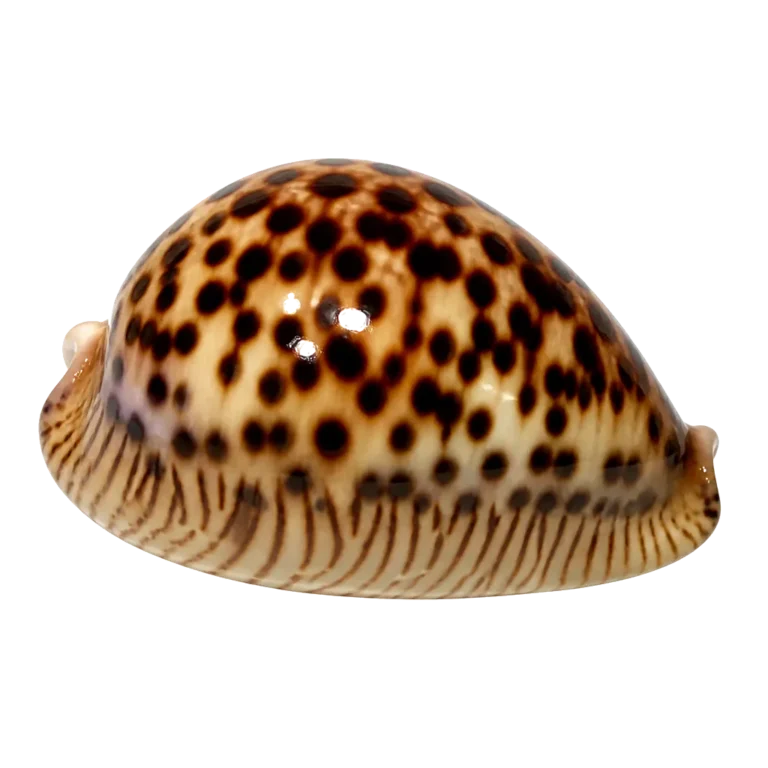
Measled Cowrie
Summary
Macrocypraea zebra is a large Atlantic cowrie from reef, rock and lagoon habitats from the southeastern United States through the Caribbean and Brazil. Its brown, white-spotted shell is often concealed by a grey, papillae-covered mantle; seeing that mantle spread over the shell at night is normal, while a cowrie that remains tightly withdrawn for extended periods warrants checking for harassment or poor acclimation.
Expect mainly nocturnal foraging. This species spends the day beneath stable rockwork or in a deep crevice, then travels over rock, sand and reef surfaces after dark to graze and investigate sessile life. Its broad omnivorous diet, rather than its shell, is the main reason it is a cautious reef inhabitant.
Care
Use a mature marine system with established rock surfaces, natural algal films and crevices. A newly set-up tank rarely provides enough continuous grazing or the varied attached foods this cowrie investigates, and an animal that repeatedly crosses bare glass and clean rock may have little to eat.
Build secure, low-access shelters beneath rock ledges or within rockwork, with open routes across sand and hard surfaces for nighttime movement. Stabilize all rocks directly on the tank bottom or otherwise secure them before introduction: a cowrie can work beneath loose structures and may be trapped if they shift.
Bright reef lighting is not required for the cowrie itself. Give it shaded daytime retreats, and do not interpret daytime inactivity as a need to force-feed; assess it after dark, when it should extend its mantle and move deliberately over the substrate.
Feeding and role
Offer varied marine foods after lights-out, including sheets or pieces of marine algae and small amounts of finely chopped meaty invertebrate-based food. Supplementation matters even in algae-rich tanks because Macrocypraea zebra also consumes small sessile animals; a cowrie that becomes inactive, loses body mass or shows a poorly extended mantle should be treated as a possible feeding problem rather than assumed to be living on algae alone.
It can graze films and filamentous algae, but it is not a dependable solution for an algae outbreak. It may also consume sponges, hydroids, tube worms, small snails and invertebrate egg masses, so its foraging can remove wanted livestock as readily as unwanted growth.
Compatibility
Keep Macrocypraea zebra away from animals that can crush, pick at or overturn a substantial snail, including triggerfish, puffers, large wrasses and predatory crabs. Repeated shell-pecking or a cowrie that never emerges after dark indicates that it is being harassed.
Treat ornamental sponges, hydroids, tube worms, small gastropods and visible invertebrate egg masses as potential food, not tankmates. It is generally less concerning for stony and soft corals themselves, but a coral display containing valued encrusting invertebrates or delicate sessile fauna is a poor match.
Add a single specimen rather than treating it as a social cleanup-crew snail. There is no clear husbandry benefit to adding a group, and one established cowrie lets you judge its appetite and any damage to sessile invertebrates before considering another.
Good to know
Acclimate slowly and never expose this mollusk to copper-based medications. Sudden salinity change can leave it withdrawn and unresponsive, while copper can seriously injure or kill it; move it only through a properly matched, medication-free system.
Do not mistake an empty-looking shell for a dead animal without checking carefully. A stressed cowrie may stay sealed inside for a time, whereas a healthy individual commonly extends its mantle over the shell after dark. A persistently retracted mantle, failure to attach or lack of nighttime movement calls for an immediate check of acclimation, predation and food availability.
Avoid handling the mantle and do not buy an animal with badly damaged soft tissue. The mantle helps maintain the shell surface, so lasting damage or poor mantle extension can lead to a dull, eroding-looking shell and reduced ability to cope with normal reef conditions.