
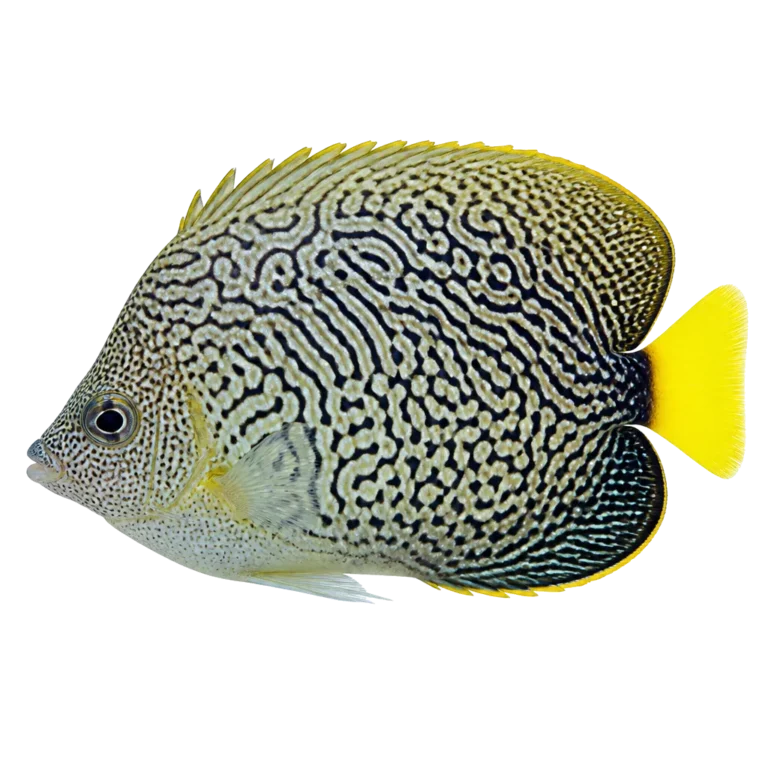
Maze Angelfish
Summary
Chaetodontoplus cephalareticulatus is a deliberate rock-picker rather than a nonstop open-water swimmer. Expect it to make regular circuits through rockwork, pausing to inspect surfaces and crevices; a fish that remains hidden, breathes heavily, or ignores food after settling is not showing normal confidence. Its exploratory feeding behaviour also explains the reef-with-caution rating: the same persistent picking can extend to coral tissue, tube worms, ornamental sponges, and clam mantles.
Care
Build the aquascape around broad swimming lanes broken by substantial live-rock structures, caves, and shaded retreats. The fish needs room to turn and cruise, but also needs several places where it can disappear from view when first introduced; a bare or overly open layout often leaves it pacing along the glass or retreating continuously. Established rock with natural grazing surfaces is more useful than decorative rock alone, especially while a new arrival learns to feed in the aquarium.
Introduce it only to a mature, consistently managed marine system with strong oxygenation and low chronic nutrient stress. This angelfish can become increasingly possessive of its preferred rockwork, so arrange major rock structures before it is added rather than repeatedly rebuilding its territory afterward.
Feeding
Offer a varied menu several times through the day: sponge-based angelfish preparations should be a regular component, supported by marine algae, mysis, enriched brine shrimp, and finely chopped marine seafood. Do not rely on brine shrimp or one convenient prepared food as the whole diet; a fish that accepts only a narrow, low-value food may remain active yet lose body depth over time.
Feed at more than one area of the aquarium when fast tangs, wrasses, or assertive feeders are present. Watch the Maze Angelfish itself rather than assuming it is eating because food disappears: it should repeatedly take bites and maintain a rounded profile behind the head, not hang back until the rush is over.
Compatibility
Keep one Maze Angelfish as the default plan. It may treat other angelfish and similarly shaped, laterally compressed fish as direct rivals, particularly after it has claimed the rockwork. Avoid crowding it with another Chaetodontoplus or a similarly sized angel unless the system is substantially larger, both fish can be introduced together, and separation is realistically possible if chasing becomes persistent.
Favour confident but non-belligerent tankmates that will not monopolize food or constantly challenge its swimming routes. Add the Maze Angelfish after peaceful community fish have settled, but before adding highly territorial angels or similarly shaped grazers. Reef stocking remains a calculated risk rather than a guarantee: individual fish may nip corals and clam mantles, with fleshy corals, tube worms, ornamental sponges, and clams requiring particular caution.
Good to know
Coral nipping can begin after a long period of apparent good behaviour, especially as the fish grows more established and learns which sessile invertebrates are rewarding to pick. Treat repeated attention to one coral or clam as an early warning: inspect for shortened polyp extension, damaged mantle edges, or tissue loss, and be prepared to remove either the fish or the target animal rather than expecting the behaviour to resolve on its own.
Colour pattern is not a dependable way to assemble a sexed pair, because young fish change markedly as they mature and angelfish have flexible sexual biology. Handle transfers carefully as well: the cheek spines can catch in a net, causing injury and prolonged stress. Use a rigid container or specimen box for capture whenever practical.