
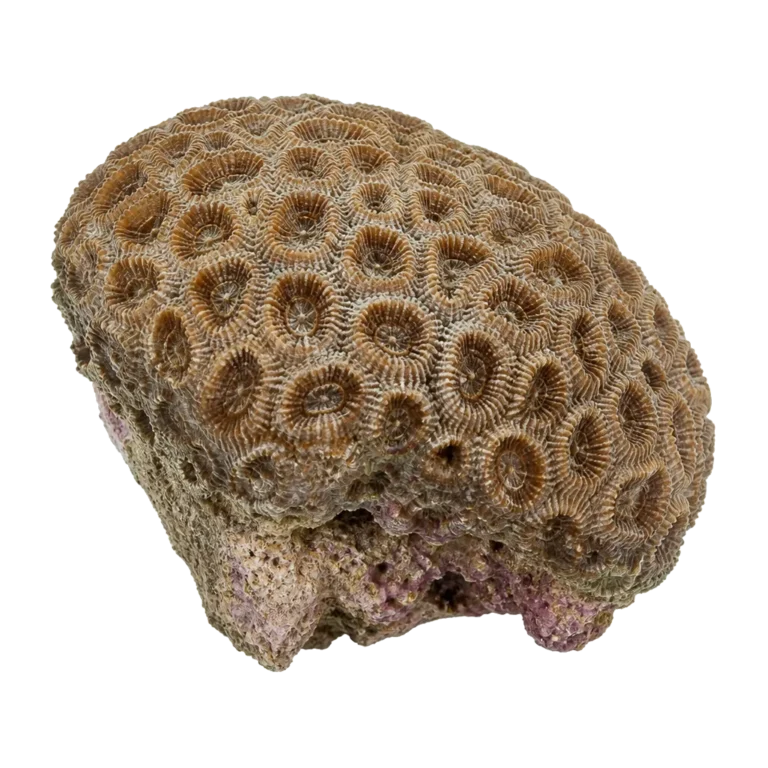
Madracis Coral
Summary
Madracis sp. is a genus-level identification rather than a single species, so colony shape can vary from compact, finger-like branches to more open branching forms. Treat the frag’s actual branch thickness and spacing as the useful guide for placement: its many closely packed branches need clean, moving water through the colony rather than a sheltered corner where detritus can settle.
This is a photosynthetic stony coral with a thin layer of living tissue over a hard skeleton. It is best suited to an established reef where conditions do not swing abruptly; a specimen that is repeatedly moved or exposed to changing light and flow may lose tissue from branch tips or bases before it has time to adapt.
General care
Mount Madracis sp. securely in the middle of the rockwork, where it can receive broad, indirect circulation from more than one direction. Avoid wedging it between rocks or placing it beneath an overhang, because debris trapped among the branches can irritate tissue and make early recession hard to see.
Handle only the bare skeleton or mounting plug. The branches can snap during transport or aquascaping, and rubbing or pinching the thin tissue can leave a damaged patch that later develops exposed skeleton. Inspect the base and branch junctions before purchase; these shaded areas are where tissue loss can be easiest to miss.
Lighting needs
Begin a new Madracis sp. in the dimmer end of its listed lighting allowance, then raise exposure gradually over several weeks by moving the coral or reducing shade in small steps. This is especially important when the source system used different lighting, since a rapid increase can pale the tissue or trigger tip recession.
With appropriate light, the coral should hold colour and show gradual extension at growing tips. Persistently darkening tissue, little visible tip growth, or a colony that remains unusually shaded may indicate insufficient light. Fading, starkly pale areas, or recession on the most exposed surfaces indicates that light is excessive or was increased too quickly; reduce intensity before moving the coral repeatedly.
Flow needs
Provide medium-to-high, turbulent flow that reaches between branches without delivering a constant hard jet to one side. At the right flow, the colony stays free of settled debris and its small polyps can remain visible rather than being held tightly shut or whipped in one direction.
Too little flow commonly shows as detritus collecting in branch forks, film algae accumulating in recessed areas, or tissue decline beginning in sheltered interior sections. Too much direct flow shows as persistently retracted polyps, tissue pulled back on the blast-facing side, or a branch that flexes noticeably under the stream. Redirect the source or widen the flow rather than simply reducing all circulation.
Feeding and growth
Light supplies most of this coral’s energy, but occasional feeding can help support recovery, growth, and colour in a lightly stocked system or when nutrients are very lean. Offer suspended zooplankton-sized foods or fine meaty particles after lights dim, using enough flow to carry food through the branches without coating the colony. Large chunks are poorly matched to its small polyps and are more likely to foul the coral than feed it.
Many Madracis forms build branching colonies, although the exact architecture varies within the genus. Leave open water around the future outline rather than spacing only for the original frag: new branch tips can extend outward and shade or touch nearby corals long before the base looks crowded.
Compatibility
Madracis sp. is generally peaceful but can still damage another coral through direct contact and local competition. It does not rely on long sweeper tentacles, so contact risk is mainly where its growing tips or side branches reach a neighbour. Start with at least 5 cm2 in of open space and increase that allowance for a fast-opening or widely branched specimen.
Keep it away from corals that expand inflated tissue into its branches, as well as aggressive encrusters that can overgrow its base. Fish and invertebrates that repeatedly perch on, pick at, or move debris through the colony can abrade the tissue; investigate recurring closed polyps or one-sided recession rather than assuming it is a lighting problem.
Water parameters
This is moderately demanding compared with forgiving soft corals because it must continually maintain a stony skeleton beneath thin tissue. Consistent chemistry is more important than chasing rapid growth: abrupt alkalinity changes are a particular risk and may appear first as stalled tips, paling, or tissue recession.
Avoid both nutrient starvation and sudden nutrient corrections. A Madracis sp. that loses colour while remaining otherwise intact may be reacting to overly lean conditions, while a sharp rise in nutrients or accumulated detritus can encourage algae and irritation in the branch structure. Make corrections gradually and assess the colony over several days rather than changing light, flow, and chemistry at once.