
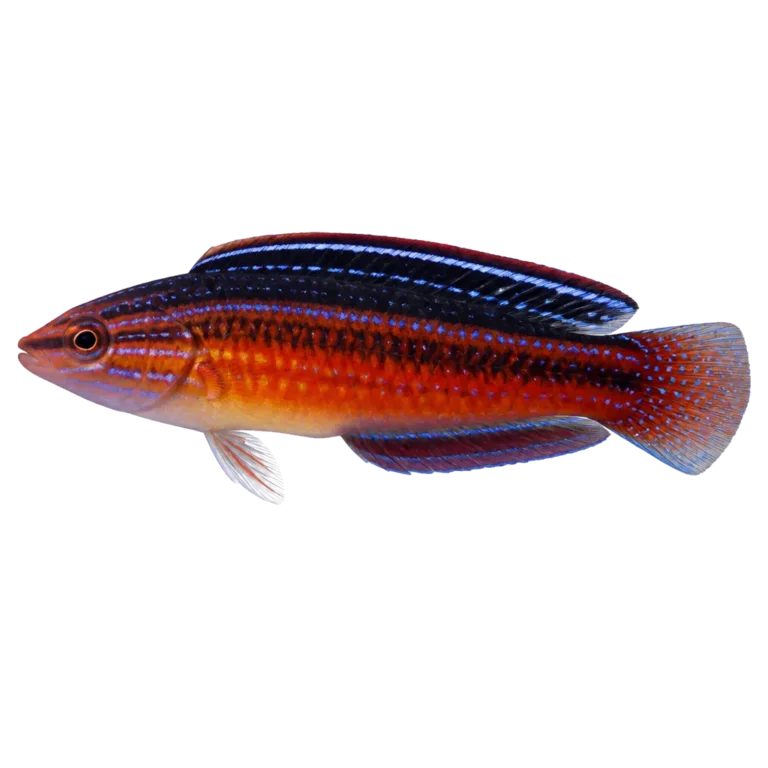
Madagascar Flasher Wrasse
Summary
Paracheilinus hemitaeniatus is a small-water-column planktivore that makes short, quick dashes above and alongside the rockwork rather than cruising the whole tank continuously. A settled fish should spend much of the day visible near cover, picking suspended food from the water and returning to a familiar refuge when startled.
Adult males may intensify their colour and raise their fins in brief flashing displays, particularly around a female or a perceived rival. This is normal display behaviour; persistent chasing, torn fins, or a fish that remains pinned in hiding is not.
Care
Build the aquascape with open lanes immediately beside rockwork, not a solid wall of rock from front to back. Paracheilinus hemitaeniatus uses nearby structure as a safety reference while it feeds in the water column, so it should be able to dart into crevices without losing room to swim and display.
Provide sheltered rockwork away from the strongest direct pump outlets. Brisk, oxygen-rich circulation suits an active reef fish, but a constant concentrated jet can leave it struggling to hold position and unable to take food. A comfortable fish repeatedly works the same open area near cover instead of hugging a corner or remaining hidden.
Feeding
Offer small, varied meaty foods several times daily: enriched mysis and brine shrimp, copepods, and finely chopped marine foods are appropriate staples. Deliver food into the water column in more than one small release so this fast-moving planktivore can take repeated bites rather than trying to swallow oversized pieces.
Do not let brine shrimp become the entire diet; use it as part of a varied, enriched rotation. Watch actual intake when housed with fast, assertive feeders: a wrasse that appears active but becomes progressively thinner behind the head or abdomen is usually losing feeding competition, not simply being shy.
Compatibility
A single male is the lowest-risk choice. A group can work as one male with multiple females when introduced together into a suitably spacious, structured aquarium, but do not assume two males will coexist peacefully. Males may treat other flasher wrasses, especially similar-looking Paracheilinus, as display rivals and repeatedly drive them from feeding areas.
Choose calm community fish that leave open water and food opportunities available, including peaceful gobies, blennies, and other non-predatory reef fish. Avoid predators, highly territorial fish, and boisterous feeders that rush every food release; add this wrasse before such fish establish control of the rockwork if possible.
It is suitable around corals, but its plankton-feeding nature means it will readily eat small live crustaceans such as copepods. Do not rely on a visible pod population to persist where this fish is fed heavily.
Good to know
Use a fully secured lid or tightly fitted mesh cover before introduction. Paracheilinus hemitaeniatus can launch upward when startled, during early acclimation, or when chased; check around plumbing, cords, and overflow openings rather than assuming a partially covered top is sufficient.
New or subordinate fish may look dull and spend more time near shelter until they learn the tank. Give it time to establish feeding confidence, but intervene if it is repeatedly chased away, misses meals, or remains hidden through normal daylight hours. Brief flashing is encouraging; continuous frantic swimming, collision with the cover, or prolonged hiding points to stress or social pressure.