
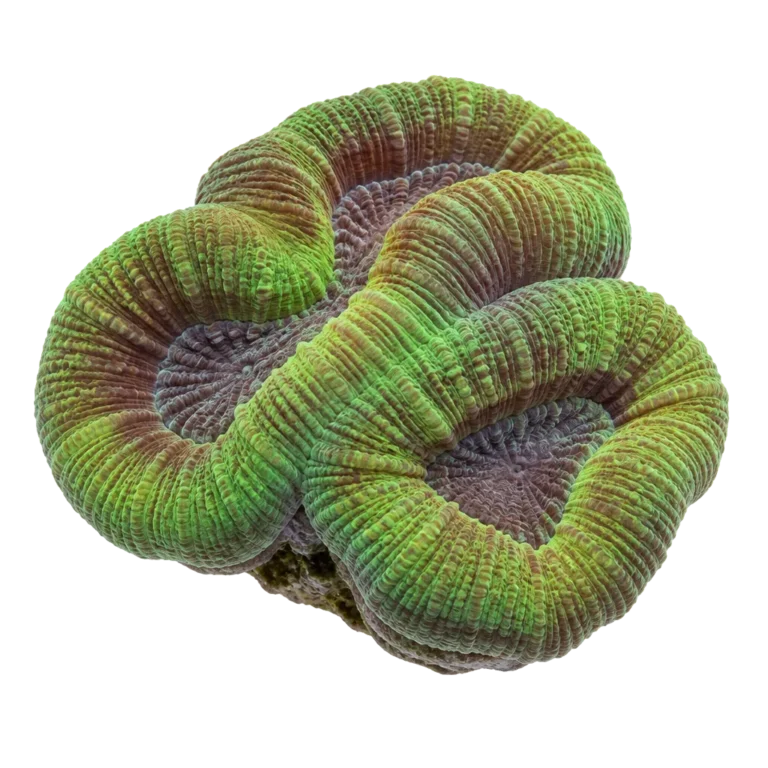
Lobed Cactus Coral
Summary
Lobophyllia robusta is a large-polyp stony coral with thick, fleshy lobes draped over a hard skeleton. Its Indo-Pacific reef origin helps explain its preference for a protected bottom position, moderate light, and indirect water movement rather than exposed, high-energy conditions.
Buy a specimen with consistently inflated tissue, clear colour, and no bare white skeleton showing through the valleys or around the edges. A newly imported coral may stay partly withdrawn at first, but persistent deflation, a gaping mouth, or tissue pulling away from the skeleton warrants correction of light, flow, or water stability before it progresses to recession.
General care
Place Lobophyllia robusta low in the aquarium, ideally on a stable sandbed or a smooth, secure rock ledge where its fleshy edge cannot rub against sharp rock. Keep it from being buried or repeatedly blasted with sand; abrasion and trapped debris can quickly damage the tissue where it meets the skeleton.
Handle only by the underside or exposed skeleton, never by the inflated flesh. Support the colony during moves, because a heavy specimen dropped onto rock can split tissue or crack its skeleton; after placement, check that snails, shifting rockwork, or digging animals cannot overturn it.
Lighting needs
Begin a new Lobophyllia robusta in a slightly shaded bottom position and increase exposure gradually after it has resumed normal daytime inflation. This is especially important for a coral moved from a dim sales system or shipped with deflated tissue.
Adequate light usually produces a full, evenly inflated appearance and stable colour. Tissue that stays dark, thin, or poorly expanded may indicate insufficient usable light, while rapid paling, bleaching, persistent contraction, or newly visible skeletal ridges after an increase in exposure suggests excessive light; reduce intensity or return it to a shadier position.
Flow needs
Use gentle to moderate, indirect and variable flow that keeps fine debris from settling without folding the tissue over itself. At the right flow, the lobes remain inflated and can gently move while the valleys stay free of detritus.
Too little flow leaves sediment, mucus, or food trapped in the folds and can lead to irritated, withdrawn tissue. Too much direct flow causes a repeatedly pinched or flattened appearance, tissue recession along exposed ridges, or a coral that never fully inflates; redirect the outlet rather than simply increasing or decreasing total circulation.
Feeding and growth
Light provides most of this coral’s energy, but target feeding is useful for a newly shipped specimen, a coral rebuilding tissue, or a colony maintained in a very nutrient-lean system. Offer small zooplankton-sized foods or finely chopped meaty marine foods when feeding tentacles are visible, and avoid large pieces that the coral cannot hold or digest cleanly.
Lobophyllia robusta typically develops into a broad, heavy colony of expanding fleshy lobes rather than a compact plug-sized coral. Growth is slow, but the living tissue and nighttime feeding response can extend well beyond the visible skeleton, so reserve open bottom space from the start.
Compatibility
Treat Lobophyllia robusta as semi-aggressive. It can deploy extended feeding or sweeper tentacles and may also use digestive filaments against nearby corals, so leave at least 15 cm5.9 in of open space around it and reassess after dark, when its reach is easiest to underestimate.
Keep it away from corals that can touch it as they grow, including fast-spreading encrusters and long-tentacled LPS. Butterflyfish and angelfish may nip the fleshy tissue, while burrowing fish, large hermits, and other animals that drop sand onto the colony can cause repeated irritation even if they do not eat it.
Water parameters
This is moderately demanding mainly because its exposed fleshy tissue responds poorly to abrupt changes. It generally does well in a mature reef system, but sudden shifts in salinity or alkalinity can trigger deflation, mouth gaping, and tissue recession before other, tougher corals show an obvious problem.
Prioritize consistency over chasing small day-to-day corrections, especially after water changes or dosing adjustments. Keep nutrients available rather than stripping the water excessively clean; a coral that gradually loses fullness or colour despite suitable placement may be responding to instability or an overly nutrient-starved system.