
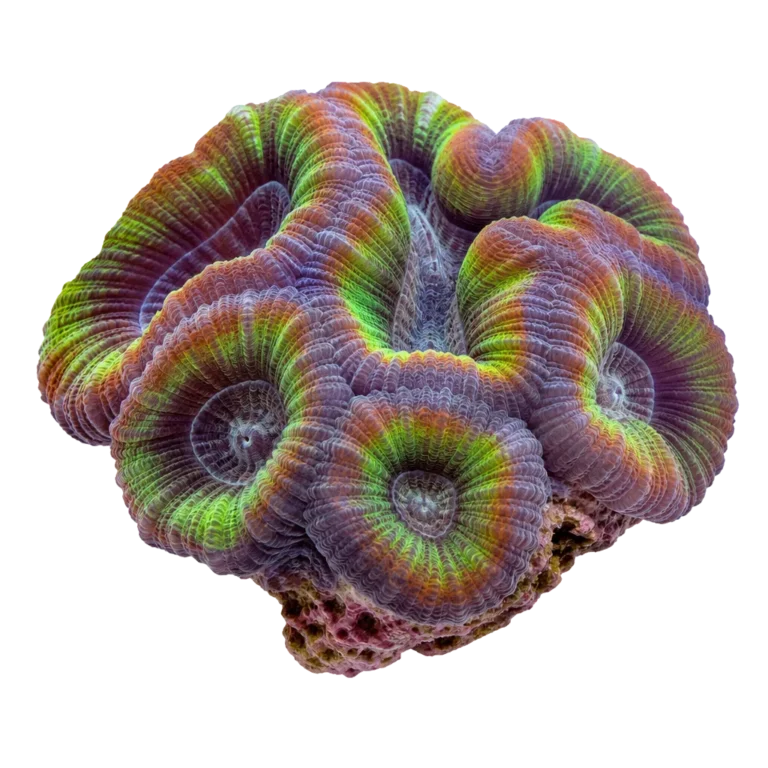
Lobed Brain Coral
Summary
Lobophyllia hemprichii is a large-polyp stony coral with thick, fleshy lobes and deep valleys over a hard skeleton. Its tissue can inflate well beyond the daytime skeleton outline, so it needs open space rather than being wedged among rockwork or tightly packed corals.
This species occurs on reef slopes, where it experiences clear water and indirect water movement rather than a constant hard blast. In an aquarium, its fleshy structure makes it more vulnerable to abrasion and direct pump flow than a similarly sized hardier-looking branching coral.
General care
Place Lobophyllia hemprichii on a stable sand bed or a smooth, secure lower-rock ledge where its underside cannot rub against sharp rock. Do not bury living tissue in sand; trapped grit can cause a localized recession that spreads if it is not corrected.
Handle it only by exposed skeleton or a firm base, never by the inflated flesh. Inspect the lower edge before purchase: torn tissue, exposed white skeleton, or tissue already peeling from a sharp ridge can turn a shipping injury into a persistent infection problem.
Give a new specimen time to settle before repeatedly moving it. A recently moved lobo may stay partially deflated, but a coral that remains shrunken or begins exposing skeleton after several days needs its light, flow, physical contact, and water chemistry checked.
Lighting needs
Start a new Lobophyllia hemprichii in the lower end of the available light and increase exposure gradually only after it remains expanded and retains or improves its color. This is especially important for corals moved from dealer systems with different spectrum or intensity.
Too much light commonly shows as persistent daytime contraction, paling or bleaching on the most exposed ridges, and tissue pulling tight enough to reveal skeletal texture. Move it to gentler light rather than making a sudden large change in several conditions at once.
Too little light is more likely to show as progressively dull color and weak daytime inflation despite suitable flow and regular feeding. If those signs persist, raise light exposure in small steps while watching for renewed expansion rather than chasing a faster color change.
Flow needs
Provide indirect, variable flow that gently moves the outer tissue and keeps debris from settling in the valleys without folding the flesh over the skeleton. Correct flow allows the coral to stay full and open while food and detritus do not collect in its grooves.
Too much flow causes repeated retraction, a tightly drawn appearance, tissue flapping, or damage where flesh is forced against sharp skeletal ridges. Redirect the pump rather than placing the coral directly in the output path.
Too little flow lets mucus, sediment, and uneaten food remain in the valleys; the coral may look dirty or develop localized irritation. Use a gentle, indirect increase in circulation or briefly baste settled debris away without blasting the tissue.
Feeding and growth
Although it receives much of its energy from light, target feeding is most useful for a newly stressed, recovering, nutrient-limited, or actively growing Lobophyllia hemprichii. Feed when feeder tentacles are visible or when a small amount of food reliably triggers a response, then keep food off damaged tissue.
Offer small, soft marine foods that an individual mouth can fully close over, such as finely chopped meaty foods or appropriately sized frozen plankton. Oversized pieces can sit on the flesh, be rejected, or foul the surrounding valley instead of improving condition.
This coral usually grows as a broad, heavy mound, adding tissue and skeletal mass outward as well as becoming fuller. Plan for both its expanded daytime footprint and its gradual lateral growth so it will not eventually touch rockwork or neighbouring corals.
Compatibility
Lobophyllia hemprichii can use nighttime sweeper tentacles and digestive filaments to sting nearby corals. Leave at least 15 cm5.9 in of clear space around it, and increase that buffer if tentacles reach farther after lights-out or if nearby corals are especially susceptible to contact.
Do not judge compatibility only by its calm daytime appearance. Check after dark for extended sweepers, and move either coral at the first sign of contact damage, including pale spots, recession, or a sharply defined dead patch on the neighbour.
Butterflyfish, many angelfish, and persistent coral-picking fish can repeatedly nip the fleshy lobes and prevent expansion. Shrimp and crabs may steal target food or irritate a feeding coral; protect meals if this leads to repeated retraction, but avoid enclosing the coral in a way that restricts flow.
Water parameters
This is generally more forgiving than many small-polyp stony corals, but it still reacts poorly to abrupt alkalinity, salinity, or temperature changes. Keep its environment consistent because fleshy LPS corals often show stress first as prolonged deflation and then as tissue recession along the skeleton.
Pay particular attention to alkalinity stability and to avoiding ultra-low nutrient conditions. Rapid chemistry corrections or stripped nutrients can leave the coral pale, poorly inflated, and less able to maintain tissue over sharp skeletal ridges.
Respond early to sustained deflation, new exposed skeleton, brown or cloudy mucus, or a receding tissue edge. These signs are not normal growth behavior and warrant checking for direct flow, light shock, sediment, coral stings, and recent water-chemistry changes before the damaged area expands.