
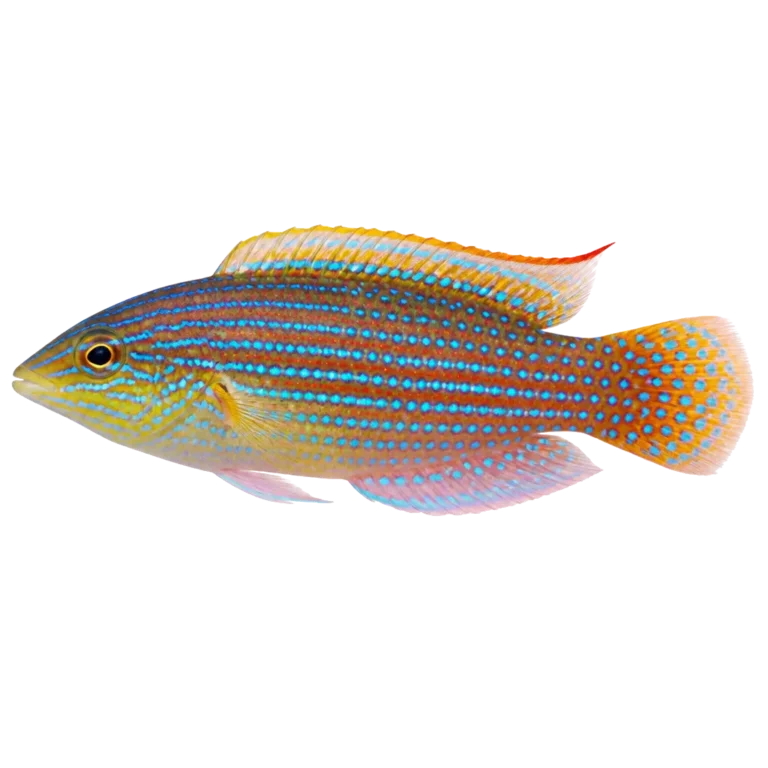
Linespot Flasher Wrasse
Summary
Paracheilinus lineopunctatus is an active water-column hunter that spends much of the day making short, quick passes above and around rockwork for suspended prey. A settled male may suddenly intensify in colour, erect its fins, and dart in looping displays; this is normal courtship or rivalry behaviour rather than an automatic sign of trouble.
Its natural tendency to hover near rubble and reef structure explains its aquarium needs: it is bolder when it has open water immediately beside secure rockwork, and more likely to remain hidden when forced to cross a bare, exposed layout.
Care
Build open swimming lanes through the upper and middle aquascape, but place branched rockwork, ledges, and narrow crevices along their edges. The fish should be able to retreat from the water column without disappearing into an inaccessible rock pile; repeated pacing at the glass or continuous hiding usually means it lacks security or is being pressured by tankmates.
Use varied, moving flow that keeps fine foods suspended through the display instead of directing a hard jet at its preferred refuge. Paracheilinus lineopunctatus is adapted to picking drifting prey and will usually spend more time out in the current when food can pass through its swimming area.
An established aquarium gives this frequent feeder a useful margin through naturally occurring microfauna. A newly set up system can work only if prepared foods are accepted immediately and offered reliably; a fish that emerges but ignores food should be treated as an urgent feeding problem rather than given time to ‘settle in’ indefinitely.
Feeding
Offer several small daytime meals of suitably small marine foods, rotating copepods, finely sized mysis, enriched brine shrimp, other chopped crustacean foods, and a quality small marine pellet once it recognizes dry food. Broadcast food into the flow so particles remain available in the water column, rather than placing a large portion on the substrate.
Feed this wrasse before or alongside faster planktivores, and watch the fish itself rather than assuming a feeding response means it is eating. A Linespot Flasher Wrasse that repeatedly rushes toward food but turns away empty-mouthed is being outcompeted or offered particles that are too large. Do not rely on live pods alone to support it in a mixed reef, because its continuous hunting style can deplete accessible prey.
Compatibility
A single male is the most predictable arrangement. A group can work when a male and several females are introduced together into an aquascape with visual breaks and ample shared swimming room, but adding another male or a similar-looking flasher wrasse to an established male often provokes persistent displaying and chasing.
Choose calm community fish that leave space at feeding time. Avoid large predators, highly territorial dottybacks or damsels, and assertive wrasses that patrol the same rockwork; the main failure is often not injury but a flasher wrasse that stays concealed and loses every feeding opportunity. Add Paracheilinus lineopunctatus before more boisterous fish whenever possible, so it learns the layout and begins feeding confidently first.
It is reef-compatible with corals, but it is not neutral toward all small reef life. Expect it to hunt copepods and other tiny crustaceans, so avoid treating a pod-dependent display or refugium as an unlimited food source.
Good to know
Use a genuinely escape-proof lid before introduction and close gaps around cables, plumbing, and lid corners. Flasher wrasses can launch themselves when startled by a sudden light change, a chase, or a disturbance outside the tank; an otherwise healthy fish found missing after a scare is far more likely to have jumped than to be hiding.
Male flashing is often brief and theatrical, especially around females or perceived rivals. Intervene when it becomes one-sided pursuit that prevents another fish from feeding or leaving shelter, rather than reacting to occasional fin-flaring alone.
Females can change sex as social hierarchy develops. A peaceful group can therefore become unstable if more than one individual develops male traits, so do not stock a group on the assumption that its original sex mix will remain fixed.
After lights dim, this species may wedge into a rock crevice and remain out of sight. Leave its chosen sleeping refuge undisturbed; repeatedly moving rockwork or probing for the fish can trigger panic and increase jumping risk.