
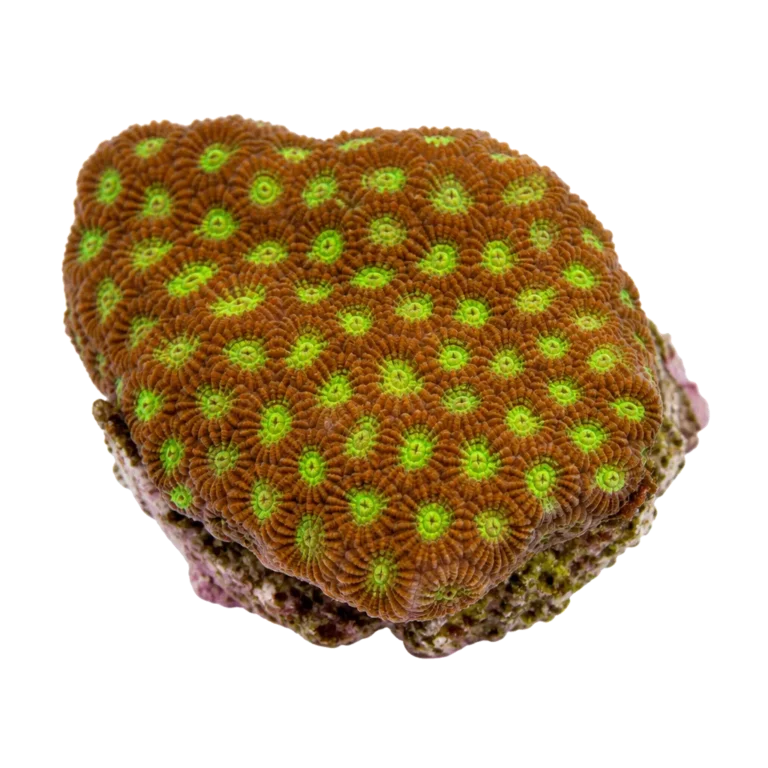
Lesser Knob Coral
Summary
Cyphastrea serailia forms a tightly textured crust or low mound of small, separate corallites. It occurs across a wide Indo-Pacific range in habitats from sheltered reef areas to reef slopes, which fits its adaptable, lower-to-middle placement in aquaria; its main long-term behavior is spreading sideways across hard surfaces rather than growing into tall branches.
General care
Mount Lesser Knob Coral securely on rockwork in the lower to middle part of the tank, with open rock around its growing edge rather than a crowded frag rack. Keep it off loose sand, where settling sediment can smother the thin advancing margin. Handle the plug, bare skeleton, or underside of a frag rather than rubbing the living surface; chipped edges are usually manageable, but crushed tissue can leave a recession point for algae to colonize.
Lighting needs
Start a new frag in a shaded lower position and move it into brighter exposure only after it has remained fully colored and begun attaching or extending at the edge. Healthy lighting usually produces retained color and a steadily expanding encrusting margin. Sudden excess light can cause paling, a washed-out center, persistently withdrawn polyps, or tissue loss on the most exposed surface; move it down or reduce the exposure gradually. In inadequate light, coloration often turns darker or browner and growth slows markedly even when the tissue remains intact.
Flow needs
Provide indirect, variable flow that keeps the surface clear without pinning the polyps flat. At the right flow, polyps can extend without being whipped continuously and fine debris does not remain in the corallite cups. Too little flow shows up as trapped detritus, algae collecting between corallites, and recession beginning in shaded pockets; too much causes persistent retraction, tissue pulling back around exposed edges, or a bare patch facing the pump.
Feeding and growth
Photosynthesis supplies most of this coral’s needs, but feeding can help a newly cut frag, a recovering colony, or a coral kept in a very nutrient-lean system. Offer suspended fine particulate coral foods or small zooplankton-sized foods after the polyps are visible, rather than large meaty pieces that sit on the surface. Growth is usually a fast encrusting sheet that can become bumpy or low-mounding, so give its perimeter room rather than judging space only by the size of the original frag.
Compatibility
Lesser Knob Coral competes in two ways: it may extend short sweeper tentacles after dark, and its encrusting edge can gradually cover slower-growing neighbors. Leave at least 8 cm3.1 in of open rock or clear space around it, increasing that gap where it faces delicate encrusting corals. Keep it away from coral-picking fish, large angelfish, and crabs that may repeatedly damage the thin surface tissue; repeated nipping is more likely to create small bare areas than a single obvious wound.
Water parameters
This is generally more forgiving than many delicate branching SPS corals, but it still performs best when chemistry changes are gradual rather than corrected in large jumps. It is especially prone to stalled edge growth or patchy recession after rapid alkalinity or salinity shifts, so make adjustments slowly and watch the living margin for several days afterward. Avoid prolonged nutrient starvation as well: a colony that remains intact but grows poorly and loses depth of color may need more available nutrition rather than more light.