
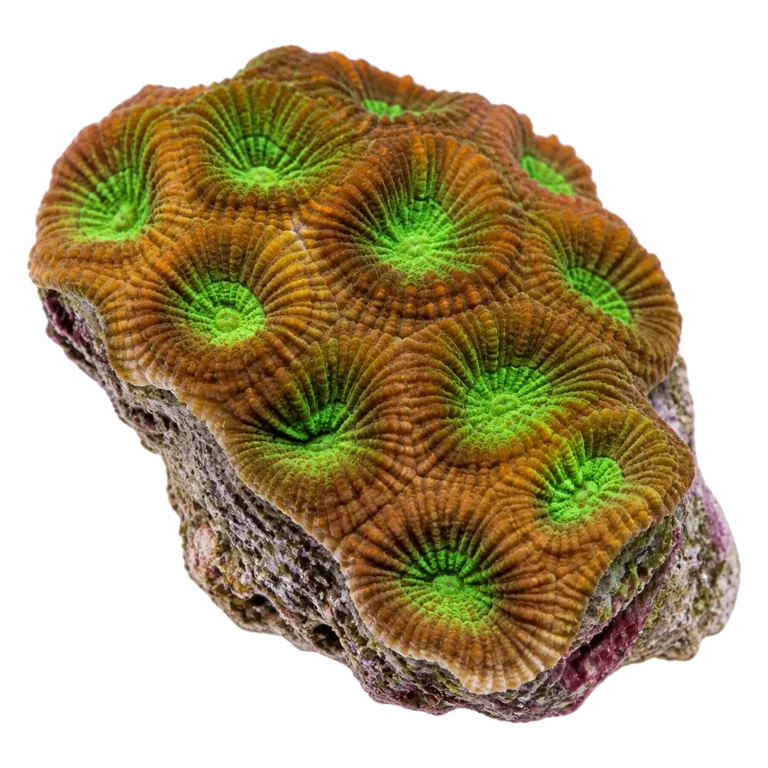
Lepthastrea Coral
Summary
Lepthastrea sp. is a genus-level identification, so colour, polyp extension and tolerance can vary among traded colonies. Most aquarium specimens form low, encrusting plates over hard rock rather than tall branches. Their Indo-Pacific reef origin and naturally close-to-substrate growth make them useful for lower rockwork, but the same spreading edge can eventually reach nearby corals if its path is not planned.
General care
Mount Lepthastrea sp. on stable lower-to-middle rockwork where the colony can spread across open surface without being shaded or buried. Avoid placing it directly on loose sand: settled particles can remain between its small corallites and irritate the living surface.
Handle only the plug or exposed skeleton and keep fingers, tools and adhesive off the tissue. A newly cut or damaged edge is the most vulnerable area; persistent recession, exposed white skeleton or a peeling margin after placement calls for checking for direct flow, detritus accumulation and contact with another coral.
Lighting needs
Begin a new colony in a dimmer part of its intended area and increase exposure gradually rather than moving it straight beneath a strong fixture. A settled colony should retain its colour and show a consistently healthy, textured tissue surface. Fading, bleaching, persistent daytime contraction or tissue loss on the most exposed side suggests excessive light or overly rapid acclimation.
If light is insufficient, the colony may darken, remain alive but add little new edge growth, and lose definition in its colour. Increase exposure in small steps only after allowing time to judge the response, because Lepthastrea sp. colonies vary and a genus-level name does not guarantee identical tolerance.
Flow needs
Provide a moderate, indirect and changing current that keeps the colony clear without pinning its tissue down. At suitable flow, fine food and suspended particles pass across the surface, debris does not settle in the corallites, and the polyps can remain normally extended rather than being held shut.
Too little flow shows first as trapped detritus, algae collecting around the margin, or a dirty film across the surface. Too much, especially a fixed jet, causes persistent retraction, tissue pulled tightly against the skeleton, or recession on the side facing the pump; redirect the flow rather than simply increasing or decreasing all circulation.
Feeding and growth
Lepthastrea sp. relies primarily on its symbiotic algae, so direct feeding is most useful for supporting new growth, recovery after fragging, or colonies in lightly fed systems. Offer fine suspended foods such as zooplankton-sized particles, powdered coral foods or very finely minced meaty foods. Large chunks are more likely to sit on the surface or be stolen than to improve feeding.
Expect growth to spread outward as a crust over the plug and adjacent rock, sometimes with low ridges or uneven contours. Leave open rock around the growth edge and decide where you are willing to trim or isolate it before it reaches another coral.
Compatibility
Treat Lepthastrea sp. as semi-aggressive at close range. Its growing edge can sting or damage a coral it contacts, even if it does not display dramatic long sweepers. Leave at least 5 cm2 in of open space around the colony, and allow more room where fast-growing neighbours could lean, shade or overtake it.
Avoid placing it beside corals that routinely inflate, extend long feeding tentacles or rapidly encrust surrounding rock. Fish and invertebrates that repeatedly pick at the tissue, overturn an unsecured frag or cover it with sand can cause localized bare patches; secure the colony and investigate repeated damage rather than assuming it is a lighting problem.
Water parameters
This is generally a forgiving coral once established in a mature reef, but it responds poorly to abrupt chemistry changes. Keep salinity and alkalinity especially consistent, because sudden shifts can show up as loss of tissue from the outer edge before the rest of the colony appears affected.
Do not use a Lepthastrea sp. colony as a test subject for rapid dosing corrections or major environmental changes. A gradual decline in colour, stalled edge growth or recession after a correction is a reason to pause further adjustments and look for instability, sediment retention, excessive light or aggressive contact.