
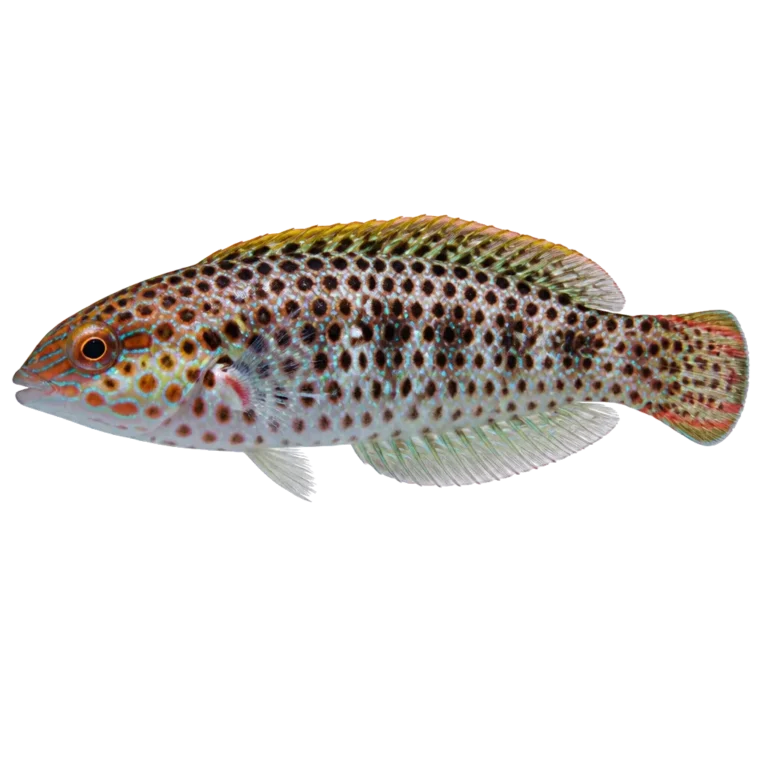
Leopard Wrasse
Summary
Macropharyngodon meleagris is a deliberate, all-day hunter rather than a showy open-water swimmer. It works the lower reef, picking copepods, amphipods, and other tiny prey from sand, rock, and crevices; a fish that repeatedly inspects the substrate is behaving normally, while one that remains hidden or ignores moving food needs close attention.
Its defining aquarium behaviour is diving into sand when startled and to rest. A leopard wrasse that vanishes after introduction may simply be settling in, but the aquarium must offer a safe sand bed before the fish is added.
Care
Use a mature reef with extensive live-rock foraging surfaces and an uninterrupted area of fine, soft sand at least 5 cm2 in deep. Coarse or sharp substrate can injure a fish that dives into it at speed, while a shallow bed prevents its normal sleeping and escape behaviour.
Build a reefscape with sheltered edges and open sand-to-rock transitions rather than filling the entire footprint with structures. Macropharyngodon meleagris spends much of its day moving low over these boundaries; repeated pacing at the glass, prolonged hiding, or frantic collisions at lights-out suggest it cannot establish a secure routine.
Fit a tight cover before introduction. A startled leopard wrasse can launch from the aquarium, particularly while it is still learning the layout and before it has adopted a regular sand-sleeping site.
Feeding
Plan for several small feedings spread through the day, supported by a naturally productive pod population. Offer finely sized marine foods such as copepods, enriched live brine shrimp as an initial feeding trigger, frozen mysis, Calanus, and chopped crustacean flesh. Live food can start a reluctant new arrival feeding, but it should not remain the sole diet.
Deliver some food low over the sand and rockwork, ideally after faster surface feeders have been distracted. This species often searches and pecks rather than rushing into a feeding cloud, so assertive fish can leave it underfed despite apparently heavy feeding.
Do not treat visible pod grazing as sufficient long-term nutrition. A fish that actively hunts all day but loses body condition, develops a pinched appearance behind the head, or stops responding to offered foods is not meeting its energy needs.
Compatibility
Keep one Macropharyngodon meleagris in most community reefs. Groups are best attempted only in a spacious, highly mature system with abundant natural forage, multiple sand-sleeping areas, and a clear plan to remove an aggressor; introducing several together is safer than adding one to an established individual.
Choose calm tankmates that leave food near the bottom for it to find. Avoid highly competitive planktivores, large predatory fishes, and combative wrasses that can intimidate it at feeding time or claim the same foraging territory.
It is coral-safe, but it is not invertebrate-neutral: it consumes copepods and other tiny benthic invertebrates. Do not add it to a system where a dense ornamental pod population is the goal, or where another pod-dependent fish already relies on the same limited prey base.
Good to know
An apparently missing leopard wrasse is often buried, especially after shipping, a disturbance, or when lights go out. Avoid tearing apart the aquascape to find it; instead, check that it reappears during the day and begins investigating food. Continued burial combined with failure to feed is a warning sign, not a reason to force it from the sand.
Macropharyngodon meleagris can change sex, so coloration and social behaviour may change as an individual matures or a hierarchy forms. Do not assume that fish sold as females will remain socially neutral if kept together; persistent chasing, exclusion from feeding areas, or one fish remaining buried through the day warrants separation.
The highest-risk period is acclimation. Many losses follow poor feeding response in a newly imported fish, so buy only an individual that is visibly alert, forages naturally, and accepts appropriate foods before purchase whenever possible.