
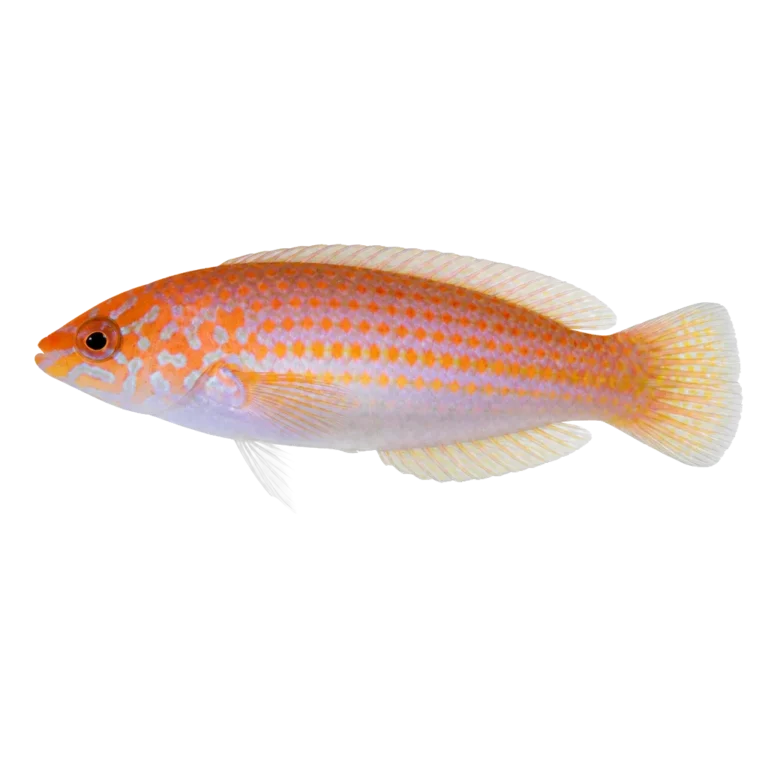
Lennardi Wrasse
Summary
Anampses lennardi is a fast, daylight-active benthic hunter that spends much of its time cruising rock edges and sand in search of small invertebrate prey. In nature it is usually encountered alone or in pairs, which helps explain why it can become intolerant of another similar wrasse in the confined space of an established aquarium.
It is a sand-burying wrasse. A fish that vanishes into the substrate near dusk, after a fright, or during early acclimation is often using its normal refuge behaviour rather than necessarily being lost.
Care
Build the aquascape around a broad area of soft, fine sand, ideally at least 5–8 cm2–3.1 in deep, with rockwork secured directly on the tank base before sand is added. Anampses lennardi needs to enter the substrate quickly and completely; coarse gravel, shallow sand, or unstable rocks can turn its normal sleeping and escape response into injury or chronic stress.
Leave open routes around the rockwork as well as sheltered foraging edges. This species is continuously on the move during the day, so a crowded aquascape with only narrow caves does not substitute for usable swimming and hunting space.
Treat a newly introduced fish that remains buried or stays at the surface as a problem to investigate, especially if dominant fish are patrolling its emergence area. A quiet introduction into a mature system with established microfauna gives it better opportunity to begin foraging while it learns to accept aquarium foods.
Feeding
Offer several small, widely distributed meals through the day rather than one large feeding. Use a rotating mix of finely sized meaty marine foods, including mysis, enriched brine shrimp, krill, and chopped mollusk or crustacean flesh; scatter some food along the sand and rock base so the wrasse can feed in its normal picking pattern.
Do not buy an individual that will not repeatedly take and swallow prepared food. This species can lose condition quickly when it only investigates food or is beaten to every item by fast planktivores; a pinched belly, reduced daytime foraging, or repeated retreat into the sand calls for immediate changes to food size, food type, and feeding access.
Avoid relying on live rock and incidental pods as its permanent diet. They can support initial foraging, but they are not a reliable substitute for frequent, energy-dense meals in a large active wrasse.
Compatibility
Keep Anampses lennardi singly in most mixed reefs. Do not add a second Lennardi Wrasse, or a closely similar Anampses or other sand-sleeping wrasse, to a tank where one has already claimed the foraging routes; persistent chasing can prevent the subordinate fish from feeding or emerging from the sand.
Favour calm fish that leave food opportunities at the substrate and rock base. Avoid boisterous, highly competitive feeders and assertive wrasses that repeatedly intercept it, because apparent peace away from feeding time can still conceal food deprivation.
Add this wrasse before strongly territorial wrasses when possible, or use an acclimation box if established fish are likely to challenge it. Corals are generally a low concern, but do not stock it with small ornamental shrimp, delicate mollusks, or other desirable small benthic invertebrates you expect to preserve.
Good to know
Use a fully secured lid or fine mesh cover with no gaps around plumbing. A startled Anampses lennardi can launch from the tank, particularly during introduction, territorial encounters, or abrupt disturbance near the aquarium.
Expect it to sleep buried and to use the same response when frightened. Do not dig it out; instead, watch for the cause if daytime burial continues or becomes more frequent, particularly harassment, missed meals, or an inability to settle into the substrate.
Its difficult reputation is largely earned during acquisition and early acclimation. Choose a robust fish that is actively foraging and demonstrably eating, then monitor body condition and feeding response closely rather than assuming occasional pecking at the sand means it is adequately nourished.