
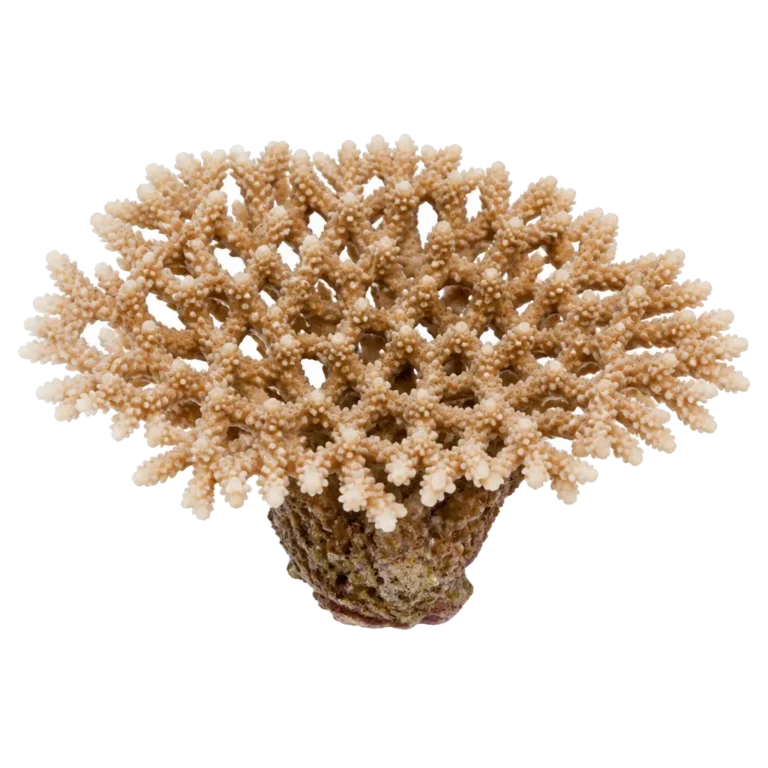
Lattice Table Coral
Summary
Acropora clathrata is a table-forming Acropora that grows outward in a flat, often lattice-like plate of laterally fused branches. Its broad horizontal form is well suited to bright, moving water on Indo-Pacific reef slopes and back-reef margins, but it can quickly shade corals beneath it in an aquarium.
Buy it only if the tank has an open upper-rockwork position and room for a spreading plate. The thin tissue and projecting branch structure make this a less forgiving coral than many fleshy LPS corals when conditions or handling are poor.
General care
Mount this coral securely on stable upper rockwork, with clear water movement across both the top and underside of the developing table. Avoid placing it where the expanding plate will trap detritus, touch the glass, or overhang corals that cannot be moved later.
Handle it by the bare skeleton or mounting plug rather than the living branch surfaces. Branches can snap during transport or aquascaping, and scraped tissue around a break can recede if the fragment is left in stagnant water or allowed to collect debris.
Lighting needs
Acclimate Acropora clathrata gradually to the intended high-light position, starting lower or under reduced intensity and moving it into place in small steps. A newly imported colony can bleach or develop pale upper surfaces when transferred abruptly from dim holding systems into strong lighting.
Healthy light exposure usually produces extended daytime polyps, retained colour, and active growth at branch tips. Dull brown colour, weak growth, and a tendency to stretch toward the light suggest insufficient intensity; paling, bright white tissue at the most exposed surfaces, or tip recession after a lighting change suggests excessive exposure or overly rapid acclimation.
Flow needs
Provide strong, irregular flow that keeps the polyps moving without holding the branches in one direction. Correct flow flushes mucus and particles from the lattice while allowing gentle, changing polyp extension rather than a constant flattened appearance.
Increase or redirect flow if detritus settles between fused branches, filamentous algae collects under the plate, or tissue recedes in sheltered interior areas. Reduce direct flow if polyps remain tightly withdrawn, tissue appears abraded on the facing side, or a powerhead produces a persistent bare patch on one section of the colony.
Feeding and growth
Feeding is most useful in lower-nutrient systems, during recovery, or when the colony shows poor growth despite appropriate light and flow. Offer fine suspended planktonic foods after lights dim or when polyps are visible; large meaty pieces are poorly suited to its small polyps and can foul the branch network.
Growth is mainly outward and horizontal, with branches often joining into a broad plate. Plan for the table to widen rather than simply grow taller, and leave room below it for access and for corals that may need relocating as its shade expands.
Compatibility
This Acropora does not need long sweeper-tentacle territory, but direct contact can still damage its thin tissue and its fast-growing plate can win space by overgrowing, shading, or pressing against nearby corals. Keep at least 10–15 cm3.9–5.9 in of open space around the growing edge and allow more room beneath the colony than beside it.
Avoid housing it within reach of known coral grazers, including butterflyfish, many large angelfish, and coral-nipping filefish. Large fish that rest on the plate or repeatedly strike it while feeding can break branches, while Acropora pests such as red bugs and Acropora-eating flatworms can spread quickly through an SPS collection and should be treated as a serious buying risk.
Water parameters
Acropora clathrata is more demanding than a typical mixed-reef coral because it responds poorly to rapid chemistry changes, especially alkalinity swings. A colony may keep its colour briefly after instability, then show reduced polyp extension, stalled tips, or tissue recession over the following days.
Keep salinity and temperature steady and avoid abrupt nutrient shifts from aggressive filtration changes or heavy corrective dosing. Extremely nutrient-poor water can leave the coral pale and slow-growing, while chronically elevated nutrients and accumulated detritus can encourage algae and tissue loss within the shaded lattice.