
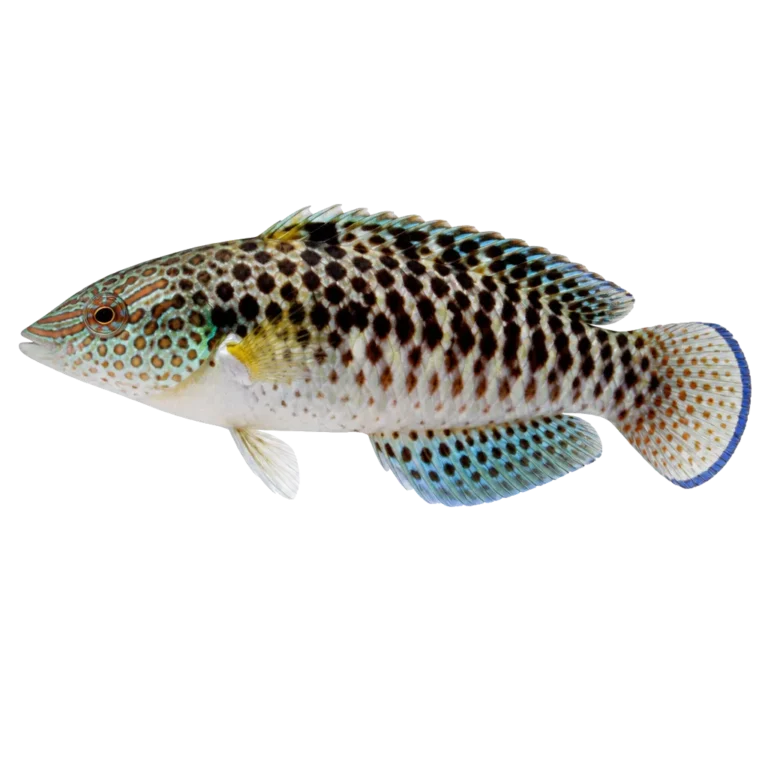
Kuiter’s Leopard Wrasse
Summary
Macropharyngodon kuiteri is a daytime, close-to-the-bottom forager that spends much of its time making short, deliberate passes over sand, rock, and coral bases while picking at tiny invertebrates. A fish that actively patrols this zone and pecks between regular feedings is behaving normally; one that remains hidden after settling in or loses interest in food needs prompt attention.
Its sand-burying habit explains two easily misread behaviours: it may vanish completely at dusk, and it may dive into the substrate when frightened. Give it time to emerge with the lights on rather than digging through the sand to find it.
Care
Keep Macropharyngodon kuiteri in a mature reef with a broad area of soft, fine sand deep enough for complete burial. Coarse or sharp substrate removes its sleeping and panic refuge; repeated frantic circling at lights-out or an inability to settle can follow. Arrange rockwork in separated low structures and leave open sand corridors, so it can search continuously without being forced into exposed open water.
This wrasse is an active but cautious swimmer, usually working the lower and middle reef rather than cruising in the water column. An established population of small benthic prey is important during acclimation, because a newly imported fish may initially graze rather than compete strongly for prepared food.
Feeding
Offer several small meals across the day, centered on enriched mysis, enriched brine shrimp, copepods, amphipods, and finely chopped marine foods. Deliver part of each meal near the sand and rockwork, where the fish naturally searches, while also offering enough suspended food for it to learn prepared foods.
Do not judge feeding success only by a quick strike at one meal. This is a continual micro-predator: a fish that picks all day but develops a pinched body or progressively ignores frozen food is not receiving enough usable nutrition. Fast, assertive feeders can quietly take most meals, so target-feed the wrasse or distract competitors at the opposite end of the aquarium.
Compatibility
A single Macropharyngodon kuiteri is the dependable choice. Do not casually mix it with another leopard wrasse or add a similarly shaped wrasse after it has established its foraging route; chasing and exclusion are most likely around the sand bed and feeding areas. If attempting a group, introduce compatible females together into a substantially larger, mature system and plan for social roles to change over time.
Choose calm tankmates that leave it room to forage, such as peaceful community reef fish. Avoid large predators and boisterous, rapid feeders that can intimidate it into staying buried or prevent it from eating. It is coral-safe, but it will reduce populations of copepods, amphipods, and other tiny benthic invertebrates; do not rely on a visible pod population remaining untouched.
Good to know
Use a tightly secured lid or screen with no practical escape gaps. A startled leopard wrasse can launch from the aquarium, especially during introduction, conflict, or sudden disturbance. Its regular nighttime disappearance into the sand is normal, but daytime burial that persists alongside poor feeding is a warning sign rather than a reason to uncover it.
Macropharyngodon kuiteri is a protogynous wrasse: social dynamics can allow a female to transition toward male coloration and behaviour. This is why an apparently peaceful group can become unstable later, particularly if one fish becomes dominant. Leopard wrasses are also reported to be sensitive to copper exposure, so avoid assuming routine copper-based treatment is appropriate without a species-specific treatment plan.