
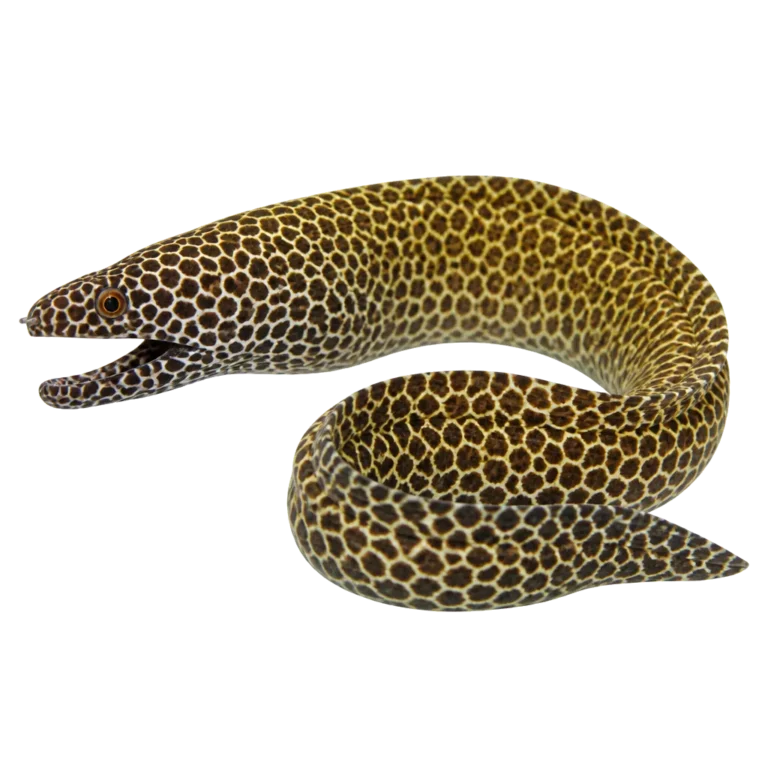
Kidako Moray
Summary
The Kidako Moray is a cave-dwelling, fish-eating moray that commonly spends the day with only its head visible, then becomes more willing to cruise and investigate food as lighting fades. A settled individual that returns to the same secure retreat is behaving normally; persistent roaming along the lid or repeated attempts to enter plumbing usually signals an escape route or an unsuitable refuge.
Its open-mouth “gaping” is normally how a moray moves water across the gills, not a display of aggression. Treat the eel as a deliberate predator nonetheless: its practical compatibility is set by the size and shape of its potential tankmates, rather than by whether it appears quiet while resting.
Care
Build the aquascape around a dark, body-width cave or tunnel with more than one exit, and place the heaviest rock directly on the tank bottom before adding sand. The eel can push beneath loose structures, so rock that merely looks stable can shift or collapse once it begins using the underside as a den.
Provide open floor-level routes between shelters rather than filling every gap with rock. This species moves by threading through crevices and may remain unseen for long periods if its preferred shelter is secure; forcing it into exposed open water makes settling and target feeding harder.
Plan for cooler marine conditions than a typical warm tropical reef, and avoid pairing it with livestock that requires consistently hot water. Strong filtration and reliable mechanical removal of uneaten food matter because substantial meaty meals can quickly foul a system.
Feeding
Use long feeding tongs to offer varied marine-origin foods such as whole or chunky fish, shrimp, squid, clam, and other crustacean flesh. Present food near the entrance to its den, especially later in the day, since a newly introduced eel may respond to scent and movement before it confidently leaves cover.
Feed substantial, measured meals a few times per week rather than scattering small foods into the tank. Remove missed pieces promptly, and reduce the portion if the eel begins leaving food or develops an overly thick body profile.
Do not rely on one item, especially plain shrimp or fish fillet, as the complete diet. Rotating whole-bodied marine prey and appropriately prepared frozen foods reduces the risk of an unbalanced diet, while tong feeding prevents fast tankmates from taking food intended for the eel. Never hand-feed: poor close-range aim can turn a feeding response into a serious bite.
Compatibility
Keep a Kidako Moray singly. Do not assume that two morays will share a den or tolerate one another simply because they coexist briefly after introduction; adding another eel later can turn established shelter use into territorial conflict.
Choose robust fishes that are clearly too large and deep-bodied to be swallowed, and avoid slender fishes, small gobies, ornamental shrimp, crabs, and similar mobile invertebrates. The eel may ignore such animals at first, then take them once it has settled, grown, or begins hunting after dark.
Add the moray before particularly pushy food competitors where possible, so it can establish a retreat and learn the feeding routine. Avoid fish that repeatedly harass its head or monopolize every offered morsel; a moray that cannot feed calmly may remain withdrawn and lose condition.
Sessile corals are not the primary concern, so a coral display can work structurally. The reef-safety exception is the cleanup crew: crustaceans are prey candidates, and any coral arrangement must also withstand the eel bracing against or moving through the rockwork.
Good to know
Make the aquarium escape-proof before the eel arrives. Secure the lid, overflow, return-line cutouts, cable gaps, and any opening large enough for the eel to test with its snout; morays can leave through gaps that seem implausibly small, especially during acclimation or nighttime exploration.
Expect a newly acquired specimen to spend much of its time hidden. The useful checkpoint is not daytime visibility but whether it accepts food, maintains a chosen shelter, and emerges predictably around feeding; repeated refusal of appropriate foods or frantic surface-level searching warrants investigation.
Use tools whenever hands must enter the eel’s area. A moray can strike at a food-associated hand even when it is otherwise accustomed to the aquarist, and a bite should be treated seriously because deep punctures can become infected.