
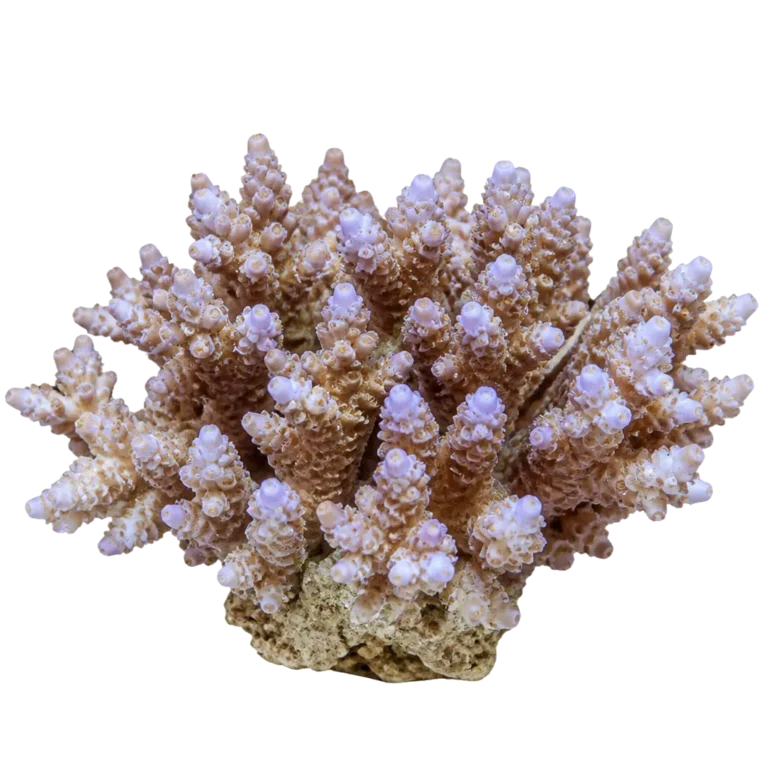
Isopora Coral
Summary
Isopora sp. is a genus-level identification, so colony form and exact tolerance can vary among specimens. Most are robust SPS corals with thick, blunt branches or encrusting bases, rather than the fine branches associated with many Acropora. That shape reflects life in bright, energetic reef habitat: give it an exposed rock position with room to build outward, not a sheltered nook where debris can settle.
Treat it as a moderate-difficulty SPS purchase. A healthy frag should show intact tissue over the branch bases and tips, with no fresh white patches, algae growing into bare skeleton, or tissue peeling from the plug.
General care
Mount an Isopora sp. securely on upper-middle rockwork before it has time to encrust the plug. Choose a position that will remain brightly lit and strongly circulated as the colony thickens; moving an established SPS colony commonly damages the encrusted base and forces another round of acclimation.
Handle only the plug or bare skeleton. Its living tissue is thin and can tear where branches meet or where the frag was cut, so avoid gripping, rubbing, or resting the coral tissue-down on rock. Inspect the underside and shaded branch junctions during maintenance, because early recession can be hidden there until algae occupies the exposed skeleton.
Lighting needs
Acclimate a new frag by beginning lower than its final position or by reducing fixture intensity, then increase exposure gradually after it remains fully colored and shows no tissue loss. This is especially important when a coral has been kept under different LEDs, spectrum, or photoperiod than your system.
Too little light is more likely to show as browning, reduced coloration, slow encrusting, and an increasingly stretched or sparse-looking growth pattern. Too much light or a too-fast increase can produce pale tissue, fading first on exposed tips and upper surfaces, or localized bleaching; reduce intensity or shorten exposure rather than repeatedly relocating the frag.
Flow needs
Provide strong, irregular flow that reaches around the branches and through the colony rather than a single constant jet aimed at one side. At suitable flow, fine particles do not collect between branches, polyps can extend without being pinned flat, and the tissue remains clean across both the exposed and sheltered surfaces.
Flow is too low when detritus settles in branch junctions, film algae builds in shaded areas, or recession begins where debris remains trapped. Flow is too forceful when tissue stays tightly compressed on the pump-facing side, polyps cannot extend even after lights-out, or a narrow windward strip develops irritation or recession; diffuse or redirect the stream instead of simply reducing all circulation.
Feeding and growth
Photosynthesis supplies most of this coral’s energy, but occasional feeding can help a newly settled frag, a recovering colony, or a system kept very lean. Offer suspended, fine zooplankton-sized foods or finely minced meaty particles while pumps are temporarily slowed enough for capture; oversized pieces can lodge in the branches and foul the tissue.
Growth is commonly a thick-branched or encrusting expansion, although the exact form varies within Isopora. Plan for the base to spread as well as the branches to widen and shade nearby rock, and leave a clear growth lane rather than treating the original frag footprint as its permanent space.
Compatibility
Isopora sp. is usually not a long-sweeper coral, but it can injure neighboring corals through direct contact, overgrowth, and shading as it enlarges. Give it at least 10 cm3.9 in of open space from other corals at placement, then increase that buffer or prune as branches and the encrusting base approach their neighbors.
Avoid fish and invertebrates that repeatedly nip SPS tissue or perch heavily on delicate branch tips. A single occasional contact is less concerning than repeated picking: watch for a persistent pale spot, missing tissue at a branch tip, or damage that returns in the same location, then separate the animal or protect the coral.
Water parameters
This is less forgiving of instability than a typical mixed-reef coral. Keep alkalinity, salinity, and temperature changes gradual and matched to a consistent dosing and water-change routine, because abrupt swings can trigger rapid tip paling or tissue recession even when a single test result appears acceptable.
Pay particular attention to alkalinity consistency and to avoiding a nutrient-starved appearance. Very low available nutrients can coincide with pale tissue and stalled growth, while accumulated detritus and excess nutrients can encourage algae on stressed areas; correct the underlying imbalance gradually rather than making large, simultaneous chemistry changes.