
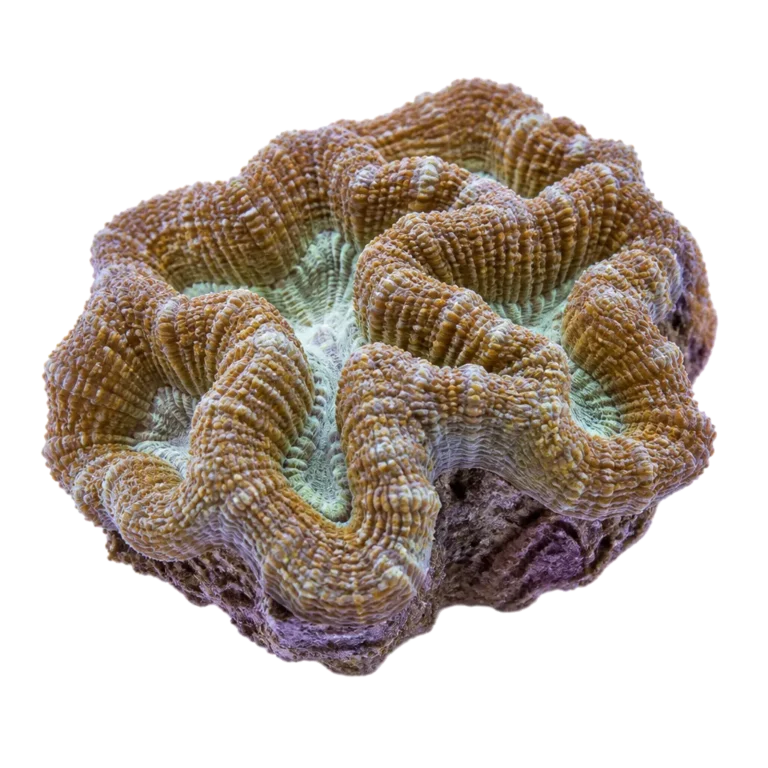
Intermediate Valley Coral
Summary
Oulophyllia levis is a fleshy large-polyp stony coral with broad, winding valleys and ridges beneath an inflated mantle. Its tissue can look full and soft by day but contract considerably after dark, so judge health by whether it reinflates consistently and keeps its mouths closed rather than by nighttime deflation alone.
This is an Indo-Pacific reef coral adapted to receiving light and gentle water movement without being blasted by surge. In an aquarium, that translates to a stable, lower-to-middle placement where its valleys can stay clear of sediment and its fleshy tissue is not pushed hard against sharp rock.
General care
Set Oulophyllia levis on a firm, level patch of sand or a broad, stable rock shelf in the lower-middle aquarium. Keep the base from rocking: a fall can tear the inflated tissue against its own sharp skeletal ridges, and a colony that repeatedly shifts will often stay withdrawn.
Handle it only by exposed skeleton or a solid plug, never by the fleshy mantle. Do not wedge tissue into a crevice, rest it on abrasive rubble, or expose it to extended air while moving it; damaged edges are prone to recession before the coral has settled.
Lighting needs
Begin a new Oulophyllia levis near the lower end of the displayed lighting guidance, then increase exposure gradually only after it has resumed normal daytime inflation. A new specimen can look acceptable for a few days while still adjusting, so make changes slowly rather than moving it repeatedly around the tank.
Too much light is suggested by persistent paling, reduced inflation, or tissue drawing tightly down into the valleys during the photoperiod. Too little light is more often seen as a gradual loss of colour intensity and poor long-term growth despite otherwise normal inflation; move it brighter in small steps rather than making a large jump.
Flow needs
Provide gentle, indirect flow that lightly moves the expanded tissue and carries away mucus and settled particles without flattening the mantle. Correct flow leaves the coral inflated, its mouths closed, and the valley floors free of visible detritus.
If flow is too weak, food, sand, or brown debris will collect between the ridges and the coral may produce excess mucus or remain partly retracted. If it is too strong or aimed directly at the colony, the tissue will whip, stay tightly contracted, or abrade along exposed ridges; redirect the pump rather than simply increasing distance from it.
Feeding and growth
Photosynthesis supplies most of this coral’s energy, but occasional target feeding is useful for a newly stressed specimen, a coral kept in a lean system, or one that has stopped gaining tissue. Offer fine zooplankton-sized foods or finely chopped meaty foods when feeding tentacles are visible, usually after the lights dim. Large pieces are commonly rejected and can rot in the valleys.
Oulophyllia levis typically builds a slow-growing, thick valley-forming colony that expands outward as well as upward. Leave open substrate around the entire colony, not just in front of it, because a small purchase can eventually occupy a much broader footprint and make later relocation risky.
Compatibility
Treat Oulophyllia levis as semi-aggressive. It can extend sweeper tentacles after dark and sting corals within reach, so leave at least 15 cm5.9 in of clear space from neighbouring corals and check the tank with a blue or dim light after dark before reducing that buffer.
Do not place delicate fleshy corals or slow-growing encrusters within its nighttime reach. Coral-feeding butterflyfish and angelfish may nip its exposed tissue, while large hermits, burrowing invertebrates, or sand-moving fish can topple it or bury the lower tissue; intervene if sand repeatedly settles against the colony.
Water parameters
This is moderately demanding rather than unusually delicate, but it responds poorly to rapid shifts in salinity and the carbonate chemistry used to build its skeleton. Keep changes gradual and consistent; unexplained repeated deflation, gaping mouths, or recession along valley edges should prompt a check for recent parameter swings before changing light or flow.
Avoid driving nutrients to an ultra-clean state. Oulophyllia levis relies heavily on its symbionts but also benefits from available dissolved and particulate nutrition, and a coral that remains pale, thinly inflated, and reluctant to feed can struggle even when the standard reef readings appear acceptable.