
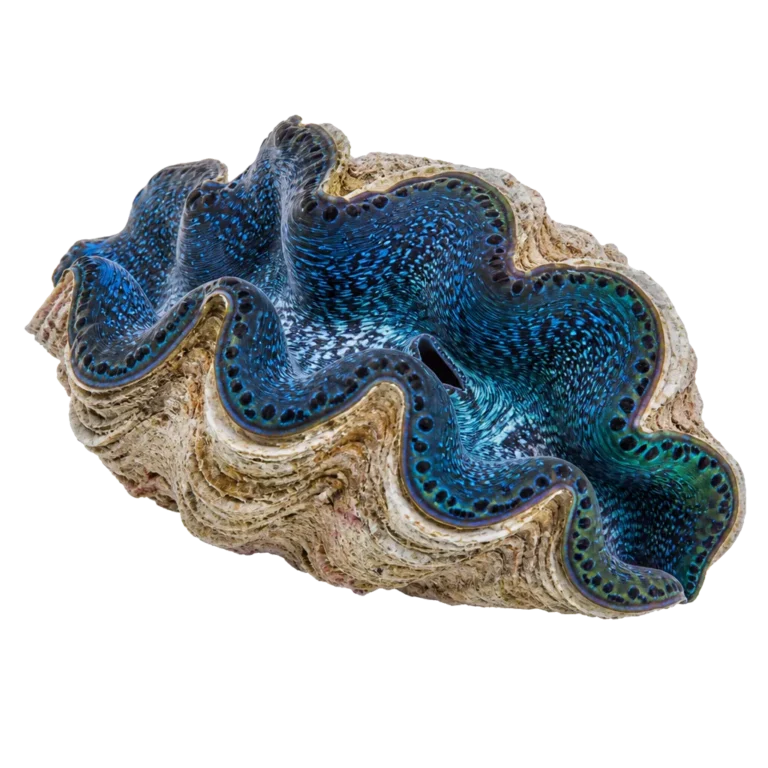
Hybrid Maxima Clam
Summary
Hybrid Maxima Clam is an aquacultured Tridacna maxima × Tridacna squamosina cross, so individual shell shape and light tolerance can lean toward either parent. Treat it conservatively as a high-light giant clam from shallow, sunlit reef habitat: a broadly extended mantle during the photoperiod and a quick shadow response are useful signs that it is settled and alert.
Care
Place it once on a stable, level rock or on sand over a buried flat rock, with its byssal opening protected from sharp edges and burrowing animals. Do not balance it where growth, snails, or a shifting sand bed can topple it; a fall can tear the foot or leave the mantle unable to face the light.
Provide strong reef lighting and moderate, irregular flow rather than a direct jet. The mantle should remain expanded without folding, flapping, or repeatedly withdrawing; persistent retraction usually means excessive flow, irritation, or unsuitable placement. Add it only to a biologically mature reef with a proven record of supporting calcifying animals, since newly established systems often change too quickly for a clam to adapt.
Feeding and role
Most of its energy comes from symbiotic algae in the mantle, so light is its primary food source. It also filter-feeds on very fine suspended plankton and organic particles; in a very nutrient-starved system, modest broadcast additions of suitable phytoplankton can help, but do not blast food into the siphons or bury the mantle in powdered foods.
Do not buy one as a cleanup crew animal. It takes up some dissolved nutrients and filters fine material, but one clam will not correct nuisance algae, detritus buildup, or an overstocked system.
Compatibility
Keep it away from fish that investigate or bite exposed mantles, especially angelfish, butterflyfish, triggerfish, puffers, and filefish. Repeated nipping can look like unexplained mantle retraction; remove the offender rather than expecting the clam to acclimate to the harassment.
The clam is peaceful with corals, but it needs an open footprint. Move or trim corals that can touch, shade, or sting the mantle as they grow, and avoid placing it within reach of wandering anemones.
It does not need companions and is usually best introduced as a single clam while its placement and response are monitored. Multiple giant clams can be kept when each has its own illuminated space and none shades or contacts another.
Good to know
Acclimate slowly to both salinity and light. Start a newly acquired clam lower or under reduced intensity, then increase exposure gradually; sudden bleaching, a washed-out mantle, or prolonged failure to open can follow an abrupt light change.
Do not pull up a clam that has attached. Its byssal threads anchor it through the lower shell opening, and tearing them can badly injure the foot; plan the location before it attaches.
Inspect the shell edges, underside, and nighttime surroundings for tiny pyramidellid snails. These parasites feed on clams and can cause gradual weakness or poor mantle extension; remove any found and check repeatedly rather than assuming the problem is lighting alone.
Avoid copper-containing medications and treatments in any system housing the clam. A persistently gaping shell, weak response to a passing shadow, or a mantle that remains tightly withdrawn is an urgent warning sign, not normal resting behavior.