
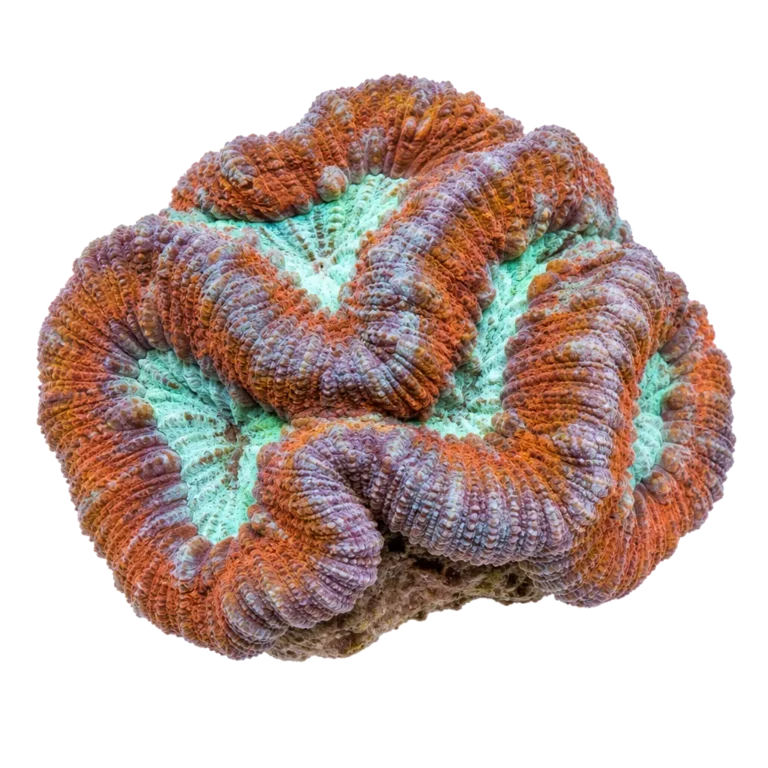
Hybrid Frammer Coral
Summary
Fimbriaphyllia paraancora × Fimbriaphyllia paradivisa, sold as the Hybrid Frammer Coral, is a fleshy branching Euphylliid hybrid whose polyps may combine hammer-like and divided frogspawn-like tentacle shapes. Its parent species come from Indo-Pacific reef habitats that range from sheltered, gentler-water areas to reef slopes, so this coral generally does best with moderate conditions rather than intense light or a direct, forceful current.
General care
Place it on the lower to middle rockwork where each head can inflate without rubbing rock, glass, or adjacent corals. Secure the skeleton or frag plug rather than the living tissue, and handle it upright with wet hands; pinching inflated polyps, tearing tissue on sharp rock, or dropping a branch can lead to recession. Choose a specimen that inflates evenly, has intact tissue around each corallite, and is free of persistently gaping mouths or damaged areas.
Lighting needs
Begin a newly acquired colony in the dimmer part of its suitable placement, then raise exposure gradually only after it remains fully inflated for several days. Insufficient light often shows as reduced vigor, increasingly brown coloration, and slower budding, while excessive light can cause paling, bleaching at exposed tentacle surfaces, or repeated daytime contraction. Change placement slowly rather than making a large lighting correction in one move.
Flow needs
Use indirect, varied flow that keeps the tentacles gently swaying and separated without folding the flesh over the skeleton. Too little movement allows detritus and mucus to collect between heads and can leave polyps looking dull or only partly expanded; redirect flow before debris becomes trapped. Too much flow makes tentacles snap in one direction, remain tightly retracted, or repeatedly collapse against the skeleton, so diffuse the pump output or move the colony out of its direct path.
Feeding and growth
Photosynthesis supplies much of this coral’s energy, but occasional feeding is useful during recovery, after fragging, or when growth has slowed despite otherwise suitable conditions. Offer small, soft zooplankton-sized foods or finely chopped meaty foods when the tentacles are extended, and use only enough that the mouths can retain it without food collecting on the tissue. Growth usually comes through new buds and branching heads, so a small frag can become a broad colony with expanding reach rather than simply growing taller.
Compatibility
Treat this coral as semi-aggressive: it can deploy sweeper tentacles that sting neighboring corals, often after dark or when competing for space. Leave at least 15 cm5.9 in of open space around it, with extra room down-current, and do not assume it can safely touch even closely related Euphylliids. Clownfish may try to host in the polyps and can irritate a small or newly introduced colony through constant contact, while coral-picking fish and large, disruptive invertebrates can damage its exposed fleshy tissue.
Water parameters
This is less demanding than many small-polyp stony corals, but it is not tolerant of abrupt chemistry changes. Keep salinity and alkalinity particularly consistent, because sudden swings can trigger prolonged deflation, tissue recession near the skeleton, or failure of new buds to develop. Avoid stripping nutrients excessively low as well; a colony that pales, stays underinflated, and stops growing despite appropriate light and flow may need its nutrient availability and recent parameter stability reviewed before it is moved.