
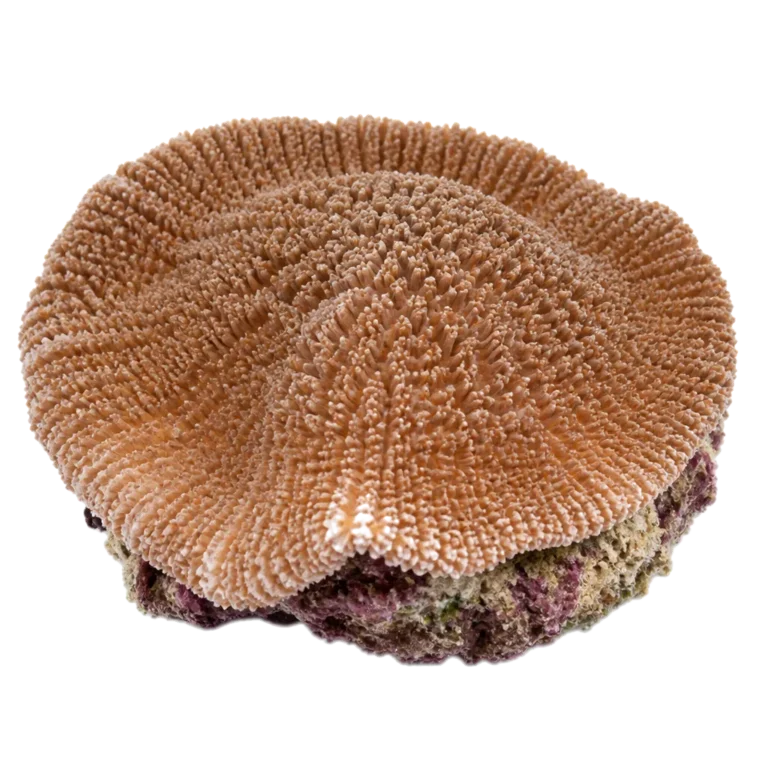
Helmet Plate Coral
Summary
Ctenactis echinata is a solitary, free-living fungiid rather than a coral that encrusts rock. Its elongated oval skeleton has a pronounced central furrow and strongly toothed ridges, so it needs a clear area on the substrate where it can remain flat and fully expanded. In nature it occurs on protected reef slopes and lagoonal habitats in the Indo-Pacific; that background suits a lower, calmer aquarium position rather than exposed rockwork in strong cross-current.
General care
Place this coral directly on an open, level sandbed or similarly unobstructed substrate, with enough room that its edges cannot touch rock or nearby corals as it inflates. Do not glue, wedge, or bury it: trapped tissue and shifting substrate can cause edge damage and make it difficult for the coral to shed sediment.
Handle Ctenactis echinata by supporting the hard underside with two hands, never by the living upper tissue or central furrow. The sharp skeletal teeth can abrade tissue during transport or if the coral tumbles, so inspect the perimeter before purchase and avoid specimens with persistent recession, exposed white skeleton, or torn tissue around the edge.
Lighting needs
Begin a new specimen in the dimmer part of its intended lower placement, then increase exposure gradually only after it remains expanded and retains normal colour. This species is photosynthetic, but abrupt exposure to brighter light can cause a bleached, washed-out appearance, prolonged deflation, or tissue pulling back from the outer ridges.
If light is insufficient, the coral may remain brown but show weak daytime expansion and little response to feeding over time. If light is excessive, reduce intensity or add temporary shading rather than moving it repeatedly; continued paling or a contracted, irritated surface is a better warning sign than colour alone.
Flow needs
Use gentle, indirect flow that keeps fine particles from settling in the central furrow and between the ridges without visibly pushing the tissue to one side. At suitable flow, the coral stays broadly inflated, its surface remains clear of debris, and offered food can settle briefly near the mouth rather than being immediately blasted away.
Increase flow slightly if detritus repeatedly collects, algae starts growing in the grooves, or a film remains on the tissue. Reduce or redirect flow if the coral stays tightly contracted, its tissue flaps sharply against the ridges, food cannot remain on the oral area, or the animal is shifted across the substrate.
Feeding and growth
Photosynthesis supplies much of this coral's energy, but target feeding is useful during recovery, in low-nutrient systems, and when improved tissue condition or slow growth is the goal. Offer small zooplankton-sized foods or very finely minced marine foods after lights dim, when feeding response is most likely. Keep the portion modest and remove food if it is not taken rather than repeatedly covering the mouth.
Growth is slow and takes the form of a larger, elongated single disc rather than a branching or encrusting colony. Plan its footprint around its expanded size and leave a clear perimeter, because a specimen that appears compact when contracted can occupy substantially more substrate when fully inflated.
Compatibility
Ctenactis echinata is generally peaceful, but direct contact can still injure either it or a neighbouring coral through localized stinging and digestive tissue response. Give it at least 10–15 cm3.9–5.9 in of open clearance on all sides, and check after dark or after feeding because expansion can reduce the gap that looked safe during the day.
Avoid placing it where burrowing animals routinely overturn it or where sand-sifting activity repeatedly covers the oral groove. Large, clumsy fish and some crabs can scrape or flip the coral, while coral-picking fish may damage its exposed tissue; a coral that is repeatedly displaced should be moved to a more protected open area rather than secured by its tissue.
Water parameters
This is usually less demanding than many delicate LPS corals when given clean, stable conventional reef conditions, but it does not tolerate abrupt chemistry changes well after shipping or placement. Keep salinity and alkalinity especially consistent, because rapid swings can show up as prolonged deflation, poor feeding response, or tissue recession along the sharp outer ridges.
Prevent sediment and nuisance algae from accumulating in the central furrow, particularly if nutrients are elevated or flow is very low. A stable specimen should remain regularly inflated and maintain intact tissue over the skeleton; persistent recession, a gaping mouth, or failure to clear debris calls for checking flow, lighting transition, and water chemistry together rather than making one large correction.