
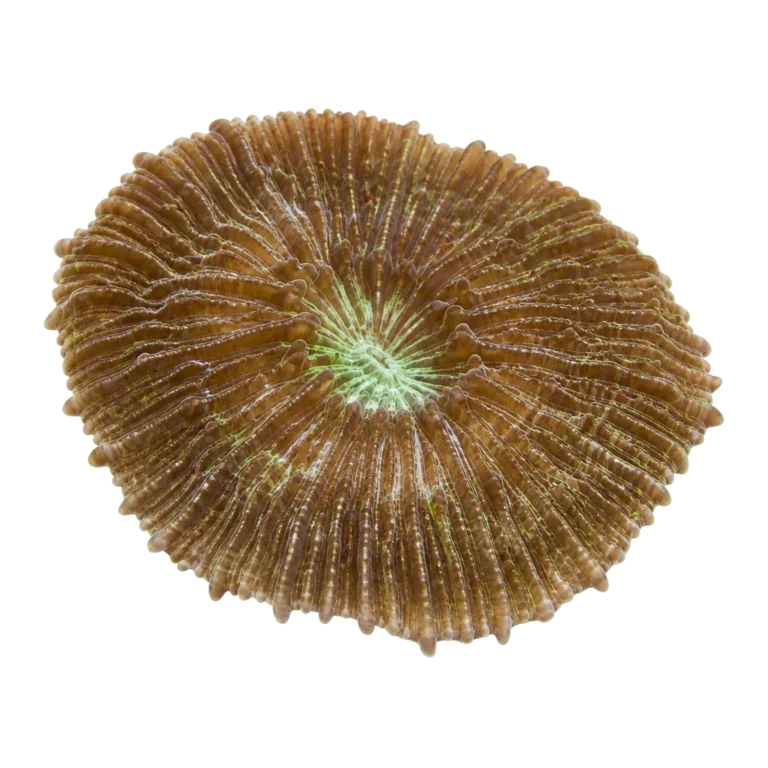
Heliofungia Coral
Summary
Heliofungia sp. is a free-living mushroom coral with a single fleshy polyp, a hard disc-shaped skeleton, and long anemone-like tentacles that commonly remain extended during the day. Genus-level identification leaves room for variation among traded specimens, but the long-tentacled Heliofungia commonly encountered in the hobby is best treated as a sand-dwelling, open-bottom coral rather than a coral to wedge into rockwork.
Its natural association with soft or rubble-strewn lagoonal bottoms explains its aquarium behavior: it needs an unobstructed area, may gradually shift position, and can be damaged when its inflated tissue is pressed against sharp rock or buried by sand. Buy only a specimen that is fully responsive, has intact tissue over the skeleton, and has no persistent gaping mouth or areas of recession.
General care
Place Heliofungia sp. on an open sandy bottom, ideally on a smooth, stable patch where the entire skeleton is supported and the tissue cannot rub against rock. Leave room around it from the first day; moving it repeatedly after it has expanded risks tearing the soft underside or exposing tissue to abrasion.
Handle it only by supporting the hard skeleton with both hands while it is submerged whenever possible. Never lift, squeeze, or turn it by the fleshy oral disc or tentacles. A damaged edge, torn tissue, or a specimen that cannot inflate clear of the substrate is a serious concern because exposed skeleton can progress to tissue loss.
Lighting needs
Introduce a newly acquired Heliofungia sp. under subdued light or temporary shading, then increase exposure gradually after it has resumed regular inflation and feeding response. This is especially important when its previous lighting history is unknown, because an abrupt increase can overwhelm tissue already stressed by collection and transport.
At suitable light, the coral should inflate broadly and maintain color while extending tentacles predictably. Persistent paling, bleaching, tight daytime contraction, or a mouth that stays open after a lighting increase suggests excessive exposure; reduce intensity or provide more shade. Inadequate light is more often seen as reduced inflation and slow decline despite otherwise appropriate flow and water quality.
Flow needs
Aim indirect, low-to-moderate flow that keeps the long tentacles gently moving independently without flattening the polyp. Correct flow carries away waste and lets the coral remain broadly inflated rather than forcing it to brace against a constant stream.
If detritus repeatedly settles on the disc, tentacles remain clumped, or the coral looks stagnant despite normal inflation, increase indirect circulation slightly. If tentacles are pinned in one direction, the oral disc folds, skeleton becomes conspicuous during the day, or the coral stays shrunken, redirect or soften the flow rather than aiming a pump at it.
Feeding and growth
Photosynthesis supplies much of this coral's energy, so target feeding is most useful for a newly imported or recovering specimen, in a very lean system, or when growth and inflation remain poor despite suitable light. Offer occasional very small meaty items such as finely divided mysis or seafood, with circulation briefly reduced so food can be captured rather than blown across the tissue.
Feed pieces small enough to be enclosed and moved into the central mouth without prolonged struggling. Oversized food can be dropped, rot on the coral, or provoke a stress response. Heliofungia grows as an enlarging solitary disc rather than a branching colony, so its footprint and reach expand outward; reserve open sand rather than planning to fill the surrounding space with frags.
Compatibility
Heliofungia sp. is aggressive by contact: its long tentacles can sting neighboring corals, and a specimen may shift enough to close a gap that initially looked safe. Keep at least 20 cm7.9 in of clear space in every direction, then reassess after lights-out and after the coral reaches full extension. Do not rely on a bare skeleton edge as the boundary of its reach.
Avoid placing it beside corals with similarly long or powerful tentacles, and keep it away from rockwork where a neighboring coral can fall or grow into it. Fish that nip fleshy LPS corals can quickly create wounds, while persistent clownfish attempting to use the tentacles as a host may keep the polyp retracted. Sand-sifting animals that dump substrate onto the disc are also poor companions because repeated burial and abrasion can prevent normal inflation.
Water parameters
This is less forgiving than a typical hardy reef coral of rapid salinity and alkalinity changes, particularly when it is newly imported or has any tissue damage. Favor a mature system with consistent chemistry and enough nutrient availability to support its symbionts; an ultra-clean, aggressively stripped system can compound poor expansion and slow recovery.
Watch the coral rather than waiting for a test result alone: sustained loss of inflation, a persistently open mouth, peeling tissue, or new exposed skeleton calls for an immediate check of recent chemistry changes, temperature stability, flow, and physical irritation. Correct abrupt changes gradually, and remove any cause of rubbing, burial, or repeated stinging before tissue loss advances.