
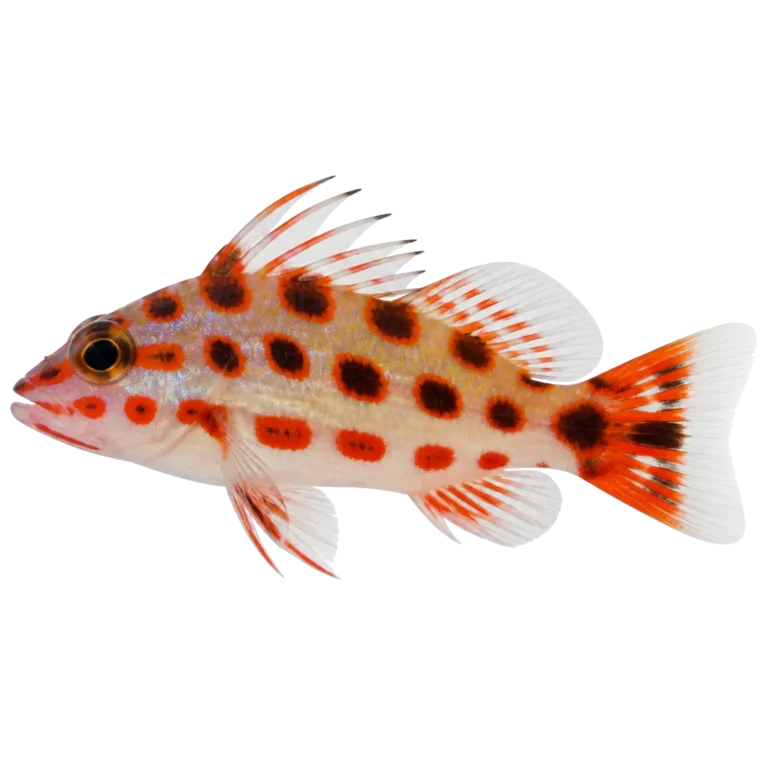
Harlequin Smiler
Summary
The Harlequin Smiler, Opistognathus eximius, is a large jawfish that spends much of its time stationed at the entrance of a self-built burrow, darting out to feed and reversing quickly back to cover. A fish that remains wary at first can become conspicuous once it has claimed a secure burrow; one that cannot settle into the substrate is unlikely to thrive.
Its large mouth is functional rather than ornamental: this is not a small, delicate sandbed community fish. Plan livestock around a substantial predatory jawfish that occupies the lower part of the aquarium but can take suitably small fishes and crustaceans.
Care
Build the aquarium around an uninterrupted area of deep sand mixed with coral rubble, shell pieces, or small smooth stones that the fish can carry and use to reinforce a burrow. Leave open sand in front of the rockwork so it can excavate without constantly undermining corals or hardscape.
Set heavy rock directly on the tank base before adding the substrate and make sure it cannot shift. A Harlequin Smiler may dig beneath nearby structures; repeated cave-ins, a blocked burrow entrance, or frantic rebuilding are signs that the layout is unsafe.
Give it a calm route between its burrow and open water rather than packing every surface with rock. It will normally hover close to its entrance and retreat tail-first when alarmed, so constant hiding after the initial settling period can indicate intimidation by tankmates or excessive disturbance around the aquarium.
Feeding
Offer a varied meaty marine diet, using appropriately sized pieces of mysis, chopped shrimp, crustacean flesh, clam, squid, and quality frozen carnivore foods. Feed near the burrow entrance at first; a jawfish that will not travel far from cover can lose food repeatedly to fast midwater feeders.
Use smaller, regular meals rather than relying on a single large feeding. Watch the individual fish rather than assuming it is eating: a Harlequin Smiler should emerge, take food decisively, and return to its burrow, while a persistently thin fish or one that only watches food pass needs less competition or more deliberate target feeding.
Do not use freshwater feeder fish as a staple. They are a poor nutritional fit and can encourage the expectation of live prey without providing a balanced marine diet.
Compatibility
Keep one Harlequin Smiler unless a genuinely compatible pair has been established and the aquarium has enough separate sandy territory for each fish to maintain a burrow. Adding another jawfish after one has settled can trigger persistent territorial chasing around burrow sites, and sexing is not dependable for routine pair selection.
Choose peaceful to moderately assertive tankmates that will not monopolize food at the sandbed or repeatedly investigate the burrow. Avoid large, highly aggressive fishes and other bottom-dwelling territorial species that can claim the same sheltering zone.
It is suitable around corals, but reef-safe does not mean harmless to every resident. Burrow construction can shift loose frags or bury corals placed on the sand, and very small fishes or ornamental crustaceans may be treated as prey once the jawfish is established. Add the jawfish before faster, more dominant feeders whenever possible.
Good to know
Fit a fully secure, gap-free lid before introduction. Jawfishes can launch upward when startled, especially during early acclimation or after sudden activity near the tank; an otherwise healthy fish can be lost through openings around plumbing or cables.
A newly introduced fish may spend most of its time inside its burrow, which is normal if it emerges to eat and the burrow remains intact. Treat repeated abandonment of burrows, frantic open-water swimming, or an inability to construct a stable entrance as a husbandry problem rather than simple shyness.
This species is a mouthbrooder. If breeding occurs, the egg-carrying fish may spend extended periods at its burrow and may feed less enthusiastically while holding the egg mass; do not mistake a brief reduction in feeding for a reason to dismantle its territory.