
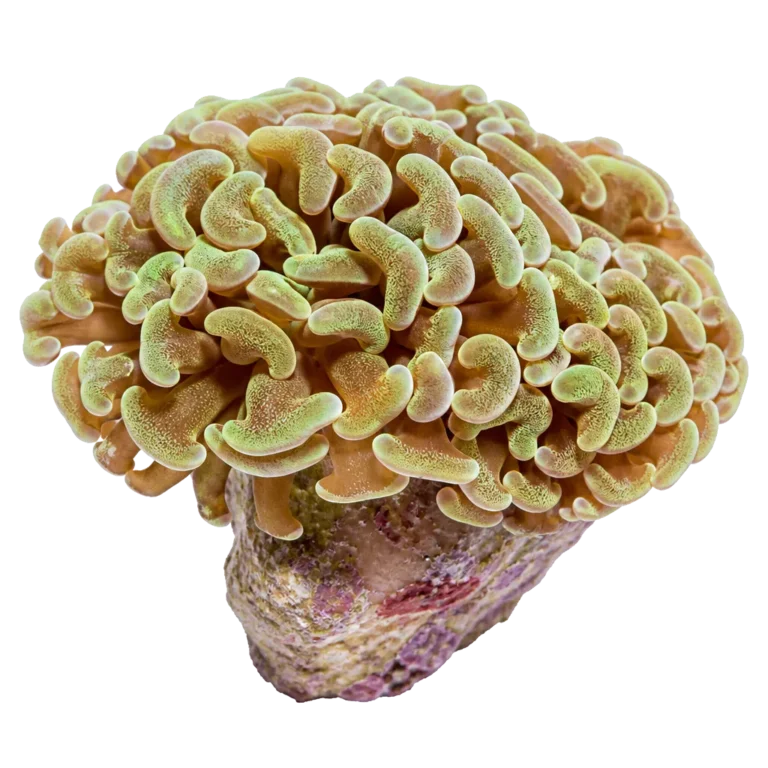
Hammer Coral
Summary
Hammer Coral is a trade name for Fimbriaphyllia sp., a genus-level label that can include branching and wall-form forms. Identify it by the broad, hammer- or anchor-shaped tentacle tips over a large-polyp stony skeleton. Its Indo-Pacific reef origins help explain its preference for moderate conditions: it should move in indirect surge rather than sit in a hard, one-directional blast.
General care
Place Fimbriaphyllia sp. on stable lower-to-middle rockwork where the expanded polyps cannot touch the sand, nearby rock edges, or other corals. Secure the skeleton so it cannot topple; a fall can tear the inflated tissue against its own sharp skeletal ridges.
Handle only the bare skeleton, never the fleshy polyp. Inspect a purchase carefully for peeling tissue, exposed skeleton beneath otherwise healthy tissue, brown gelatinous material, or a colony that remains tightly withdrawn after settling, as damaged hammer coral tissue can deteriorate quickly.
Lighting needs
Begin a new Hammer Coral in a slightly shaded lower-to-middle position, then increase exposure gradually only after it has resumed normal daytime expansion. This reduces the risk of light shock when a coral has come from different lighting or has been shipped.
A well-matched position usually produces full, inflated tentacles without repeated midday withdrawal. Persistent paling, bleached areas, or retraction during the brightest part of the photoperiod suggests excess light; reduced expansion, duller appearance, and little growth after an adequate settling period can indicate that the coral needs a modest increase in exposure.
Flow needs
Aim for indirect, changing flow that keeps the tentacles gently swaying and allows food and detritus to move away without folding the polyp over the skeleton. Redirect a pump rather than aiming it at the colony.
Too little flow leaves detritus or mucus trapped among the tentacles and can lead to poor extension. Too much flow makes the tentacles whip, remain tightly contracted, or repeatedly drag tissue against skeletal edges; move the coral or diffuse the current before tissue damage develops.
Feeding and growth
Photosynthesis supplies much of this coral’s energy, but occasional feeding is most useful in nutrient-lean systems, during recovery after shipping, and when encouraging growth. Offer small zooplankton-sized or finely chopped meaty foods when the tentacles are extended, and avoid oversized pieces that are repeatedly dropped or regurgitated.
Growth is usually by new heads on branching forms or by expansion along a shared skeleton on wall forms. Plan for the colony’s daytime size and its eventual lateral growth rather than placing a small frag into a narrow gap.
Compatibility
Hammer Coral is semi-aggressive and can deploy stinging sweeper tentacles, often after dark or during feeding. Leave at least 10–15 cm3.9–5.9 in of open space from neighboring corals in every direction, including above, and reassess after lights-out because the effective reach can exceed the daytime outline.
Do not assume other Euphylliidae will always be safe at close range; responses vary among colonies and contact can still cause irritation. Butterflyfish, angelfish, filefish, and other fish that pick at fleshy LPS corals can prevent full extension, while an overly persistent clownfish may keep a small colony closed or abrade its tissue.
Water parameters
Fimbriaphyllia sp. is moderately demanding rather than fragile, but it responds poorly to abrupt changes. Keep alkalinity, salinity, and temperature consistent, especially during water changes or dosing adjustments; repeated swings commonly show first as incomplete expansion, then as recession from the skeleton.
Avoid driving nutrients to an undetectably lean state. A Hammer Coral that stays shrunken despite appropriate light and flow should prompt a review of recent parameter changes and nutrient availability before repeatedly moving it around the tank.