
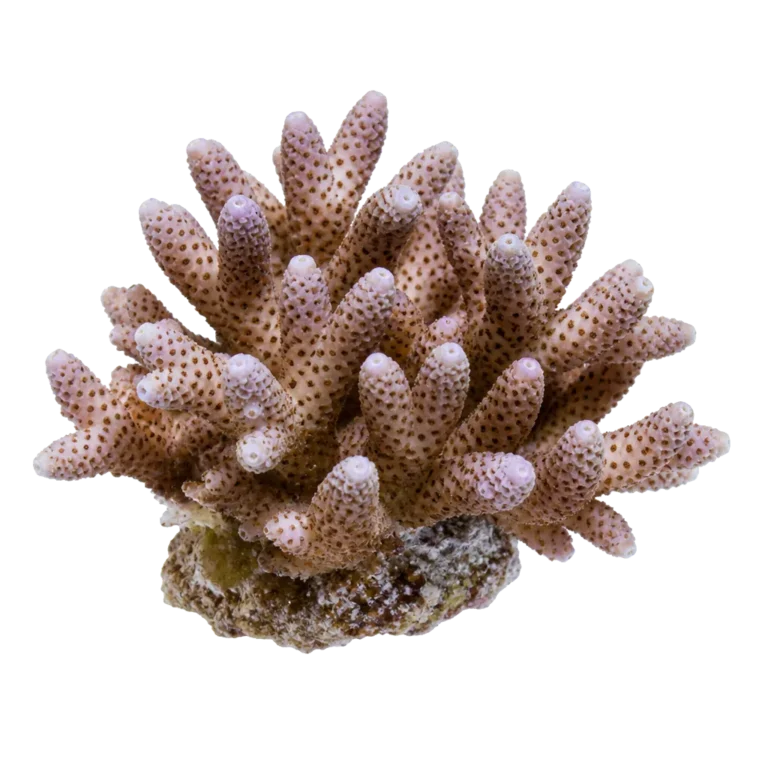
Guttatus Birdsnest Coral
Summary
Seriatopora guttata is a branching SPS coral whose comparatively stout, blunt-tipped branches can knit into a dense birdsnest-like thicket. Its shallow Indo-Pacific reef habitat helps explain its preference for bright light, energetic water movement, and clean branch surfaces; it is best chosen for an established reef where those conditions are already consistent.
Expect a fast-growing colony rather than a compact accent coral. Healthy tissue should cover the branches evenly and small polyps give the colony a soft, fuzzy look; rapid paling, persistent retraction, or bare white patches are signs to investigate light, flow, or water-chemistry changes promptly.
General care
Mount this coral securely in the upper-middle rockwork where it can receive light and multidirectional circulation from all sides. Leave access around the colony: once branches thicken and interlock, detritus and shaded dead spots are much harder to correct without moving or cutting it.
Handle the hard base or a firmly encrusted section, not the branch tips. The branches are brittle and can snap during transport, cleaning, or when large animals climb through the aquascape; a break is usually frag-able, but fresh damage can lose tissue if it is repeatedly disturbed.
Lighting needs
Introduce it below the final intensity or under temporary screening, then increase exposure gradually over roughly two weeks. This is especially important when moving a colony from a retailer, a different fixture, or a lower-light position, because an abrupt increase can bleach tissue before the coral has adjusted its symbiotic algae.
At suitable light, coloration remains even and the colony holds regular daytime polyp extension. Persistent darkening and slow growth can indicate insufficient light, while a washed-out appearance, bright white exposed skeleton, or recession beginning on the most exposed tips suggests excessive light or an overly rapid acclimation.
Flow needs
Provide strong, random movement that makes the small polyps sway without flattening the tissue against the skeleton. Aim intersecting or alternating flow near the colony rather than pointing a pump directly at it, so water reaches the inner branches as the colony becomes denser.
Too little flow allows detritus to settle between branches, often followed by poor inner-polyp extension, algae accumulation, or tissue loss in enclosed areas. Too much direct flow keeps polyps tightly retracted and can produce localized tissue recession on the pump-facing side.
Feeding and growth
Light supplies most of this coral’s energy, so direct feeding is most useful when the aquarium is very nutrient-poor, during recovery, or when trying to support faster growth. Offer fine suspended foods such as small zooplankton or other micro-particulate reef foods upstream; large meaty pieces are not well matched to its small polyps and can foul the colony.
Growth usually develops as a bushy network of branches that broadens as well as rises. Plan for the colony to shade corals below it and to trap more debris as its interior closes in; occasional trimming may be needed to preserve circulation and clearance.
Compatibility
Seriatopora guttata is a poor combatant compared with corals that deploy long sweeper tentacles. It can sting at direct contact, but should not be expected to defend itself from aggressive LPS corals or fast-spreading neighbours; allow at least 10 cm3.9 in of open space, with more room beside corals known for long nighttime sweepers.
Keep it away from coral-nipping angelfish and butterflyfish, and avoid placing it where large crabs, urchins, or heavy grazing snails routinely climb through the branches. These animals may not eat the coral, but can break branches or repeatedly abrade tissue.
Water parameters
Treat this as more demanding than a typical mixed reef coral because it responds poorly to rapid swings rather than merely imperfect values. Keep salinity and temperature steady, and avoid abrupt corrections to alkalinity, calcium, or magnesium; sudden alkalinity changes are a common trigger for tip recession or fast tissue loss in branching SPS.
Avoid chasing an ultra-clean appearance by stripping nutrients too quickly. A sudden nutrient reduction, major water-chemistry correction, or unstable dosing schedule can cause fading, reduced polyp extension, and stalled growth even when individual test results appear acceptable.