
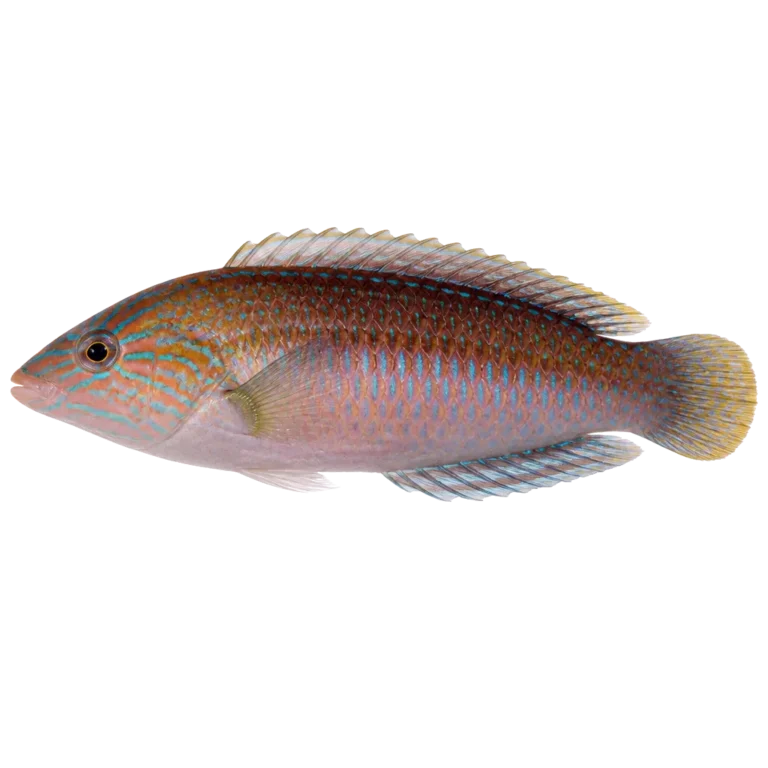
Günther’s Wrasse
Summary
Pseudolabrus guentheri is an active rock-associated wrasse that spends much of the day moving between reef structure and picking at small benthic prey. In an aquarium, that translates to a fish that should be visible and continually investigating the aquascape rather than hovering in open water.
Its confidence can turn into territorial behaviour once it has learned the rockwork. Persistent patrolling, flared displays, or repeated chasing of similarly shaped fish are signs that the wrasse has claimed too much of the available structure.
Care
Build the aquascape with interconnected rockwork, caves, overhangs, and broken sight lines, while retaining clear swimming lanes around the structure. This lets the wrasse forage naturally and retreat or reroute without having to cross another fish’s claimed area.
Avoid a sparse, pillar-like layout in which every fish must use the same few passages. Pseudolabrus guentheri is most likely to become difficult when it can patrol the entire reef face uninterrupted and repeatedly intercept tankmates.
Use a tightly fitted lid or screen cover. An alarmed wrasse can launch upward during a chase, sudden disturbance, or introduction of a new fish, and an otherwise healthy specimen may be lost through even a small opening.
Feeding
Offer a varied marine-meat diet in small portions spread across the day rather than relying on one large feeding. Rotate suitably sized frozen crustacean foods, finely chopped marine seafood, and a dependable prepared carnivore food so the fish receives both immediate feeding response and dietary variety.
Feed near the wrasse’s usual foraging route, but use more than one delivery point when fast planktivores or assertive fish dominate the water column. A wrasse that repeatedly searches the rocks after feeding while its belly remains pinched is being outcompeted, not necessarily refusing the offered food.
Do not treat ornamental shrimp, tiny crabs, or other small mobile invertebrates as a substitute food supply. Predation may still occur even when the fish is well fed.
Compatibility
Keep Pseudolabrus guentheri singly as the default plan. Do not assume that two individuals will form a compatible pair simply because they are purchased together; established adults can treat one another as direct competitors for the same rockwork and feeding routes.
Choose tankmates that are robust enough to ignore occasional displays and dissimilar enough in shape and behaviour that they are not read as rival wrasses. Avoid adding other assertive wrasses, elongated rock-foraging fish, or closely similar species unless the aquarium has substantial separated territories and a clear fallback plan.
Add this wrasse after more timid rock-dwelling fish have settled, but before highly dominant territorial fish. Introducing it into a tank already controlled by a belligerent resident can leave it confined to cover; adding it before every other similar forager can allow it to establish excessive ownership instead.
Reef compatibility requires a specific invertebrate check: ornamental crustaceans and other small motile invertebrates may be hunted. Sessile corals are not the main concern, but a reef stocked around decorative shrimp or micro-crustaceans is a poor match.
Good to know
Territorial behaviour may strengthen after the fish has settled rather than appearing immediately on arrival. Watch for repeated, targeted chases at the same fish, especially around feeding areas or preferred ledges; this is more significant than a brief introductory display and may require changing the aquascape or separating one fish.
A sudden disappearance after a disturbance should prompt a lid and floor check before assuming illness. Wrasses are capable escape artists, particularly during social conflict or when startled.
Do not use its willingness to eat prepared foods as evidence that ornamental invertebrates are safe. Hunting is part of its normal foraging pattern, so losses of small shrimp or similar animals can occur without any preceding sign of hunger.