
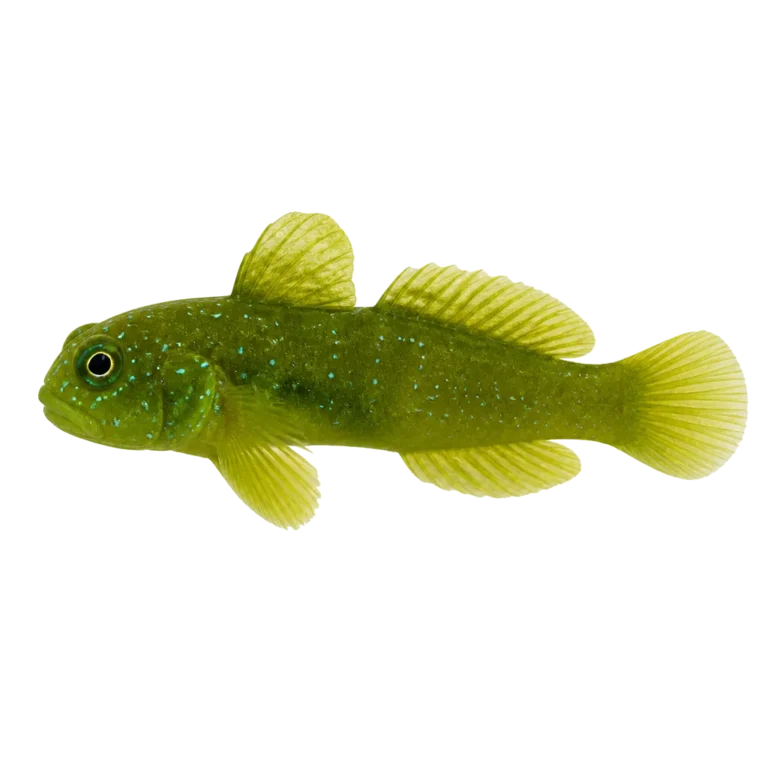
Green Clown Goby
Summary
Gobiodon atrangulatus is a perch-and-dart fish rather than an open-water swimmer. It spends much of the day sitting within branching structure, making brief hops to seize passing food and returning to the same refuge. A fish that remains tucked into its chosen branches but emerges promptly for food is usually behaving normally.
Its close association with branching Acropora helps explain two aquarium traits: it strongly values a compact, branched refuge, and it can irritate SPS by perching on or nipping at polyps. Choose this species for a calm display where its subtle, stationary behaviour can be observed, not for a fish expected to remain continuously visible in open water.
Care
Build the aquascape around a protected, branch-like refuge with several routes through it. Dense coral skeleton, inert branching structures, or carefully selected coral colonies give the goby a place to perch and retreat; an exposed fish that repeatedly wedges itself behind equipment or stays on the sand is signaling that the available cover does not suit it.
Keep flow broad rather than forceful at its preferred perch. Gobiodon atrangulatus can hold position in structure, but it should not have to fight a direct jet to remain there; persistent sheltering away from the current and missed food are practical signs that flow is excessive in its territory.
Leave its chosen perch undisturbed during routine coral moves and aquascape work. This species forms a strong attachment to a small area, so removing or heavily trimming that structure can leave it displaced and difficult to feed until it adopts another refuge.
Feeding
Offer small, varied meaty foods that can be swallowed whole, such as finely chopped marine crustacean foods, enriched brine shrimp, copepods, and small frozen blends. Deliver food close to its perch with a baster or pipette, then watch for actual captures rather than assuming it is feeding in the general rush.
Use several small feeding opportunities through the day when possible. This goby is easily outcompeted by fast, midwater feeders, and a fish that still watches food pass but does not leave its branches needs food directed into its cover or less competition at feeding time.
Do not rely on oversized chunks or a single coarse frozen food. Repeatedly taking and spitting food, a pinched abdomen, or a gradual loss of body condition points to unsuitable particle size or insufficient access, even when the rest of the tank appears well fed.
Compatibility
Keep Gobiodon atrangulatus singly unless you have a known compatible pair. It may defend a small perch aggressively against another clown goby, especially where both fish want the same branch network; chasing, exclusion from cover, and one fish becoming permanently hidden are reasons to separate them.
Favour peaceful, small tankmates that leave branch cover and targeted food alone. Avoid predators that can consume a tiny goby, as well as highly active planktivores or assertive perch-dwellers that monopolize its feeding zone and shelter.
Add it before, or alongside, other small territorial perch fish so it can settle into a refuge without having to displace an established resident. In a reef, the important exception is SPS: this fish may nip Acropora and related small-polyp stony corals, so do not treat reef compatibility as a guarantee that every coral colony will be unaffected.
Good to know
A settled fish may disappear into branches for long periods and then appear immediately when food arrives. That pattern is normal; concern is warranted when it no longer responds to food, is repeatedly driven from its perch, or remains pale and isolated after lights-on.
Social trouble can develop after an apparently peaceful introduction. If two individuals begin using different parts of the aquarium but one is later confined to an inaccessible hiding place, intervene rather than waiting for the hierarchy to resolve; the subordinate may be unable to feed adequately.
Inspect SPS colonies after introduction. Repeated attention to one coral, closed polyps around its resting spot, or localized tissue irritation means the goby has selected that colony as a perch or feeding site; moving the fish or accepting that coral-specific risk is usually more realistic than expecting the behaviour to stop.