
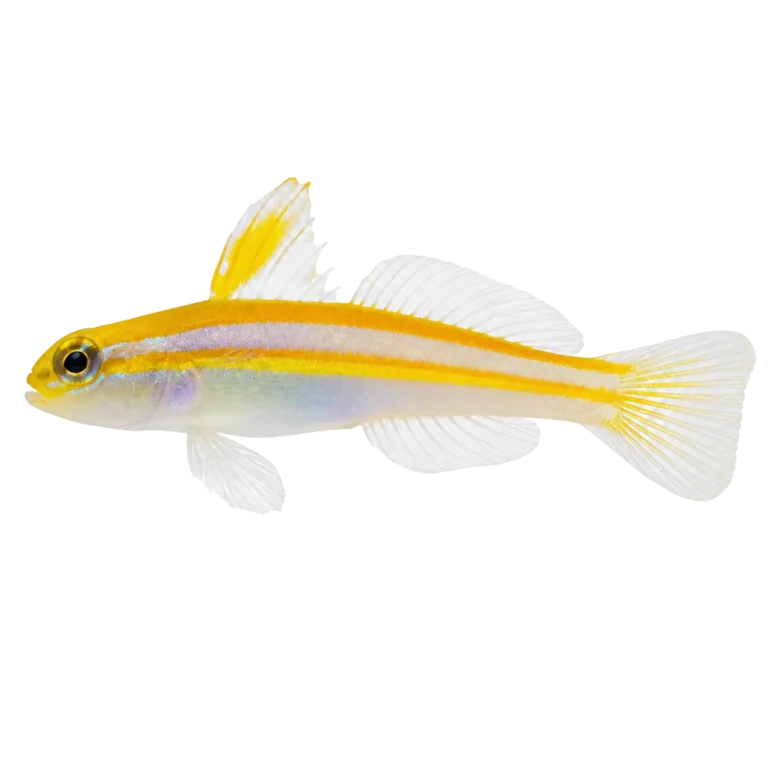
Gold Neon Goby
Summary
Gold Neon Goby is an ambiguous trade name. The supplied name Elacatinus xanthosoma is not an accepted species name; the matching accepted species is Paragobiodon xanthosoma, the emerald coral goby. This is a branch-dwelling coral goby, not a roaming cleaner goby: expect it to perch within fine coral branches, make short dashes for passing food, and return to the same refuge.
A fish that remains tucked into its chosen branches is usually behaving normally, not necessarily hiding from poor conditions. Its natural attachment to dense branching coral explains why it is most visible when the aquascape offers an elevated, intricate perch rather than open sand or broad bare rock.
Care
Build the aquascape around at least one protected, fine-branch refuge with gentle-to-moderate flow passing through it. Paragobiodon xanthosoma spends much of its time holding position among branches, so a sparse layout can leave it exposed and result in persistent retreating rather than relaxed perching.
Keep powerful direct flow off its preferred resting site. It should be able to sit in the branches and make brief feeding sorties; repeated tumbling, constant effort to hold position, or abandonment of the perch indicates that the flow is poorly directed for this fish.
A branching SPS coral can provide the most natural cover, but it is not essential if a similarly intricate rock or artificial branch structure provides secure visual shelter. Choose the coral deliberately, because this goby's use of living branches can be consequential for sensitive colonies.
Feeding
Feed small, appropriately sized marine pellets and finely chopped meaty foods where the goby is perched. Copepods, mysis and enriched brine shrimp can all be useful, but rotate foods rather than relying on brine shrimp as the main diet.
Offer small portions more than once through the day when practical, and use a pipette or turkey baster to deliver food into the branches if faster fish strip the water column first. A goby that repeatedly leaves its perch to chase food but returns empty, or develops a noticeably pinched belly, is being outcompeted.
Do not treat cleaning or food picked from tankmates as nutrition. Any incidental ectoparasites are supplemental only, so the fish must reliably accept prepared foods before it is added to a stocked community.
Compatibility
Keep one individual, or add a known compatible pair together. Unrelated adults can defend the same branch refuge as territory, and a newcomer may be confined to open water or remain hidden under sustained chasing.
Favour calm, small community fish that will not monopolize fine foods. Avoid fish large enough to swallow it and high-speed feeders that dominate every feeding response; the practical risk is starvation or permanent hiding rather than open conflict.
Paragobiodon xanthosoma is generally reef-compatible with an important SPS exception: it may perch continuously in delicate branching coral and can irritate polyps through repeated contact or occasional nipping. Avoid placing it with a prized or already stressed branching colony if localized polyp retraction would be unacceptable.
Good to know
Once a goby has claimed a branch cluster, conspecific aggression may become more obvious than it was during the first few days after introduction. Persistent face-to-face displays, chasing from the refuge, or one fish forced to perch near the surface calls for separation rather than waiting for the hierarchy to settle.
A sudden lack of sightings is not automatically a loss. Check deep within the chosen coral or branch structure at feeding time; a settled individual often stays concealed until fine food passes close enough to trigger a short feeding dart.
If a pair begins using one coral colony as its permanent base, inspect that colony regularly for reduced extension or damaged branch tips. Moving the goby early is safer than waiting for repeated occupation to further stress a sensitive coral.