
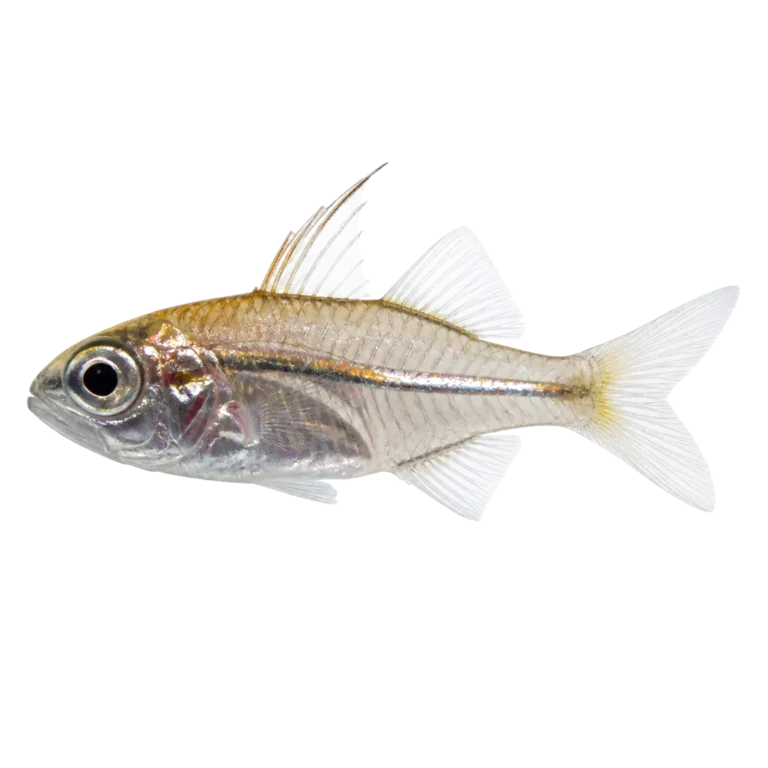
Glass Cardinalfish
Summary
Apogon leptacanthus is a translucent cardinalfish that spends much of the day hovering as a loose group around branching cover rather than cruising the whole aquarium. In a bare or brightly exposed layout, the group may stay pressed into one corner or disappear into rockwork; a branched, shaded refuge lets them hold position in view and move out to feed.
Their dusk-and-night activity explains why newly introduced fish can seem withdrawn under full lighting yet become noticeably more active as the aquarium dims. Judge acclimation by whether the group emerges to take suspended foods, not by daytime boldness alone.
Care
Build the aquascape around a protected midwater station: leave a calm-to-moderate-flow pocket beside branching rock, coral skeletons, or other fine structure, with open water immediately in front of it. This gives the group a place to hover together while still allowing it to intercept planktonic food; strong, direct flow can scatter fish that are trying to remain in formation.
Keep the group rather than treating this species as a solitary cardinalfish. A lone individual or an undersized social group is more likely to remain concealed and feed hesitantly, while a settled group uses the same sheltered zone as a visible home base. Plan the available open-water footprint and filtration around the group’s continual particulate feeding, not just the small size of each fish.
Feeding
Offer small, suspended foods in several modest feedings spread through the day, with an additional feeding toward evening when the fish are more willing to leave cover. Copepods, finely chopped crustacean flesh, mysis sized for their mouths, and enriched brine shrimp are useful rotation foods. Release food upstream of the group so particles pass through its hovering space instead of dropping straight into the rockwork.
Watch the slowest fish at every feeding. Fast surface feeders and assertive planktivores can clear the water column before Apogon leptacanthus commits to feeding; use more than one delivery point or briefly target-feed near the group’s refuge when this happens. Do not make plain brine shrimp the staple, because a narrow, low-quality diet can leave apparently full fish in poor condition. Their frequent feeding also adds nutrient input, so adjust portions when uneaten particles collect on the substrate.
Compatibility
Add a complete group together whenever possible. Introducing one or two fish to an established group can leave the newcomers isolated at the edge of the refuge and unable to compete at feeding time; simultaneous introduction gives the group a better chance to settle around the same shelter.
Choose peaceful community fish that do not hunt small midwater prey or monopolize every suspended food item. Small gobies, blennies, gentle clownfish, and similarly non-threatening reef fish are generally better companions than large predators, highly territorial fish, or rapid, boisterous feeders. Add the cardinalfish before more forceful midwater species so they establish a secure feeding station first.
They are safe with corals and are not a coral-nipping concern. The relevant exception is tiny mobile crustacean life: a fish maintained on zooplankton will readily consume exposed copepods and similarly sized fauna, so it is not a hands-off choice for a display intended to maintain conspicuous populations of such prey.
Good to know
Mouthbrooding can explain a sudden change in one fish’s feeding. A male carrying eggs may hold a visibly full mouth, make repeated jaw movements, and refuse food while the rest of the group eats. Avoid assuming it is simple shyness, but investigate promptly if the fish also breathes heavily, isolates continuously, or develops other signs of illness.
A group that remains hidden all day is usually responding to exposure, intimidation, or food competition rather than needing to be forced into the open. Improve the protected branching refuge and make sure fine foods reach that location; once secure, this species often becomes most visible around lower-light feeding periods.