
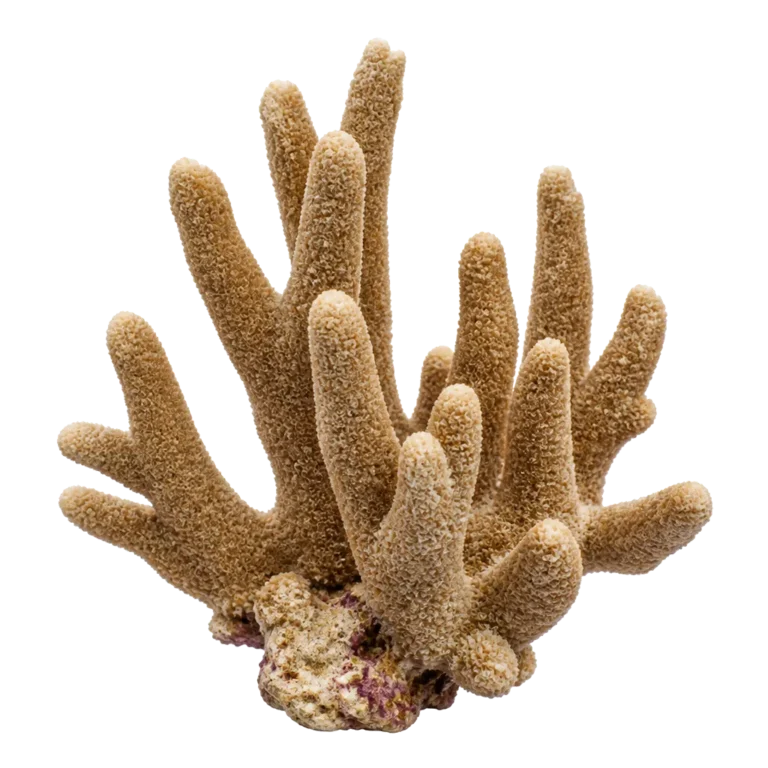
Finger Coral
Summary
Montipora digitata is a branching SPS coral with compact, finger-like branches and very small polyps. Its shallow Indo-Pacific reef habitat helps explain its preference for bright light, vigorous water movement, and a mature system with consistent chemistry.
Expect a small frag to first secure itself with a spreading base, then produce upright branches that can quickly occupy the space above and around it. Plan its final position before it begins growing rather than treating it as a temporary filler coral.
General care
Place Montipora digitata in the upper-middle rockwork where it can receive light and broad circulation without being shaded by larger corals. Mount the frag firmly on stable rock; a loose plug can topple as branches gain height, damaging both the coral and nearby colonies.
Handle the plug or bare skeleton rather than the living tissue. The branches can break during placement or maintenance, and damaged areas are more likely to collect algae if they remain in a low-flow pocket. A clean break is usually manageable, but avoid repeatedly moving a newly mounted frag while it is trying to encrust.
Lighting needs
Acclimate a new frag gradually, especially if its previous lighting is unknown. Start it lower than its intended position or reduce exposure with shading, then move it into its permanent placement in small steps after it maintains normal color and polyp extension.
Too little light commonly shows as duller or browner coloration, slow encrusting, and weak growth at the branch tips. Too much light too quickly can cause paling or bleaching, often most obvious on upper surfaces and fresh growth; reduce intensity or add temporary shade rather than making repeated major placement changes.
Flow needs
Provide strong, irregular flow that reaches between the branches and changes direction rather than a constant narrow jet aimed at one side. At the right flow, the small polyps remain extended when conditions allow, surfaces stay clear of settled debris, and the colony receives movement from more than one direction.
Too little flow leaves detritus on the base or between branches and can encourage algae on shaded tissue. Too much direct flow can keep polyps tightly withdrawn or cause tissue loss on the side facing the pump; diffuse or redirect the stream if one area stays bare while the rest of the colony looks healthy.
Feeding and growth
Light provides most of this coral's energy, so feeding is most useful as a supplement in systems with very lean nutrient availability or when supporting active growth. Offer fine suspended planktonic foods rather than large particles, and use gentle broadcast feeding so food can pass across the polyps without blasting the colony.
Montipora digitata typically spreads a base and then builds upright, branching fingers. Its fast growth can create shade beneath its own canopy and allows it to reach neighboring corals sooner than expected, so leave open water and accessible rock around the colony for pruning.
Compatibility
Montipora digitata is generally peaceful because it lacks long sweeper tentacles, but it is still a strong space competitor. It wins mainly by encrusting, branching into available space, and shading slower neighbors; begin with at least 10–15 cm3.9–5.9 in of clearance and increase that buffer as the colony develops.
Keep it away from corals that deploy long nighttime tentacles or have much stronger direct-contact defenses. Fish that pick at coral tissue and unstable invertebrates such as large grazing urchins or bulldozing crabs can damage branch tips or dislodge a frag, so secure the mount and investigate persistent localized tissue loss rather than assuming it is a water-quality issue.
Water parameters
This is moderately demanding compared with a typical mixed reef because its SPS skeleton and fast growth expose sudden chemistry changes quickly. Keep alkalinity and salinity especially consistent; abrupt correction dosing or rapid water changes can lead to reduced polyp extension, paling, or tissue recession even when the final test values appear acceptable.
Avoid nutrient extremes and rapid swings. Very depleted water can coincide with faded color and stalled growth, while persistently excessive dissolved nutrients can darken the coral and promote algae at the base; make corrections gradually and watch whether healthy tip growth resumes before changing multiple variables at once.