
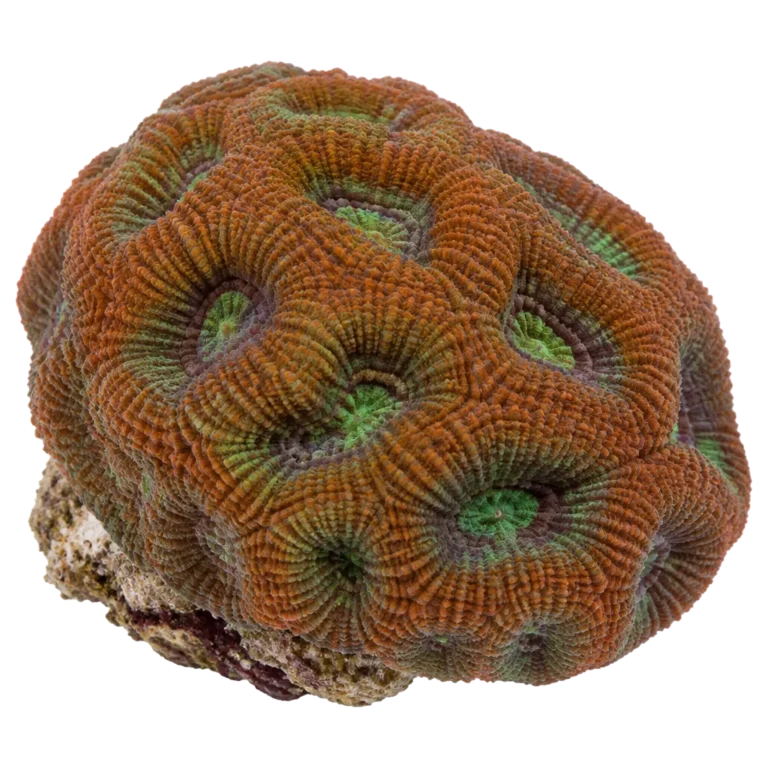
Favia Coral
Summary
Favia sp. is a genus-level label, and corals sold as “Favia” are sometimes closely related look-alikes with similar care needs. Expect a colonial LPS coral with fleshy, patterned tissue spread over a hard, ridged skeleton. Its slow, space-claiming growth and nighttime defensive tentacles make it better suited to an open lower-to-middle rock position than a tightly packed mixed-coral arrangement.
General care
Place it securely on stable rockwork in the lower-middle part of the aquarium, where the colony cannot topple or rub against neighbouring corals. Keep the living tissue clear of abrasive sand and avoid locations where detritus repeatedly settles between corallites; persistent debris can lead to irritated, shrunken tissue and recession along the skeleton.
Handle Favia sp. only by the plug or bare skeleton. The tissue is easily torn against sharp skeletal ridges, especially when the coral is inflated, and a damaged edge can become a starting point for recession. Inspect a prospective purchase for full tissue coverage, intact edges, and no exposed white skeleton beneath the living tissue.
Lighting needs
Start a newly acquired colony in a dimmer part of its intended area, then increase exposure gradually after it remains inflated and retains its colour. This is especially important when moving a coral from a differently lit system, because abrupt exposure can pale the upper tissue or cause localized recession before the coral has adapted.
Too little light is more likely to show as persistently darkening tissue, weak growth, and reduced daytime fullness despite otherwise good conditions. Too much light usually produces paling or bleaching on upward-facing areas, contracted tissue during the photoperiod, or recession beginning on the most exposed surfaces; move the colony lower or provide partial shade rather than making a large lighting change all at once.
Flow needs
Use low-to-medium, indirect flow that keeps the surface clean without blasting the tissue. At an appropriate setting, the tissue remains full, food and mucus are not trapped in the valleys, and the coral can extend feeding tentacles after dark without being pinned flat.
Too little flow allows detritus to collect between polyps and can leave the coral coated in mucus or sediment. Too much direct flow keeps tissue tightly withdrawn, makes it flap or peel at skeletal edges, and can lead to exposed skeleton; redirect the pump rather than placing the colony directly in a jet.
Feeding and growth
Favia sp. receives much of its energy from light, so feeding is most useful for supporting recovery, tissue condition, and faster growth rather than as a daily survival requirement. Offer fine zooplankton-sized foods or very small meaty particles when feeding tentacles are visible, often after the lights dim. Briefly reducing flow helps the coral capture food instead of letting it drift into the aquarium.
Growth is usually slow and can range from encrusting outward over its base to forming a low, thickening mound, depending on the coral sold under the Favia label. Plan for the living edge to expand into surrounding space over time, rather than mounting it where it will soon contact another coral.
Compatibility
Treat Favia sp. as semi-aggressive. It can extend sweeper tentacles, particularly at night, to sting nearby coral tissue, so leave at least 10–15 cm3.9–5.9 in of open clearance around it and check the colony after dark before reducing that gap. A neighbour may show delayed tissue loss or pale burn marks rather than immediate damage.
Most fish ignore the coral, but persistent nipping from angelfish, butterflyfish, filefish, or other tissue-picking animals can keep polyps closed and damage the fleshy surface. Avoid placing it where large mobile invertebrates routinely climb over it or where a fish repeatedly settles on the colony; repeated contact can cause localized recession even when water conditions are suitable.
Water parameters
Favia sp. is generally forgiving in a mature reef aquarium, but it responds poorly to abrupt chemistry changes rather than to a stable, ordinary reef environment. Keep alkalinity and salinity from swinging, because sudden changes can cause tissue withdrawal, poor feeding response, or recession along exposed skeletal edges.
As a stony coral, it needs consistently available calcium, alkalinity, and magnesium to maintain and extend its skeleton. Watch for gradual tissue thinning, stalled growth, or new exposed skeleton after dosing changes or rapid nutrient reductions; correct the underlying instability gradually rather than making repeated large adjustments.