
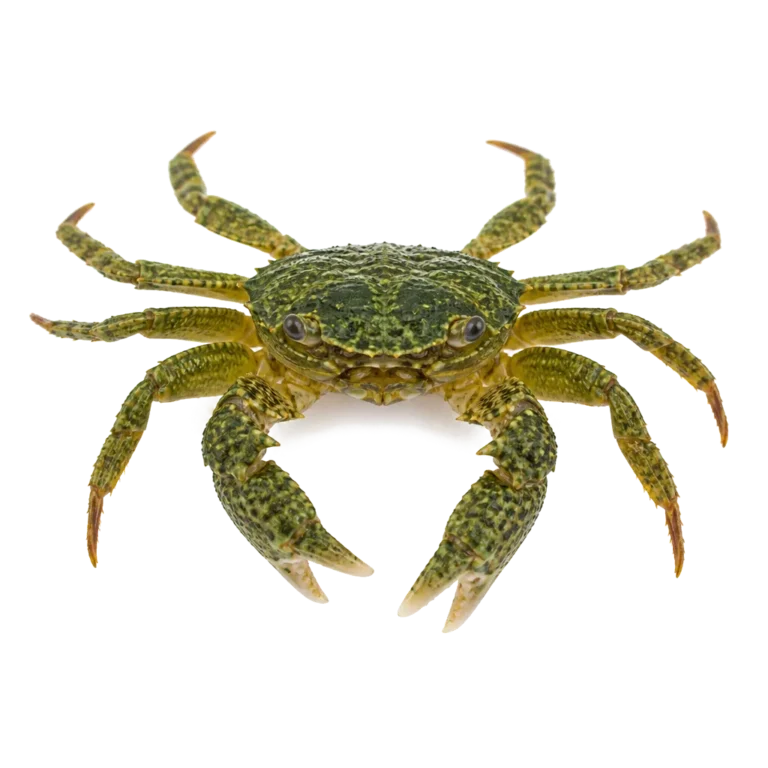
Emerald Crab
Summary
Mithraculus sculptus is a small Caribbean and Gulf of Mexico mithracid crab recognized by its flattened, spoon-like claws, which it uses to scrape and handle algae. It spends much of the day wedged into rockwork or coral branches and is often most visible after lights-out; a crab that remains concealed can still be feeding normally.
Its natural association with reef structure means it is best suited to an aquarium with porous live rock, crevices, and established surfaces to forage over. The common name “emerald crab” is applied loosely in the trade, so use Mithraculus sculptus rather than color alone when identifying the animal and judging its likely behavior.
Care
Provide stable rockwork with tight crevices that the crab can enter without being exposed to constant attention from fish. It will pick through the rock and sheltered undersides rather than remain in the open, and a newly introduced crab that vanishes into the aquascape is usually behaving normally.
Choose an established aquarium with natural algal films, detritus, and biofilm available between feedings. A freshly set-up, overly sterile system offers little grazing and can leave a crab hungry even when water conditions appear suitable. It has no special lighting or flow requirement beyond the needs of the reef aquarium itself.
Feeding and role
Treat Mithraculus sculptus as an omnivore, not a dedicated bubble-algae solution. It may graze bubble algae and other algae, but individual appetite varies, and one crab rarely clears a substantial infestation before new growth appears. Remove accessible heavy accumulations by hand and address the nutrient source rather than relying on the crab alone.
Offer marine algae regularly and supplement with small, targeted portions of meaty marine foods or sinking leftovers. If it repeatedly searches coral tissue, attacks small invertebrates, or becomes unusually bold at feeding time, assume its available food is inadequate or competition is too high and increase appropriate feeding.
Its useful cleanup role is localized: it can consume films, fragments, detritus, and uneaten food in crevices that are difficult to reach. It is not a substitute for routine maintenance, export of accumulated waste, or a broader grazing plan.
Compatibility
Keep Mithraculus sculptus away from reliable crab predators such as triggerfish, larger wrasses, puffers, and other fishes capable of crushing crustaceans. A crab that never emerges even after dark, has missing limbs, or disappears soon after introduction may be being harassed rather than simply hiding.
Reef compatibility is conditional. A well-fed individual often confines its attention to algae and scraps, but larger or hungry crabs may nip fleshy coral polyps, pick at stressed corals, or prey on very small snails and other vulnerable invertebrates. Move the crab if repeated nighttime damage is seen around the same coral or invertebrate.
Add them individually rather than stocking several solely for algae control. They can defend feeding areas from other crabs, especially where the rockwork offers few separate territories; only consider multiple individuals in a spacious, structurally complex aquarium with enough natural forage and supplemental food for each.
Good to know
This crab molts as it grows. A pale, intact-looking empty shell may be a shed exoskeleton rather than a dead crab, so check for movement elsewhere in the rockwork before removing it. Leave the crab sheltered after a molt because its new shell is soft and it is more vulnerable to fish and other crabs.
Avoid copper-based medications and other treatments not labeled as safe for crustaceans. Copper exposure can kill crabs, and abrupt changes in salinity during transfer can cause severe stress or a failed molt; acclimate carefully to the aquarium’s salinity before release.
Do not assume a missing crab has died. Mithraculus sculptus can remain hidden for extended periods, especially after introduction or before and after molting. Investigate only if there is a persistent odor, a confirmed body, or continuing unexplained predation on corals or small invertebrates.